



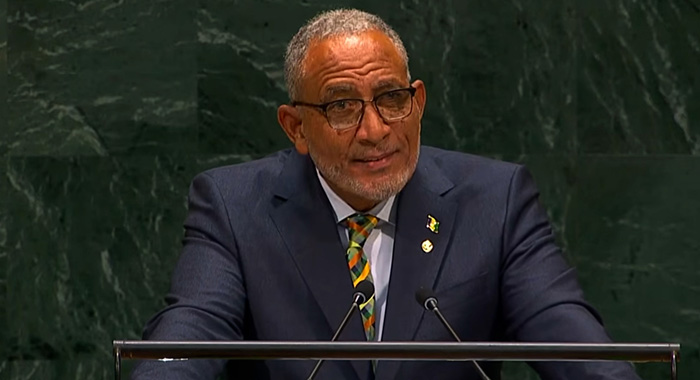

Prime Minister of St. Vincent and the Grenadines, Godwin Friday, used his first address to the United Nations General Assembly on Friday to call for sweeping reforms of the global system, including changes to the UN Security Council, climate finance rules, an end to the US embargo on Cuba, and reparatory justice for slavery and indigenous genocide.
Speaking during the high-level debate of the 79th Session, Friday, who was elected to office in November, said trust in multilateral institutions was “broken” and warned that hope had “retreated” as small and vulnerable states continue to bear the brunt of climate change, economic shocks and global conflicts they did not create.
He urged member states not to abandon the UN, despite its flaws, but to “fix it,” arguing that the organisation is “what we have made it” and must be reformed rather than discarded.
Friday backed long‑standing calls for reform of the Security Council, saying the body remained rooted in the power dynamics of 1945 and did not reflect contemporary geopolitical realities
He said the Security Council should include at least one permanent African member “with all the attendant rights and privileges,” and warned that failure to address this would confirm that the structure of global governance is “not about governance and fairness, but about power”.

On representation at the highest levels of the UN, Friday noted that all nine secretaries‑general since 1946 have been men and said that, after eight decades, “surely the time has come for an equally capable woman” to hold the post.
He formally endorsed Guyanese diplomat Carolyn Rodrigues‑Birkett as Kingstown’s preferred candidate for secretary‑general, describing her as a “principled multilateralist” and a strong advocate for developing countries and small states
The Vincentian leader devoted a substantial portion of his address to climate change and economic vulnerability, arguing that for small island developing states, climate impacts are “a present danger and recurring financial emergency,” not a distant prediction.
Citing Hurricane Beryl’s devastation in July 2024, he said a few hours of extreme weather can wipe out infrastructure and livelihoods built over many years and “set a country back,” forcing governments repeatedly to borrow just to rebuild.
Friday renewed calls for the full operationalisation of a multidimensional vulnerability index to determine access to concessional financing, saying traditional income‑based classifications do not reflect the real risks and limited adaptive capacity of small island states.
He endorsed elements of the Antigua and Barbuda Agenda for SIDS and the Bridgetown Initiative, including automatic debt service suspension after disasters, expanded and rechanneled Special Drawing Rights, and multilateral development banks that lend on terms appropriate for development partners, not commercial creditors.
“Affordable, patient, concessional capital is not charity to small states; it is justice for states that contribute the least to the climate crisis, yet bear the highest costs,” he said.
Turning to peace and security, Friday linked wars in Ukraine and the Middle East to food and fuel price shocks in the Caribbean, saying conflicts “far from our shores” were driving up shipping costs and destabilising global markets.
He called for an immediate end to the war in Ukraine, with full respect for sovereignty and territorial integrity, and urged a permanent ceasefire in the Middle East, protection of civilians, and a two‑state solution guaranteeing peace and security for both Israelis and Palestinians.
Friday reiterated CARICOM’s commitment to Latin America and the Caribbean as a “zone of peace” and said regional disputes, including the border controversy between Venezuela and Guyana, must be resolved peacefully and in accordance with international law and the UN Charter.
On Haiti, he said the ongoing insecurity and humanitarian crisis were “a pain felt across our region” and called for sustained international support to strengthen institutions, improve security and create conditions for credible elections.
He also urged industrialised countries to halt the illicit flow of assault weapons into the Caribbean, saying these arms are fuelling gang violence and undermining public safety.
On longstanding geopolitical issues, Friday repeated St. Vincent and the Grenadines’ opposition to the decades‑old economic embargo on Cuba, calling it a form of “collective punishment” that denies the Cuban population access to medicine, fuel, trade and normal development.
He said such measures were inconsistent with the principles of the UN Charter.
The prime minister highlighted his country’s 45‑year relationship with Taiwan and praised Taipei’s contributions to development, disaster response, education and public health in St. Vincent and the Grenadines.
He called for Taiwan’s meaningful participation in the UN system and its specialised agencies, arguing that this would strengthen, rather than weaken, the universality and effectiveness of global cooperation.
Friday also placed reparatory justice at the centre of his message on fairness and historical responsibility. He welcomed the General Assembly’s March 2026 resolution, led by Ghana and supported by the African Union and CARICOM, which declared the trafficking and racialised chattel enslavement of Africans to be the gravest crime against humanity.
He said CARICOM’s ten‑point plan for reparations remains a blueprint for addressing the enduring legacies of slavery and the near‑annihilation of indigenous peoples in the Caribbean, contending that “the past is not the past when its consequences still shape who is rich and who is poor in the world today.”
In his closing remarks, Friday argued that restoring trust in the UN system depends on whether small and vulnerable states feel protected and heard.
He said confidence would be rebuilt when debt is restructured fairly, when disaster response funding arrives in time, when the benefits of technologies such as artificial intelligence are shared rather than “hoarded and priced out of reach,” and when embargoes and historical injustices condemned in the General Assembly are finally addressed in practice.
Despite outlining multiple crises, Friday said he remained hopeful that, with “courage, honesty and fairness,” the UN could still “live up to its name” and deliver for all its member states.