



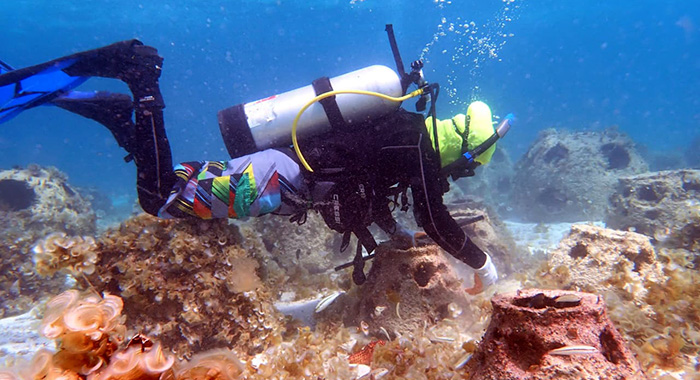

We Are Mayreau Inc. (WAM) is marking six months of implementation under the Targeted Ridge-to-Reef Ecosystem-based Adaptation Interventions in St. Lucia and St. Vincent and the Grenadines (TREBAI), the regional restoration initiative working from the hilltops to the reef.
For small island developing states like Saint Vincent and the Grenadines, that work is urgent by definition.
What happens on a farm reaches the reef within days, and after Hurricane Beryl destroyed all coral nursery and farming infrastructure in 2024, little buffer remains to absorb another shock.
Since starting in March, WAM has re-established one coral gene bank nursery, expanded its coral gardener team, expanded its climate-smart agriculture programme on Union Island and Mayreau, and made a rare ecological find that drew regional attention.
On the reef, WAM’s new Mayreau nursery holds three coral trees and 60 fragments of Staghorn (Acropora cervicornis) and Elkhorn (Acropora palmata), moved directly from St. Lucia in the first-ever transfer of coral genetics (assisted gene flow, aka AGF) between countries in the Windward Islands.

WAM, along with Richmond Vale Academy (RVA), are the first recipients of this shared regional genetic banking effort.
The coral gardener team has doubled to 11, drawn from 18 applicants across Union Island, Mayreau and beyond, including our first-ever woman junior coral gardener.
On land, two climate-smart agriculture coordinators have been onboarded across both islands, and 25 farmers have applied to the climate-smart farming programme.
WAM has begun engaging with three primary schools, with a mandate to deliver a climate-smart farming programme guided by an interdisciplinary curriculum developed for students that considers successful regional models and best practices.
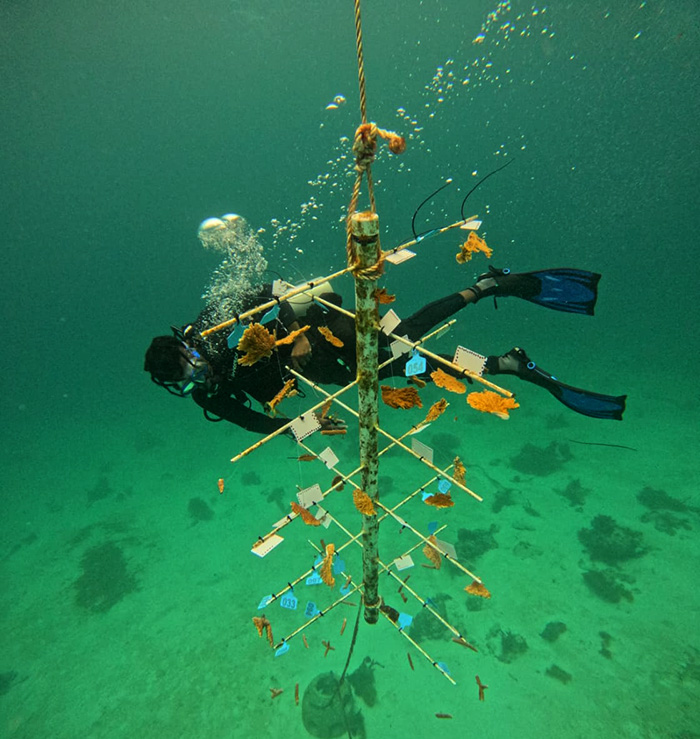
“We have also engaged the Ministry of Agriculture as we seek to deepen our relationship and build a program for work attachment for Southern Grenadines participants,” a press release said.
Equally central to this phase is securing stable employment and livelihoods for coral gardeners, farmers and coordinators, and building trust with the community; WAM treats these priorities as foundational to everything else the project delivers.
In August, a reconnaissance dive off Battowia in the Northern Grenadines, conducted with the support of Dive Bequia, located more than 15 previously unrecorded colonies of Acropora cervicornis (staghorn coral) — a species thought functionally extinct in SVG waters.
Much of these first six months of work focused on expressing and expanding core pillars of Reef Life Inc. (2022-present), a blue social enterprise developed by WAM as one of its key flagship programmes. It exists to hold oceans, land, people, and policy as one living, circular system.
Through partnerships, immersive experiences, education and hands-on conservation, Reef Life carries forward community-rooted knowledge and responds to how climate injustice is already reshaping livelihoods across the Grenadines.
As the enterprise rebuilds, it will share its brand story and introduce the people working behind the scenes, laying a foundation for marine restoration and more sustainable livelihoods for communities living within a marine protected area.
TREBAI is delivered by CLEAR Caribbean, registered in the UK with operations out of St .Lucia, alongside implementation partners Richmond Vale Academy in St. Vincent and WAM in the Southern Grenadines.
The Caribbean Biodiversity Fund funds the project, with support from Germany’s Federal Ministry for the Environment, Climate Action, Nature Conservation and Nuclear Safety through the International Climate Initiative and KfW.
WAM has also formed new partnerships with several private-sector associates and continues to work alongside various ministries to develop skills training and learning opportunities for members of its growing team. CLEAR’s sub-grant to WAM totals up to US$518,700 over a three-year term running through April 2029.
“Six months in, the real potential lies in the power of Reef Life. We’re thinking holistically about what our islands and oceans need and about the challenge and opportunity of being small,” WAM’s Executive Director Marion Isaacs said.
“We embrace this smallness and feel masses of potential building in what we have managed to bring to life so far. We focus on relationship-building, especially as we come from complex histories. We see relationships as new infrastructure: something to strengthen what we’re doing and to keep us committed and accountable in everything we’re organising, planning, and growing.”
With Reef Life’s new Project Coordinator, a marine conservationist, joining the team in September, WAM said it expects implementation to accelerate over the next six months, including coral gardener diving certification, continued outplanting, completed farmer onboarding, and the first community meetings planned to begin this month.