



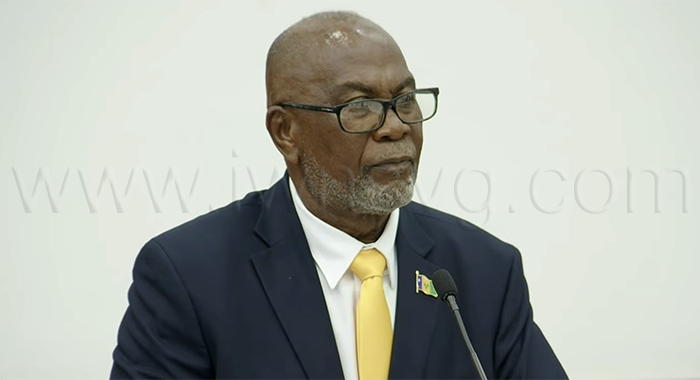

Acting Prime Minister St. Clair Leacock has defended his description of St. Vincent and the Grenadines (SVG) as “broke”, arguing that the 2023 Audit report shows the country inherited its financial difficulties from the previous administration and that debt obligations are consuming a growing share of government resources.
Speaking on the New Times programme on NICE Radio on Monday, Leacock said he stood by the remark, but described it as an acknowledgement of the situation rather than an attempt to assign blame for its own sake.
“… I stand by my statement,” he said. “In order for you to fix a problem, you have to acknowledge that you have a problem.”
Leacock first made the statement on Friday on “Keepin’ It Real”, another programme on the same radio station.
Leacock said government financial officials had described the economy as being “at a precipice” when the New Democratic Party (NDP) administration took office in November.

“… when this thing was explained to us by the financial authorities — director general finance and planning, director of planning, budget officer, and so forth — they they use a particular formulation, and that formulation was to say that the government arrived at government with the economy at a precipice, … meaning that the economy, if we [we weren’t careful], we’ll break our neck in St. Vincent and the Grenadines. We didn’t have any money,” Leacock said.
He argued that the country had limited funds available and faced substantial obligations from earlier borrowing.
His remarks came amid public criticism over the government’s assessment of the economy.
Leacock said it was important to distinguish the current administration’s management from the financial conditions it inherited.
He described attempts to blame the administration for the country’s fiscal position as “politically dishonest”.
To support his argument, Leacock cited figures he said came from the Director of Audit’s 2023 report.
He said the report showed total public-debt servicing costs of $303.6 million, an increase of $62 million, or 25.7 per cent, compared with the previous financial year.
He also quoted the report as saying the increase was the highest annual growth rate in the preceding five years.
Leacock said the report’s findings indicated that debt payments were putting increasing pressure on public finances.
Quoting from the report, he said: “These indicators suggest a growing share of government resources is being absorbed by debt obligations.”
He also pointed out that the report said: “Cash flow challenges persisted throughout the financial year.”
Leacock commented:
“When you meet them, when you see them, and you ask them, ask them, ‘What does that statement mean?’ Ask the child in community college.”
He added:
“You know what that means? That in 2023, you consistently find yourself in a situation [where] the amount of money you have to pay out is greater than the amount of money that was coming in. That’s what that really means…
“So in 2023, the government was not receiving enough money on the recurrent side of the budget to pay its debt, to pay for its expenditure. That was happening to them. So when they spoke and said that they’re leaving ‘a hook and the gill’, he was speaking aloud that which he was experiencing, that he didn’t know he could deal with it.”
The “hook in the gill” comment is a reference to an April 2023 statement by then-prime minister Ralph Gonsalves, who announced that within seven months SVG’s debt to Taiwan had increased by EC$477.9 million and “put a hook in the gill of anybody” in Kingstown who wants to break the diplomatic ties with Taipei.
In another example, Leacock said the report showed that projected capital revenue for 2023 had fallen short of expectations.
He said capital receipts were expected to generate $223 million, but the amount realised was $93 million.
The deputy prime minister also said domestic bond transactions provided $121.5 million in capital revenue, describing that as borrowing through the sale of government paper to be repaid later.
Leacock argued that such borrowing could not continue without limits.
“We can’t keep borrowing and borrowing and borrowing,” he said, while acknowledging that governments would still need to borrow at times.
He used an analogy about someone repeatedly borrowing from different shops to explain his concern that continued borrowing, without a clear means of repayment, could deepen the country’s financial difficulties.
The acting prime minister said the government’s response was to manage spending carefully, stabilise the economy and seek investment beyond government borrowing.
He pointed to private-sector investment and efforts to expand areas such as agriculture, tourism and fisheries, adding that the government was also listening to outside advice while pursuing what he called “our own homegrown approach”.
Leacock said he expected to discuss the figures in greater detail during upcoming estimates and budget debates, adding that he intended to rely on the audit report rather than political assertions.
“Not what Friday says, Leacock says, or Nature says, but what the Director of Audit report says,” he said, referring to the prime minister, Godwin Friday and Infrastructure Minister, Nigel “Nature” Stephenson.