



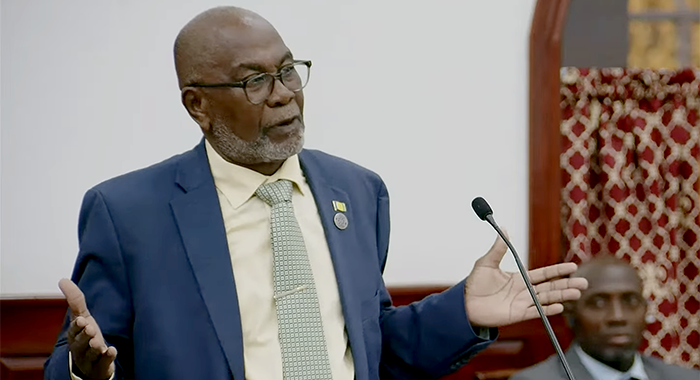

Deputy Prime Minister St. Clair Leacock on Thursday defended the government’s position on joining the Development Bank of Latin America and the Caribbean (CAF), after opposition senator Carlos James warned that the bank’s loans could carry variable, potentially high interest rates.
Leacock argued that CAF was part of a broader plan to stabilise St. Vincent and the Grenadines’ finances, reduce waste, and build growth, not a way to borrow the country out of its difficulties.
James, who led the opposition’s response to the bill in the absence of Opposition Leader Ralph Gonsalves, supported the legislation but challenged the government’s description of the financing and urged it to spend any borrowed funds on projects that can deliver lasting returns.
“I lend my support,” James said, but urged the government to “spend it wisely to meet the benefit of the people of St. Vincent and the Grenadines”.
Leacock acknowledged James’s support for the bill, saying, “Thanks for your support. Thanks for coming to your senses.”

Leacock did not present CAF as a cure-all, saying, “We cannot borrow ourselves out of the difficulties in which we find ourselves at the moment.”
Instead, he argued that the New Democratic Party government, which came to office 11 months ago, aimed to combine careful financial management with efforts to raise productivity and attract investment.
“We have a plan,” Leacock told Parliament and described it as: “Stabilise the economy. Stop the haemorrhaging. Cut the loss. Reduce the waste. Bring our people to a state where they understand they must cut and contrive; live within your means.”
The deputy prime minister said such language was “necessary for these times”.
He noted that James had also noted the external factors affecting SVG’s economy.
“The external challenges and factors over which we have so little control is like a tsunami coming at us. We have nothing to do with the Ukraine war. We have nothing to do with the Iranian war. We have nothing to do with a lot of other things,” he said.
“The fact of the matter is that we are not only just cleaning up and stabilising, but we are putting ourselves on a new course, a new direction,” Leacock told Parliament.
CAF as one element of the plan
Leacock presented CAF membership as part of a wider set of tools, rather than a standalone solution.
He called it a development bank and said becoming a shareholder could give SVG access to development-oriented financing and guidance.
“Let us join an institution in which we become a shareholder, and which has a development culture to financing its members,” he said.
He argued that CAF’s role in development financing set it apart from ordinary commercial lending.
The Central Kingstown MP said the bank’s focus on development and social objectives made it a useful addition to the country’s financing options.
But he also stressed that the country’s response could not rely on borrowing alone.
The broader strategy included public-private sector partnerships and mobilising private capital.
Leacock described the people of SVG as an important part of the solution, calling for “productivity management: doing more with less, motivating the people and mobilising the people”.
He said the government was putting in place “the appropriate architecture” to move the country forward, with CAF among the components.
A plan shaped by fiscal pressure
Leacock said the government had to acknowledge the seriousness of the fiscal situation before deciding how to respond.
He cited advice from government officials and international institutions and said he had concluded the country was “in a very difficult situation”.
He described the administration as having arrived “at the brink of a precipice”, presenting that as a warning about the scale of the challenge.
Leacock urged a practical approach to saving, using the examples of squeezing the last toothpaste from a tube and joining leftover pieces of soap.
The point, he said, was that “people could be imaginative and creative” about reducing expenses
Leacock also argued that managing the country’s finances required a mix of measures, not simply new borrowing.
He described the government’s goal as freezing the debt burden while increasing economic output, which meant using available resources and partnerships to support growth.
Trust, partnership and a broader national effort
Leacock urged the public to give the government time and confidence to carry out its approach.
“You have to trust and have faith in the Minister of Finance,” he said, adding that the administration was listening to advisers and taking advice.
He also called for the effort to extend beyond government. “This has to be an all-of-St. Vincent approach,” he said, after describing the need for a coordinated national response.
ULP-era borrowing left SVG with fewer options, heavy fiscal burden
Leacock accused the ULP administration of taking on borrowing without having a clear way to repay it.
He cited an arrangement involving US$48 million in Saudi Arabian funding, saying the previous government had been told it would need US$3 million to access the funds.
“You went and dug another hole,” he said. “You borrowed the three to get the 48, so you’re now $51 million short.”
He argued that the broader problem was borrowing beyond the country’s ability to service its obligations, adding that the ULP government “did not have the means to pay back” what it had borrowed.
Leacock linked that situation to a constrained fiscal position, saying SVG needed to “freeze the debt and increase our output.”
He argued that reducing the debt burden required more than seeking another loan; it also required higher productivity and careful spending and investment that could expand the economy.
Misuse of public funds and financial instruments
Leacock also said that the previous administration mishandled money and its obligations to public institutions.
He said funds received for specific purposes were diverted to pay debt, and that the government borrowed from VINLEC rather than repaying it, issuing bonds in return.
The former prime minister further said the ULP administration did not pay the National Insurance Services (NIS), used financial instruments instead of payment, and sent money directly to NIS rather than through the Consolidated Fund, “in violation of the fiscal rules”.
He also referred to $123 million that had not appeared in the 2023 budget papers as originally forecast.
The effects of ULP’s actions
Leacock portrayed these decisions as leaving the country with limited capacity to meet its obligations and little room to address its economic problems through borrowing alone.
He also argued for greater use of public-private partnerships and private investment, saying government needed to mobilise resources beyond its own borrowing capacity.
“We have to leverage all of the instruments that are available to you,” he said, naming “the people of the country” as central to improving productivity.
Leacock also acknowledged continuity in the process, saying the previous administration had started discussions about CAF.
“You started a conversation three years ago,” he said, adding that the current government had examined it and taken forward the parts it considered useful.