



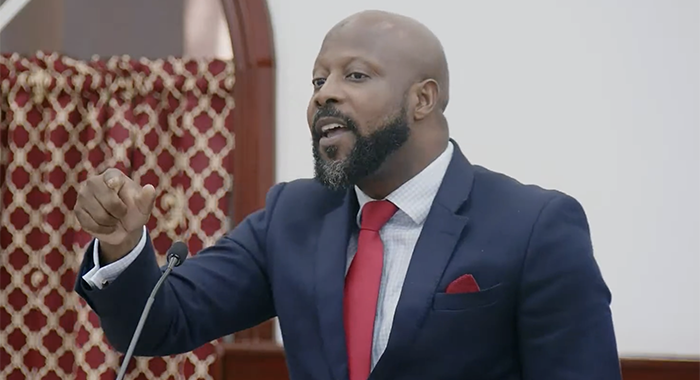

Opposition senator Carlos James supported the legislation formalising St. Vincent and the Grenadines’ membership in the Development Bank of Latin America and the Caribbean (CAF), but challenged the government’s description of the financing.
His support in Parliament on Thursday came even as he challenged the 11-month-old New Democratic Party government’s economic record and urged it to spend any borrowed funds on projects that can deliver lasting returns.
James, who was defeated in November as MP for North Leeward after one five-year term, argued that the NDP administration had not delivered on campaign promises to improve people’s lives and ease household costs, and questioned whether future CAF borrowing would be affordable or well spent.
He argued that the membership process began under the former Unity Labour Party administration and warned that access to CAF loans should not be confused with access to concessionary financing.
“I am not here to oppose the bill and to discredit the work of CAF,” he said, adding that he supported the legislation.

James, who led the opposition’s response to the bill in the absence of Opposition Leader Ralph Gonsalves, said his support came with questions about the cost and use of future borrowing.
‘It is not concessionary financing’
James challenged Prime Minister Godwin Friday’s characterisation of CAF financing, arguing that while the terms may be competitive, borrowing costs would be tied to market rates and could change.
“It is correct to say that it is not concessionary financing,” James said.
He pointed to the secured overnight financing rate (SOFR) as a basis for the variable interest rate.
At the time of his presentation, James said the rate stood at about 4.2% and, after CAF’s fees and spreads, SVG’s borrowing cost could reach “about 5.5% and upwards.”
He cautioned that the rate could rise further with market conditions, adding that his concern was how that would fit with the country’s debt-management approach.
“We have to be concerned about that,” he told Parliament, arguing that SVG had generally sought to keep borrowing rates below 5%, except in emergencies.
He also cited CAF loan rates averaging around 6% or more in 2023–24.
James said the initial US$2 million share subscription would provide access to an estimated US$8 million borrowing envelope but questioned how quickly the country would draw on it and what it would use the money for.
“The question then we will raise … is whether we are breaking our long-standing national debt management strategy of keeping interest rates strictly below 5%,” he said.
A call for projects, not recurrent spending
James urged the government to be cautious about borrowing and to identify projects that can generate economic value.
“If it is not projects that are going to generate economic growth and to have a positive net present value, then we’re going to have some problems,” he said.
He warned against using CAF funds for salaries, budget support or other recurrent spending.
“Find projects that you can see a return on the investment,” he said, adding that funds should “trickle down to the working people of St. Vincent and the Grenadines.”
James acknowledged that CAF could offer technical cooperation, regional partnerships and access to development programmes.
He cited climate adaptation and disaster-risk financing among the areas where membership could be useful, and said CAF had provided assistance to SVG after Hurricane Beryl, including a grant and immediate support
He also pointed to CAF’s ability to coordinate with other institutions and to respond more quickly than some traditional lenders, with drawdown possible within three to four months.
‘A process’ begun before the bill
James also disputed Friday’s account of when the membership effort began. He said SVG’s interest in becoming a CAF shareholder predated the current administration.
“This process in signing on to CAF actually started some three years ago,” he said.
To support that point, James referred to a letter dated Nov. 2, 2023, from CAF’s executive president to then Finance Minister Camillo Gonsalves, acknowledging a letter of interest sent in September of that year.
He also recalled discussions at a World Bank and IMF spring meeting aimed at expanding CAF’s presence in the Caribbean.
James described the work as “a government of continuity”, and said the previous administration had helped initiate and advance the process.
Support, with a warning
Alongside his financial cautions, James criticised the government’s wider economic direction and questioned how it would manage the country’s fiscal pressures. He said he aimed to raise concerns, not reject the bill.
“As His Majesty’s opposition, our role [is] to ensure that we caution you,” he said.
“I lend my support,” James said, but urged the government to “spend it wisely to meet the benefit of the people of St. Vincent and the Grenadines…
NDP’s yet to match Vincentians’ economic reality
“I am not here to oppose the bill and to discredit the work of CAF,” he told Parliament.
Promises versus people’s experience
James contrasted the NDP’s pre-election promises with what he described as the economic conditions people were experiencing after the party took office.
He recalled the pledge that, “from the moment you vote us into office, the very next day, your life is going to be better,” as well as the promise to “put the money where the pain is.”
He also cited a pledge that the fuel surcharge would not exceed the electricity-consumption charge.
James argued that households were instead facing a high cost of living and rising energy costs.
The senator said the government’s subsidies were “not sufficient” and “not working,” and called on the administration to find more effective ways to address those pressures.
He said he took “no pleasure” in highlighting the challenges, but considered it necessary to hold the government accountable.
“The solution in fixing the problem lies with the government,” he said, while acknowledging external pressures, including imported inflation and higher oil prices.
James also criticised what he saw as a lack of a clear development strategy, adding that he was “not impressed” with the government’s direction and urged it to show how it would stimulate growth and replenish public revenue.
Disagreement over the ULP’s economic record
Government speakers challenged James’ account, arguing that the new administration inherited severe fiscal problems.
Foreign Affairs Minister Dwight Fitzgerald Bramble said the NDP administration inherited an overdraft exceeding EC$200 million, more than the EC$85 million legal limit, and unpaid amounts owed to local businesses.
Prime Minister Godwin Friday later referred to national debt of about EC$3.6 billion, or roughly 113% of GDP, and said debt servicing was constraining public spending.
James, in turn, argued that public borrowing and spending under the previous administration had responded to crises and supported people affected by events including COVID-19, the eruption of La Soufrière and Hurricane Beryl.
Senator Keisal Peters, who was also a minister in the former ULP administration, made a similar point, saying that pandemic and disaster support should be included in discussions of the country’s debt.