



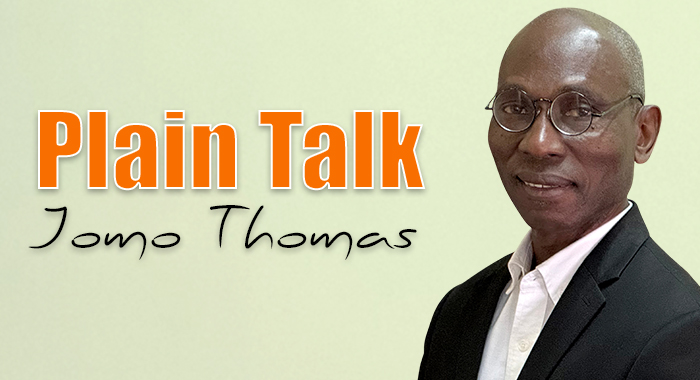

By *Jomo Thomas
Plain Talk has always maintained that the struggle for Reparations is not for the faint of heart. The developments unfolding at the Commonwealth Heads of Government Meeting in Antigua are proof perfect that the Caribbean would need more marathoners than sprinters if it is ever to receive just compensation for the crimes against humanity committed by the former enslaving countries, among whom the United Kingdom played the lead role as head crook.
This year has witnessed rapid changes and advances in the struggles for reparatory justice. Beginning with the March 25 United Nations vote of 123 for, 3 against and 52 abstentions, which labelled chattel slavery as the gravest crime against humanity, to the Next Steps conference in Accra, Ghana, which united Global Africa in the push for reparations, to the 3rd Caribbean Reparations Conference in Barbados last September, there has been a momentum shift. Renewed focus has been brought to the crime and underdevelopment that slavery and colonialism have wrought on the Caribbean.
Some say we are at a tipping point. We say not so fast. While there have been great advancements, strong headwinds remain. We need look no further than King Charles’ lazy, tired trope of sorrow and regret, and the UK’s PM Burnham’s insulting 40 million pounds offer in response to the developmental mess Britain largely created. The Caribbean, once labelled as the most prized piece of real estate in the world, is currently, by any measurement on the developmental scale — health, education, wealth generation, debt burden or climate vulnerability — at the very bottom.
This is not the time for eloquent speech and nice-sounding prose. Who really cares about Charles’ crocodile crooning about his personal pain and sorrow? If “evil need not have the last word”, what is so difficult about apologising for slavery and committing to repair?

It is a lie to say, as Charles did in Antigua, that “history is not for us to choose or change”!
In Requiem for a Nun, the American novelist William Faulkner said, “The past is never dead. It’s not even past.” Charles knows that history continues to shape the future. As historian William Pettigrew revealed in his groundbreaking book, Britain’s Slave Traders: A Forgotten History, King James II was the most important English slave trader of the 17th century. Pettigrew also established the true significance of the trade in enslaved Africans in Britain’s development as a modern nation.
Therefore, the foundation stone for the wealth currently owned by the House of Windsor, which Charles now rules, is money gained from the capture, torture, transhipment and enslavement of Africans. He does not have to speak for all of Britain. He could apologise for the sordid and despicable acts of his foreparents and offer to give back some of the hundreds of millions in treasures stolen from enslaved and colonised peoples, some of whom now serenade him as King of the Commonwealth.
As Antigua’s Gaston Browne said, “fairness also requires an honest engagement with our shared history”. Charles’ platitude is useless drivel.
And then there’s Britain’s prime minister, Andy Burnham’s insult.
As the CARICOM Ten-Point Plan for Reparatory Justice: A Manifesto for the Coming Enlightenment declares, “The case for slavery reparations and climate justice is inextricably linked … Colonialism is an historical and ongoing driver of the climate crisis that has compounded the economic, social and environmental vulnerabilities of the Caribbean.”
Clearly, the effects of slavery and colonial exploitation remain evident in economic inequality, development challenges and other structural shortcomings. Brought kicking and screaming to the apology pulpit at the CHOGM in Antigua, Burnham’s waffling comments about an apology and his strident opposition to financial reparations were underwhelming, given the gravity of the problems facing our region.
St. Lucia’s PM Phillip Pierre was on point when he declared that “an apology without repair is incomplete”.
So, what should we make of Britain’s Burnham commitment to offer 40 million pounds over 3 years aimed at accelerating critical infrastructure investment, including green energy initiatives? He should have been laughed out of the room. Twelve English-speaking Caribbean countries are in the Commonwealth. Sit with the announcement again — 40 million pounds over three years. Now let’s calculate the insult. If the money were shared equally, each country would get 333,000 pounds or 113,000 pounds per year. Burnham and his ilk are not serious partners.
Burnham’s announcement lends added weight to Mia Mottley’s bold speech at the United Nations General Assembly last September: “The same mindset that allowed for enslavement is the same mindset that currently sustains inequities in power structures and international institutions.” PM Mottley was highlighting the ongoing legacy of slavery and its impact on global governance and financial systems.
Here’s a contrast in commitment. Since 2022, following the Russian invasion of Ukraine after years of Western provocation, with a chief culprit being the United Kingdom that Burnham now leads, Britain has squandered about 25 billion pounds in a senseless and unwinnable war aimed at dismembering and defeating Russia — 25 billion with a capital B.
Yet Burnham insults our leaders, people and countries with a measly 40 million pounds offer. As Black Stalin reminds us, “Black man doh get nothing easy.” The struggle continues — reparations in our lifetime.
*Jomo Sanga Thomas is a lawyer, journalist, social commentator and a former Speaker of the House of Assembly in St. Vincent and the Grenadines.
The opinions presented in this content belong to the author and may not necessarily reflect the perspectives or editorial stance of iWitness News. Opinion pieces can be submitted to [email protected].