



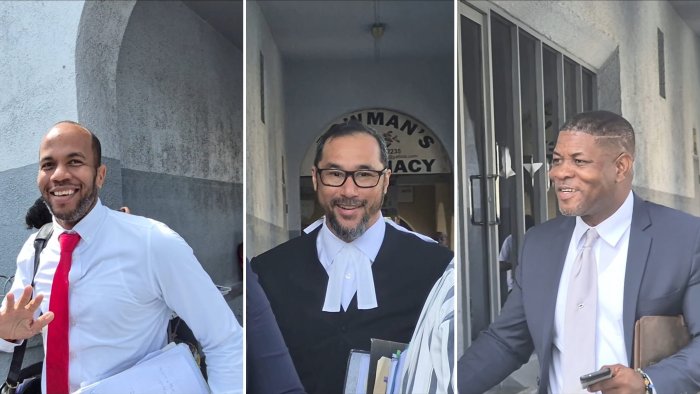

“Give up your Canadian citizenship. What is so precious in it?” These were the words of Stuart Young, Senior Counsel representing Unity Labour Party (ULP) petitioners Luke Browne and Augustus Williams during closing submissions at the High Court in Kingstown on Tuesday.
The high-stakes constitutional battle, which has stretched over several months following the November 2025 general election, entered its final phase of oral arguments before Justice Gertel Thom. Browne and Williams are challenging the election of Prime Minister Godwin Friday and Foreign Affairs Minister Dwight Fitzgerald Bramble over their Canadian citizenship. Once submissions conclude, the judge will reserve her decision before issuing a final ruling.
Addressing the court, Young pointed to Friday, who testified that leading the country is “the greatest honour of his life.” Young argued that despite describing the office in those terms, Friday has chosen to voluntarily retain his Canadian citizenship—a status the petitioners contend disqualifies him from sitting in the House of Assembly.
Young said that individuals elected to Parliament cannot hold allegiance to a foreign power or state.
He also told the court that when the law was updated in the past, lawmakers could have exempted Commonwealth citizens from Section 26 of the Constitution and Section 35 of the Representation of the People Act, if they believe such an exemption should apply.

Young said that the Constitution contains mandatory disqualification provisions and added that these cannot be selectively applied.
“You cannot cherry-pick,” Young told the court, noting that an individual may meet the basic qualifications to serve, yet remain barred if they are a judge, bankrupt, or of unsound mind.
He explained that by taking the oath taken to acquire Canadian citizenship, the respondents committed voluntary acts that trigger disqualification under the Constitution.
Addressing claims that the respondents’ rights are being taken away, Young maintained that the Constitution confers no such right to sit in Parliament while holding foreign citizenship.
Young pointed to his own status as a citizen of Trinidad and Tobago—another Commonwealth nation—noting that he cannot run for election in St. Vincent and the Grenadines. He said that holding dual status results in a split allegiance.
Young asked the court to adopt the literal meaning of “foreign state,” submitting that there is no ambiguity in the constitutional phrase “foreign power or state” under Section 26.
He also dismissed the evidence provided by Professor Hamid Ghany—whom the respondents called as an expert witness in late September to testify on Commonwealth citizenship and parliamentary qualification—saying his testimony was of little or no value to the court.
Young told the court that lawmakers should not put themselves in a position of potential conflict, asking what happens when Canada takes a different position to St. Vincent and the Grenadines.
Young added that elected representatives should have a “clean slate” of allegiance and avoid any “perceived split loyalty.”
Characterising the respondents’ reliance on Commonwealth ties to the British monarch, Young said their argument amounts to saying that because both countries share the same King, “we special.”
Focusing on the process of naturalisation, Young added that by taking the Canadian citizenship oath, an applicant indicates a willingness to accept all the rights and responsibilities of citizenship. He maintained that it is not an oath to democracy or constitutional monarchy, but an oath to Canada. He said that the applicant is now under allegiance to that state.
“How much clearer does it have to be?” Young asked.
He added that the defence has not provided any legal authority of Canadian law, via experts, to state otherwise.
The lawyer also urged the court to distinguish the case from older regional precedents in which respondents had not acquired foreign citizenship through naturalisation.
Concluding his submissions, Young asked the court to declare petitioners Browne and Williams the duly elected representatives for East Kingstown and the Northern Grenadines, respectively, or, in the alternative, to declare the election of Friday and Bramble null and void.
Speaking to the media following Tuesday’s session, Bramble declined to state how he felt about the petitioners’ bid to claim the parliamentary seats, saying, “ well, I would not want to comment on anything like that right now, respectfully…”
Reflecting on the day’s submissions, Bramble described the ongoing legal battle as “a process,” adding that, like the Prime Minister, he is “very confident” that “we will prevail.”
Friday told the media that the lengthy legal arguments “can be a bit tedious,” but added that the petitioners’ case contained “nothing surprising” or different from what was expected ahead of Wednesday’s continuation.
“I’m confident about our position as we were at the beginning,” Friday said.
Meanwhile, Young said the oral closing submissions “have gone very well for the petitioners,” adding that their arguments were “very cogent” and “very easy” to follow.
“At this stage, one must be very cautious about how much you say, because it is really now for the determination of the court,” Young said. “But I expect, and what I’ve seen of the respondents’ submissions, that they have taken a very different approach to that we have taken for the petitioners, where we are focused and surgical, and this is the law; and not surprisingly, we have gone and thrown a seine out there hoping to pull something in but we will deal with that in our reply as well.”
Summarising the petitioners’ position, he added: “What we see in the mandatory disqualification—that is what the crux of this case is—by the acts taken by the two first respondents, as we’ve said throughout the whole of today, becoming a Canadian citizen by a process of naturalisation, as well as traveling on Canadian passport, we say that that falls in breach of the Constitution, and therefore it is mandatory disqualification. As I pointed out to the court, which is accepted…once the court finds that those are, in fact, disqualifying provisions…I do not want to say much more at this stage.”