



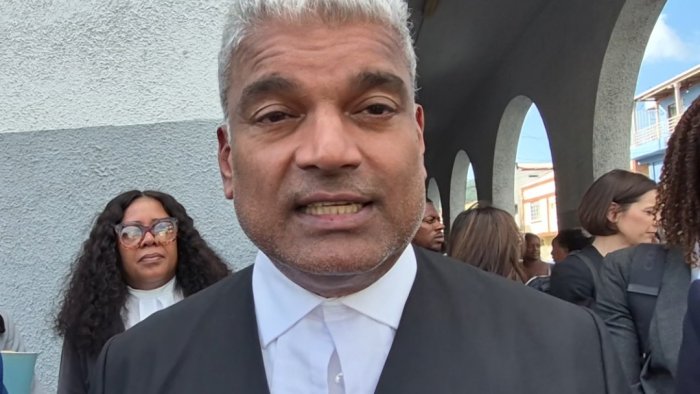

Lead defence lawyer Anand Ramlogan has described efforts to bar dual citizens from holding parliamentary office as “archaic,” warning that disqualifying educated members of the diaspora threatens the economic and intellectual development of the Caribbean.
The petitions, filed by defeated Unity Labour Party candidates Augustus Williams and Luke Browne, seek to void the electoral victories of Friday and Bramble from the November 2025 general election. The petitioners claim that the Canadian citizenship of both men violates Section 26(1)(a) of the Constitution regarding allegiance to a foreign power. The defence counters that Commonwealth citizen provisions under Section 25 protect their eligibility to sit in Parliament.
Ramlogan told reporters on Thursday that High Court judge Justice Gertel Thom reserved her judgment following the conclusion of closing submissions in the election petitions against Prime Minister Godwin Friday and Minister of Foreign Affairs Dwight Fitzgerald Bramble.
He noted that the trial marked the third occasion on which counsel addressed closing submissions.
“And the learned judge has indicated that she has reserved her judgment,” Ramlogan said. “She has a lot of food for thought, and that she will give her judgment not on this side of the law term, so I anticipate her judgment will probably be delivered sometime early in the new year or sometime during the course of next year.”

Ramlogan congratulated Friday on his one-year anniversary in office before outlining the wider implications of the ruling for small island states where diaspora populations often double domestic headcounts.
“This is a matter that has significant implications because the Caribbean comprises small islands with a very small population,” Ramlogan said. “And that goes whether it’s Trinidad and Tobago, St Vincent and the Grenadines, Barbados. Doesn’t matter. It’s our same common story throughout the Caribbean.”
He maintained that blocking citizens educated or married abroad from serving ignores the reality of a globalised world.
“And at a time when the world of technology is fast becoming accustomed to the concept of a global village, it is simply archaic and not right to say that dual citizens, people who are educated or married abroad, will be prohibited and disqualified from serving their country and serving their parliament,” Ramlogan said.
He insisted that Caribbean nations need citizens with international education, opportunity and exposure to return home with their children and serve. Ramlogan pointed out that Friday and Bramble gave up careers in Canada to reside in SVG and build a better future for its people.
Ramlogan continued his point, arguing that disqualifying such individuals “retards” the growth and development of SVG and the wider Caribbean.
“This is a matter—it might very well be a matter—that at some stage all Caribbean countries will have to take a careful, hard look at dispassionately because it is about creating a better future for us in the Caribbean,” Ramlogan said.
“So, Prime Minister, I know it is a matter at CARICOM—CARICOM as a body as well… because it is a matter that requires a more strategic macro-economic police decision, because if you minus the people who [are] foreign investors and the people who work as expatriates in the oil and gas sector in Guyana, Trinidad and Tobago, and indeed anywhere else in the Caribbean, at the end of the day, what you end up with is a weak economy, a weaker society, and a less realistic possibility of creating a better and brighter future for children to inherit,” he added.
Ramlogan said that the defence submitted a census report from the government’s Statistical Office as evidence, showing that a significant portion of the Vincentian diaspora comprises young people seeking education and work abroad. Ramlogan argued that countries must attract these individuals back to strengthen their intellectual capital and infrastructure.
Instead, this case is about saying, ‘Let’s keep them out. Close the door so they can’t come and serve their country, can’t come and serve in government, and they must remain out’—slamming the door shut in the faces of people who want to come back and serve after they have been educated and after they’ve worked outside,” Ramlogan said. “It’s just a non-starter. It’s a no-brainer. It makes no sense.