



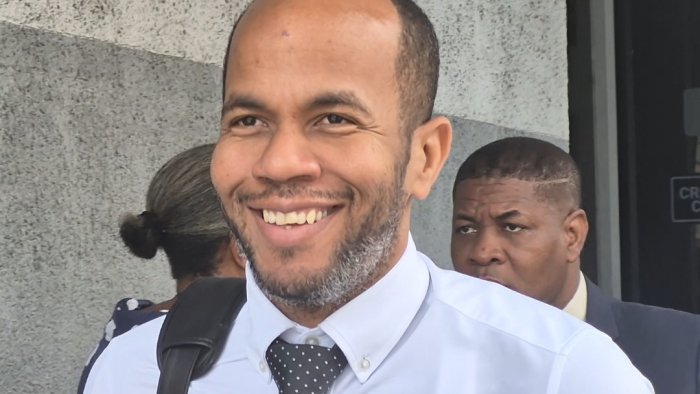

Election petitioner Luke Browne told reporters outside the High Court on Thursday that Prime Minister Godwin Friday and Foreign Affairs Minister Dwight Fitzgerald Bramble showed “recklessness” and “disregard” for the trust of the electorate by not renouncing their Canadian citizenship before the November general election.
Browne, who contested East Kingstown for the Unity Labour Party (ULP), spoke after closing arguments in the consolidated election petitions. He and fellow petitioner Augustus Carlos Williams, who contested the Northern Grenadines, are challenging the general election victories of Friday and Bramble of the New Democratic Party (NDP). The petitioners argue that Section 26(1)(a) of the Constitution disqualifies Friday and Bramble from sitting in Parliament because they voluntarily acquired Canadian citizenship through naturalisation.
Browne maintained that the petitioners raised the matter before voters went to the polls.
“First point I want to make is that we really didn’t have to be here. Before the elections, we made a point that there was an issue concerning the respondents because they have a foreign passport and they are naturalised citizens of Canada,” Browne said.
He insisted that Friday and Bramble could have renounced their citizenship to show undivided loyalty to St. Vincent and the Grenadines.

“And I think that the fact that they did not do that demonstrated a lot of recklessness and a lot of disregard for the trust that the electorate might have vested in their hands,” Browne said.
He added that the respondents’ “recklessness” and “negligence” left all parties dealing with the petition hearing in court for months.
“I thought that it was incumbent upon me, and I think the same is true with my colleague Carlos Williams, to put this matter before the court,” Browne said, adding that they exercised their constitutional right to file the petitions.
“And having done so, I don’t believe that we could have asked for better representation that came to us in the form of Senior Counsel, Stuart Young from Trinidad and Tobago, and of course, he was ablely assisted by Al Elliot and Carlos James in this matter,” Browne said. He added that they worked with excellence and addressed the matter in clear terms.
Closing arguments focused on how the Constitution defines dual citizenship and disqualification from Parliament. Browne said both the Constitution and a layman’s understanding make it clear that Canada is a foreign power.
“And if you were following in court, you’d see that they say it boils down to what is the definition of a foreign power or state? What is a foreign country?” Browne said. “Canada is not Bequia. Canada is not Union Island. Canada is not Mayreau or Mustique. Canada is a foreign country. Don’t come, after a clear demonstration of recklessness on your part, and try to give the impression that Canada is a part of St. Vincent and the Grenadines,” he said.
“I think that that is a matter of insulting your intelligence, and I think that the law is clear on the matter,” Browne added.
He pointed to Caribbean case law cited during the proceedings, including an Antigua and Barbuda ruling involving Baldwin Spencer where the court deemed Canada a foreign power.
“I think we have a good case, a strong case. I am not taking anything away from the efforts of the respondents to their counsel,” he said.
Browne also questioned the cost of the litigation to taxpayers, noting that the respondents retained five foreign lawyers alongside local counsel.
“What are the taxpayers going to have to pay in terms of footing this bill for persons who are in the court, not because of official actions that were taken on their part, so I just put that out there for your consideration,” Browne said.
While he maintained that the petitioners have a good case, Browne said they will not put themselves in the shoes of presiding Judge Gertel Thom, who reserved her decision.
Her Ladyship, the judge, is a very experienced judge—very experienced in relation to the particulars of St. Vincent and the Grenadines, very experienced in relation to what the Court of Appeal might have to say on a matter like this,” Browne said.
He added that no better person could administer justice in the case.
“We look forward to crystal clarity being brought upon this, and I believe that we will live to fight another day,” Browne said.
Lawyers for Friday and Bramble, led by Senior Counsel Anand Ramlogan, have argued throughout the proceedings that Canadian citizenship does not disqualify the two men and that the petitions seek to overturn the will of the voters.