



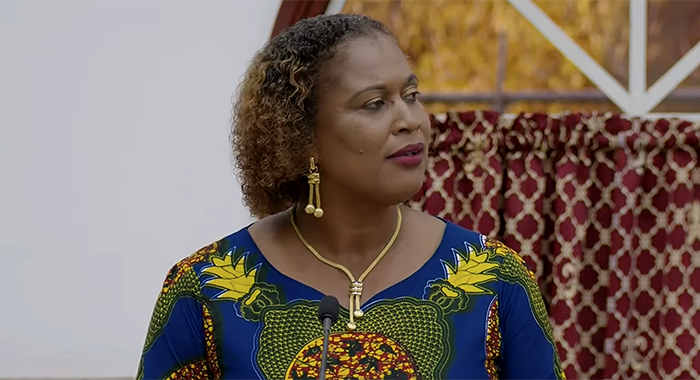

Minister of Social Welfare Shevern John told Parliament on Tuesday that raising the monthly public assistance grant from EC$360 to EC$500 is among the clearest signs of the New Democratic Party government’s commitment to vulnerable Vincentians.
“A promise made and a promise delivered,” she said as she delivered a ministerial statement reflecting on the government’s first year in office.
John, who is also the Minister of Social Welfare and Community Empowerment, Ecclesiastical Affairs and National Heritage, also reported on several other areas.
She covered a new job readiness programme, 37 community projects, the retrofitting of seven community centres, and a church-based “Restore” campaign and announced that the Argyle petroglyph park will be handed to the National Trust on Friday.
“This has been a year of hard work, determination, and action,” John told Parliament. “We have faced challenges, addressed inherited difficulties and began important work across the ministry. While there is still much to accomplish, we have made progress,” the North Windward MP said.

She opened with a reference to the Book of Job, addressing the prime minister directly: “Though we have not been dealt a good hand, Honourable Prime Minister, we will come forth as gold.”
‘They experience it every month’
In February, the government fulfilled its campaign promise and increased the monthly social welfare payout to vulnerable Vincentians from EC$360 to EC$500.
“We did not simply state before the people that we understood their struggles. We took a decision and increased the assistance they received,” John said.
“It was not merely an adjustment to the figure in the budget. It was a deliberate decision to place greater support in the hands of thousands of vulnerable Vincentians who depend on this assistance to meet their basic needs.”
She said the old rate “was inadequate to meet the realities confronting many elderly people, people with disabilities, and other vulnerable members of our society” as living costs rose.
“We acted because we believe that dignity must not be determined by a person’s economic circumstances,” she said.
The minister addressed her critics directly, saying, “The opposition may question the decision, the timing, or it may seek to diminish its significance. But the thousands of beneficiaries who now receive $500 instead of $360 understand the difference. They do not have to be told that the increase is real. They experience it every month.”
The minister said her ministry’s emergency assistance programme continues to help households with medical emergencies, funeral costs, utility bills and back-to-school expenses.
She said the vulnerability grant programme assists about 667 people, with over 100 people receiving a hot meal.
From grants to jobs
John said the ministry’s “We Can” initiative, co-funded by the World Food Programme, offers family life education, farm skills internships and business skills support.
For the first time, the ministry is running a job skills readiness programme under We Can, funded by UNICEF.
Close to 200 people from across the country are taking part, and training ends next month, John said, adding that the programme will be expanded in the coming year.
“It means that our support is not stopping at the provision of grants. We are helping people prepare for work, improve their prospects, and take greater control of their economic circumstances,” she said.
“The government is not interested in keeping people dependent on the state. We are interested in creating the conditions in which more people can become self-reliant, productive, and empowered.”
Community development ‘practically dormant’
Turning to the Department of Community Development, John said: “When I got into the ministry, community development was practically dormant.”
She said the ministry’s aim is to have “communities that are active, organised, informed, and equipped to take responsibility for their own advancement”.
She said the department held nine community consultations this year under its “Five Cs” series, despite staffing and administrative constraints. “They were not simply meetings; they were an expression of our belief that communities must have a voice in decisions that affect their development,” she said.
The consultations helped identify projects for the GYVE Programme (Greater Youth Volunteerism Engagement Fund), which approved 37 community-led projects across the country in 2026.
She said the projects include rebuilding bus sheds, restoring walls, community clean-ups, upgrading recreation spaces and heritage sites, and developing waterfalls.
“We are bringing people together, encouraging volunteerism, improving public space, and giving residents an opportunity to take pride in the places where they live,” she said, pointing to work on the bridge at Biabou as an example.
Struggle over community centre keys
The minister described resistance when the ministry started retrofitting community centres. She said some people had been treating the buildings as their own.
“People take up the community centres as if it was their home. They have keys and they don’t want to give up the keys,” she said.
“They’re telling you that you have to give them time to come out — two months, three months, four months — of a space that was not even allocated to them…
“When you say you’re developing community spaces for people, you can’t develop it for one person, but it was what was happening over the years, and we really met a struggle,” she said.
John said the programme still exceeded its target of five centres, with work started at seven: Orange Hill, Lauders, Biabou, Redemption Sharpes, Rose Hall, Rose Bank and Layou???
“We will see those spaces come alive because this is a government that delivers,” she said.
Churches and the ‘Restore’ campaign
Through the Ecclesiastical Affairs Division, the ministry has launched a “Restore” campaign that brings churches together in “prayer, engagement, and activities aimed at encouraging national reflection, strengthening communities, and renewing our relationship with God.” She said the response had been encouraging.
“We believe that churches and faith-based organisations have an important role to play in promoting hope, compassion, responsibility, and positive social change,” John said.
Garifuna heritage and the Belize visit
Speaking on national heritage, John said the subject is “particularly close to my heart”, noting her Garifuna heritage.
“As a Garifuna woman, I stand in this honourable house with a profound appreciation of what it means to inherit a history defined by resilience, survival, identity, and commitment to cultural preservation,” she said.
She noted that she accompanied Prime Minister Godwin Friday on his visit to Belize one week earlier for Garifuna Settlement Day.
John called it “more than a diplomatic visit, adding that it was “an opportunity to reconnect with an important part of our shared Garifuna heritage.”
John said the prime minister built ties with the National Garifuna Council of Belize and Belizean Prime Minister John Briceño “to ensure that the [Garifuna] language will be passed on to children in St. Vincent and the Grenadines, and we look forward for when that exchange happens”
Petroglyph park, Diamond centre handover
The minister said the ministry has held three heritage markets this year. It has also worked with the St. Vincent and the Grenadines National Trust on the Argyle petroglyph park, which she called “an important site of historical and cultural significance to our nation”.
She said the Peace Memorial Hall now falls under her ministry. A new board is working to strengthen its management, and repairs to the electrical, air conditioning and plumbing systems are under way.
The Diamond Multipurpose Centre in South Windward, built under the Economic Planning Division, will be opened and handed over on Tuesday.
It will provide space “for meetings, programmes, training, and other activities that will contribute to social and community development,” she said.
John also said that in October St. Vincent hosted the 10th meeting of the OECS Council of Ministers on Human and Social Development, the first time the country had hosted the regional meeting.
MPs urged to ‘go back to your communities’
The minister reiterated her Christian faith, quoting Psalm 121, “I will lift up mine eyes unto the hills, from whence cometh my help.
She urged her parliamentary colleagues to stay close to voters.
“I remind my ministers to serve. Go back to your communities, meet the people. Ensure that you connect with them,” she said.
“This first year has demonstrated that we are not afraid of the work. We have made commitments, and we have begun to fulfil those commitments. We have faced challenges, and we have continued forward. We have listened to the people, and we have acted,” John said.