



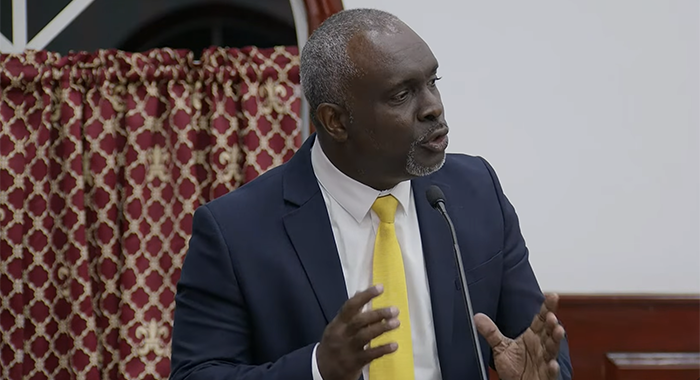

Students in St. Vincent and the Grenadines were “just being pushed up and out” of the education system without basic reading and maths skills, Education Minister Phillip Jackson told Parliament on Tuesday.
He said his “Big Push” initiative will require every child without a learning disability to read, write and perform at or near grade-6 level by the end of primary school.
“This minister is not going to send thousands of students into secondary school ill-prepared to take advantage of the opportunities,” Jackson said in a ministerial statement on Nov. 24.
Jackson, who is also minister of vocational training and innovation, digital transformation and information, spoke of the initiative as he reported to Parliament on the New Democratic Party (NDP) government’s first anniversary.
He also announced that the government will pay for up to nine CSEC subjects per student from June 2027.

Jackson defended the government’s decision to scrap illegal secondary school registration fees and outlined an EC$90 million digital transformation project.
He accused the former Unity Labour Party administration of being “afraid” to face problems in the system.
‘We must start with the facts’
Jackson said one of his first questions to senior staff was whether they had looked at students’ literacy and numeracy results.
“The data at that time showed really poor performance,” he said.
He said former ministers had preferred to talk up their record in “this wonderful ‘education revolution’, and they themselves were even afraid to … say, ‘Hey, it’s not doing so well’,” he said.
“I said, ‘Listen to me. This is not what we’re here. For us to transform our nation and help all of our students achieve, we must start with the facts.’ And the facts were that our students were just being pushed up and out in the education system, and we say that has to stop
He said he gave a directive that “all of our students who do not have learning disabilities, by the time they get to grade six, they have to be able to read and write and perform at grade six or very near grade six level”.
Under the initiative, the ministry will put “a massive emphasis on literacy and numeracy” from kindergarten through the first three years of school, “and ensure that we are not just pushing our children up and out.”
The minister said that St. Vincent and the Grenadines can ill afford that sort of leadership.
“That sort of governance is a thing of the past,” he said. “We have to make sure that all of our students are fully equipped with all of the possibilities to take full advantage of the opportunities.”
Link to dropouts and crime
Jackson tied the initiative to school dropout and crime. “If we don’t, we’re going to have, as has been happening, large dropout rates,” he said.
“And as the Minister of National Security tell you, these people then become vulnerable to certain elements, negative elements in our society,” said Jackson, a former educator.
Up to 9 CSEC subjects paid for
Jackson followed with a measure for parents of older students. “Many parents struggle just to get to sign up their children for CSEC subjects, and thanks to the leadership of the Prime Minister, I can stand here and proudly announce that your government is going to pay for … up to nine of the subjects approved by your school come June 2027, when you do your CSEC examinations,” he said.
“This is leadership that understands the context in which students are operating and parents are operating,” he added.
Registration fees: ‘That’s poor governance’
The minister also revisited his early decision to scrap extra charges for registering at secondary schools. He said MPs regularly hear from constituents who cannot afford them.
“Many of these fees have been allowed by the previous administration to just exist, but many of them are illegal. But that administration … they were afraid to do anything about it because somehow they figure that they might lose support. That’s poor governance,” Jackson said.
He said staff advised him to wait. “They say, ‘Minister, let’s wait until next year.’ I said, ‘No, we’re doing it now.’ And we did that. We made sure that all of those fees are properly set in law and are just and fair. And oh, what a wonderful reaction we got from our parents!”
He said the previous government had commissioned a study on the fees.
“I saw the memo, but they were brutally afraid to do anything about it… This NDP government, led by Dr. [Godwin] Friday, is not afraid … Though it will cause some noise, it might cause some negative reaction, but it’s the right thing to do.”
‘Bring that heart power’
Jackson said he had asked staff across the ministry to write to him frankly about their challenges.
“I don’t want you to hide anything. You send those papers on my desk. I will read them and I will discuss them with you,” he said.
“For the first time, the staff felt that they had a real stake in the educational service … and they had a voice.”
Praising a senior technical staff meeting held two days earlier, he said: “The brain power is evident. It is amazing. It is mind-blowing. All I want you to do now is to bring that heart power, that commitment power, to match your brain power, to transform our education service, to ensure that no student gets left behind.”
$90 million digital push
Jackson said he wanted to “tell a story, not just of numbers and a list of accomplishments”.
He later outlined an EC$90 million digital transformation project, which he described as a pyramid built on revised laws and regulations, online government services and digital skills.
“Very soon, you will see the rollout of many of these things,” he said. “No longer will there be long lines, wasting time and increasing the waste of energy and productivity, but easy access to government service and the ability to even react and provide your feedback.”
He said a digital adoption programme will soon send specialists to businesses to assess their needs and draw up plans, backed by grants “so that they can make the necessary and critical investments to take their plans forward”.
The minister said businesses could also take those plans “to a credit union, to the bank, or wherever there is funding available”.
As minister of telecommunications, he said the National Telecommunication Regulatory Commission is using Universal Service Fund money “to make sure that our poorest citizens get access to digital technologies”.
He said he has also told the regulator to set up an incubator and accelerator so the best ideas from its app competitions “can get an opportunity to scale up and become a real-world use case”.
‘Built by ordinary citizens’
Jackson closed with a call to citizens. “A great country is not built by great politicians or great governments. A great country is built by ordinary citizens who every day get up and do small and great things,” he said.
“That is what we are celebrating after one year, and I am fully confident with that attitude and with that spirit, we will do greater things.”