



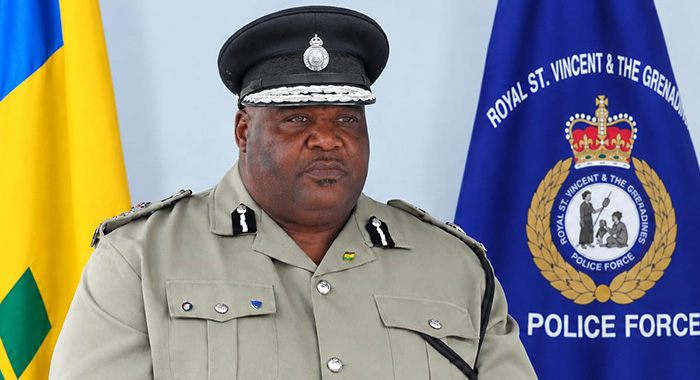

Acting Commissioner of Police Trevor Bailey has outlined new measures to strengthen professional standards, accountability, and public confidence within the Royal St. Vincent and the Grenadines Police Force (RSVGPF).
Bailey addressed institutional challenges during a general meeting with officers on Thursday, telling officers that members of the public expect higher standards from law enforcement.
Addressing officers across the ranks, Bailey began with what he described as a fundamental principle to policing: respect.
He said that respect must govern how officers treat their colleagues, interact with members of the public, handle people’s property and exercise the authority entrusted to them.
Bailey warned that the misconduct of an individual officer can undermine the credibility of the entire organisation, adding that professional standards must extend beyond the performance of official duties to personal conduct and social media activity.

He cautioned supervisors against the practice of shielding subordinate officers from accountability or attempting to justify inappropriate conduct.
“If it is wrong, it is wrong, just correct it,” Bailey said.
He urged supervisors to identify shortcomings, provide guidance and take corrective action where necessary, reminding them that overlooking misconduct ultimately compromises the development of junior officers and the effectiveness of the organisation.
Strengthening accountability and the handling of public complaints
Among the organisational changes outlined by Commissioner Bailey was the separation of the Public Relations and Complaints functions into two distinct entities.
The Complaints Branch, located at the Central Police Station, will focus on investigating complaints made by members of the public against police officers, while the Public Information Branch will be responsible for official media communications and disseminating information on police activities.
He explained that the separation is intended to streamline the complaints process and facilitate greater transparency.
Bailey said that neither rank nor position should exempt an officer from investigation when a complaint is made.
He instructed officers at stations throughout the country to provide immediate assistance to people reporting alleged police misconduct.
Where a complainant presents with injuries or complains of pain, officers are to issue the necessary medical forms, advise the individual to seek medical attention and direct the matter to the Complaints Branch.
Bailey said that members of the public must not be turned away simply because the responsibility for investigating their complaints lies with another department.
Professional standards, use of force and continued training
During an open-floor discussion, Bailey reiterated that officers are held accountable for their actions while on duty, including the circumstances surrounding the drawing and discharge of firearms.
He said that officers must provide proper written accounts of their actions when required and that compliance with these reporting obligations is not optional.
Bailey also committed to facilitating organisation-wide training in de-escalation and conflict resolution.
He acknowledged that some policing practices employed in the past fell short of the standards the organisation should uphold today, saying he is willing to lead efforts to correct those practices rather than perpetuate them.
Protecting public confidence and strengthening crime prevention
Bailey also addressed the unauthorised circulation of internal police information, explaining that breaches of confidentiality have consequences beyond administrative inconvenience.
He warned that such practices can undermine the confidence of victims, witnesses and other members of the public whose cooperation is essential to criminal investigations.
He urged officers to safeguard information entrusted to them and allow official communications to be disseminated through the appropriate channels.
Turning to crime prevention, Bailey acknowledged the work being undertaken by operational units to prevent violence and protect communities.
He commended the newly established Drone Unit for its early contributions and praised the community engagement initiatives being undertaken within the Eastern Division, encouraging other divisional commanders to emulate these efforts.
He called on officers to redouble their efforts as the country approaches the end of the year.
Investing in officers and recognising service
Bailey also addressed the responsibility of leadership to recognise the sacrifices and contributions of police officers.
He announced plans to begin the process of awarding outstanding long-service medals to eligible officers, acknowledging that these distinctions had been earned and should have been conferred.
He announced that the annual Police Awards and Retirement Ceremony is scheduled for Jan. 15, 2027.
Bailey also focused on the development of recently graduated officers.
He urged experienced personnel to build upon the standards established at the Police Training School, provide mentorship and ensure that young officers are properly guided, supported and integrated into their respective departments.
Leadership and organisational direction
Throughout the meeting, Bailey said that improving the Police Force requires the participation of every officer, but that those entrusted with leadership bear a particular responsibility to establish, maintain and enforce professional standards.
The RSVGPF said Bailey’s address underscored the principle that the authority exercised by police officers carries a corresponding obligation to account for their actions to the people they serve.