




The government has identified EC$120 million that can be spent in the event of a tropical cyclone impacting St. Vincent and the Grenadines this hurricane season.
“… I always try for us to put aside some money,” Prime Minister Ralph Gonsalves said as he urged residents of SVG to prepare for the hurricane season.
He noted the Contingency Fund to which one percentage point of the 16% VAT is contributed, with special laws governing how the money can be spent.
“We have dipped into the fund because we have the disasters. We have had COVID, Hurricane Elsa, the volcanic eruptions, Hurricane Beryl and so forth,” Gonsalves said on NBC Radio.
” I always try to see if we could have about $120 million put aside,” he said, adding that this includes EC$50 million in the Contingency Fund.

“We use the instrument called the Catastrophe Deferred Drawdown Option at the World Bank. We have arranged, again, such a drawdown. We negotiate that in order to put that aside,” the prime minister said.
He said the Cat DDO funds, a loan amounting to US$20 million or EC$54 million, can be accessed in the event of a natural hazard impacting the country. The repayment period is 45 years.
“We had to pass a number of laws, do a number of regulations to fit with the World Bank requisites,” the prime minister said.
“So, 50 from the Consolidated Fund, 54 from the Cat DDO, that’s 104. So, you see, almost reach 120. Then we will get a US$5 million to borrow — that is $13.5 million — easy from the Caribbean Development Bank,” Gonsalves said.
He said that with the CDB, the country usually gets the loan having spent money in response to the natural disaster.
“But you know you have that for certain. So, you could always bridge it until you get that money. And then, a reliable friend like Taiwan will chip in with 3, 4, 5, million US, depending on the circumstances.
“I’m not talking about small amount of monies — a $200,000, a $50,000 which this or that agency or government may give when a disaster happens. Those monies, you hear about them, but they could hardly take care of the relief, much less to any recovery.”
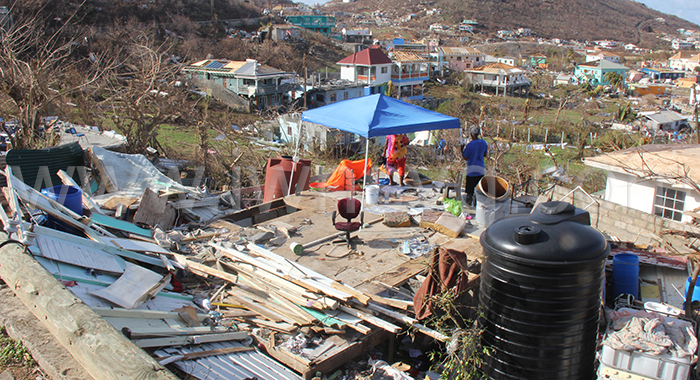
The prime minister said that Hurricane Beryl left “a number close to 1 billion Eastern Caribbean dollars” in loss and damage when it moved across the country, affecting mostly the Southern Grenadines on July 1.
The Barbados-based Caribbean Institute for Meteorology and Hydrology said on May 27 that its forecasters have a 70% confidence in their forecast that there will be 19 named storms, with nine becoming hurricanes and four of them major hurricanes, but noted that the forecast will be updated later in the hurricane season.
Fewer emergency shelters
The prime minister said the government has inspected emergency shelters.
“We have 140 shelters listed for the 2025 season. And while we have a reduced number, it doesn’t mean that there would not be enough places for persons to go to,” the prime minister said.
Meeting with NEMO, BRAGSA
He said he had met with the director of the National Emergency Management Organisation (NEMO), Michelle Forbes and the permanent secretary.
During that meeting, he had a long telephone conversation with BRAGSA “about certain things which need to be done,” Gonsalves said.
He said NEMO has been preparing for the hurricane season by, among other things, conducting training in logistics, warehouse management, shelter management, forklift training, disaster planning with hoteliers throughout the country and with private sector organisations “and carrying them through the steps as to things which need to be done to prepare for a hurricane season.
“In collaboration with the Red Cross, we have been doing capacity building training and community strengthening programmes across the country, but especially so in the southern Grenadines, because they were worse affected by Beryl.”
He said the houses that his government have repaired or rebuilt are, “generally speaking, in a much better condition than they would have been before”.
Gonsalves, however, said he had received “some complaints that some of the contractors have short-changed in some of the repairs and some of it is not of the quality which we should have had.
“And that is a matter which I’ve raised with the Ministry of Housing and they’re doing their double checks and their supervisions and the like to try and improve.”
I am curious to know how many of the 140 emergency shelters listed for the 2025 season are located in the Southern Grenadines and where, exactly, they are. How many are on Union and how many people can they reasonably accommodate? With our major Mayreau shelter at the Robert Divonne Marine Centre now without a roof, windows or front wall, surely the Honourable Prime Minister is not suggesting that with our primary school alone standing as an emergency shelter on Mayreau, “it doesn’t mean that there would not be enough places for persons to go to.” Exactly home many people can our primary school reasonably accommodate for any length of time? And where would the rest of Mayreau residents be expected to go?