



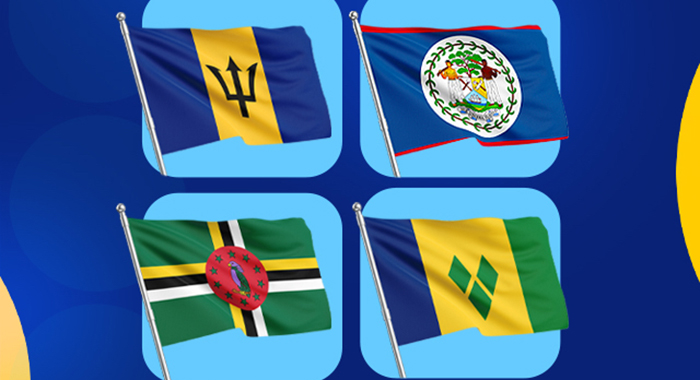

Free movement among nationals of St. Vincent and the Grenadines (SVG), Barbados and Belize came into effect on Wednesday, two days after a law facilitating such movement was passed in the Vincentian Parliament.
Dominica is also part of the agreement, but since Dominica and SVG are members of the Organisation of Eastern Caribbean States (OECS), both countries have enjoyed such free movement since 2009.
Kingstown, Bridgetown, Belmopan and Roseau have decided to forge ahead with full-fledged free movement under the CARICOM Treaty, while other members of the 15-member integration movement work through their reservations.
The free movement means that, effective Oct. 1, except where prohibited on the grounds prescribed by law, such as national security concerns, citizens of the four countries can travel to and work in each other’s countries for an unlimited period of time and can work on arrival, without needing a work permit.
They would also not need a CARICOM Skills Certificate, which previously defined the categories of workers who could move among the bloc and live and work indefinitely.

In Kingstown, the free movement was effected by amendments to the Immigration Restriction Act, which received bipartisan support.
The amendments also allow nationals of the OECS associated member states, namely the French Caribbean departments of Martinique, Guadeloupe and St. Martin, to visit and remain in SVG for up to six months.
“… persons born in those countries or born of individuals who are born in … any of those French overseas territories would be entitled to a six-month entry into St. Vincent and the Grenadines to enhance freedom of movement,” Prime Minister and Minister of National Security, Ralph Gonsalves, said while presenting the law to Parliament.
However, unlike under the CARICOM arrangement, employment is not permitted.
Gonsalves said that while the agreement among the four CARICOM countries included Belize, in practical terms, Barbados, located 100 miles east of SVG, would be the one of greatest practical importance to SVG.
“Clearly, Belize is of historic significance because there’s a significant group of Garifuna, persons of Garifuna descent, who came out of St. Vincent and the Grenadines,” he said.
He was referring to the descendants of indigenous Vincentians who were exiled to Belize in the 1790s after their chief, Joseph Chatoyear, was killed by British colonisers.
“But clearly, the one where we have most people moving would be between St. Vincent and the Grenadines and Barbados,” the prime minister said, adding that this would be of great help to Vincentians.
“And many of us have constituents, people who currently, from St. Vincent, go to Barbados and they’re not supposed to work in the six months but sometimes they do work under the radar, but they are not very well protected, because they are not supposed to be working,” he said.
Gonsalves said the converse is also true for Barbadians in SVG, saying, “employers often take advantage of them because they do not have the legal status.
“Now, after October the first, they’d be able to go to Barbados and work — come out the plane and work there — in the way in which Grenadians can come here under the OECS arrangement or St. Lucians or Vincentians go there, Antigua, or St. Kitts.”
Also on Monday, Parliament passed a law ascribing contingent rights, such as the right to own property and access healthcare and other social services, to the CARICOM or OECS national to whom the free movement rights have been extended.
Gonsalves, however, emphasised that the free movement does not extend to people who obtain citizenship through economic citizenship programmes.
Dominica is the only country among the four CARICOM nations that have agreed to full free movement that has a CBI programme.
“Well, you will notice how the common legislation here is formulated,” Ginsalves said, noting that in CARICOM, Antigua and Barbuda, Dominica, Grenada, St. Kitts and Nevis, and St. Lucia have CBI programmes.
“The other nine do not have. That’s why the formulation is as it is here,” he said.
“This section applies to a person who holds a passport or a document establishing identity and nationally prescribed by law issued by a qualifying OECS state, evidencing that the person was born in the state, or is a descendant of a person born in the state or in another qualifying OECS state,” Gonsalves said.
“So that takes care of that particular problem,” he said, referring to economic citizens.
Would a two-way ticket still be necessary, or would a one-way ticket suffice?