



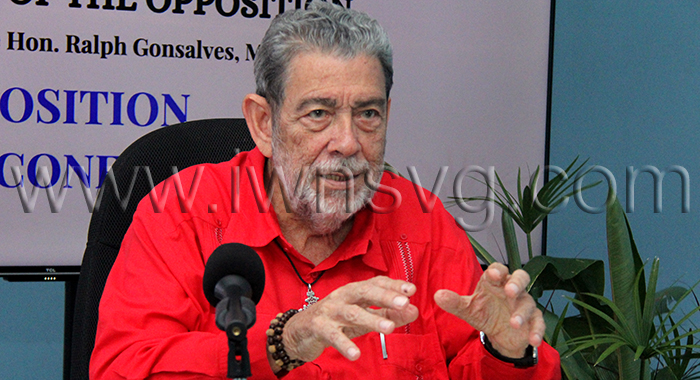

Opposition Leader Ralph Gonsalves says that regarding the capture of President of Venezuela Nicolas Maduro by the United States, it is important not to conflate a military intervention or a political operation with law enforcement.
“And what has taken place has been put out as a law enforcement activity. The question which arises: Is it a law enforcement activity simpliciter?” Gonsalves, a former prime minister, said at a press conference in Kingstown.
Gonsalves was the prime minister of St. Vincent and the Grenadines (SVG) for 24 years until he was defeated at the polls in November.
During his time in office, he maintained close ties with the Chavez and Maduro governments in Caracas.
Gonsalves organised the talks in St. Vincent between Guyana and Venezuela in December 2023 as Maduro was threatening to act on Caracas’ century-old claim to two-thirds of Guyana’s landmass.

“I don’t want to get into, at the moment, as to motives, as to whether this has to do with oil regime change,” he said of Maduro’s arrest and transportation to New York.
Maduro remains in prison in the United States as he awaits trial on drug trafficking charges, which have also been proffered against his wife, Cilia Flores, who was also captured by the US military in Caracas on Saturday.
“I want to narrow the scope for the time being, because we have to come to see if we could arrive at some solution. And there has to be a patience and a calm,” Gonsalves said.
He said “civilised countries” have had extradition treaties since the 1870s, adding that in the case of CARICOM, a 15-member bloc of Caribbean countries of which SVG is a member, each member country has internal legislation dealing with extradition.
“For instance, if the United States of America claims that a particular individual has committed an offence against American law, and would like that person extradited, there is domestic legislation in our respective countries.”
Gonsalves said CARICOM countries also have mutual legal assistance treaties with the United States.
“There are some countries which do not extradite their citizens, plain and straight as a matter of their constitution. We do not have that problem, but you will have to go through a judicial process.
Fair trial for Maduro in New York?
“So, questions arise: Can Nicholas Maduro get a fair trial in New York City?”
Gonsalves, a lawyer, said he was sure that the federal prosecutors in the United States of America would probably say “yes”.
“But we have heard even the President of the United States repeatedly stated that he couldn’t get a fair trial in the state of New York, in New York City,” Gonsalves said.
“And in these circumstances, history is also an important guide,” he said and cited examples over the last 200 years “of leaders being abducted, kidnapped, and charges brought, which through the passage of time, have been shown to be trumped up”.
Gonsalves mentioned Toussaint L’Ouverture in Haiti in 1801-1802.
“We have to educate our people in this complicated situation so that we can make wise and mature judgments, because, mark my word, what has occurred in Venezuela is an undermining of the multilateral system and an enthronement of unilateralism and [US] President [Donald] Trump is not making any bones about it,” Gonsalves said.
He said Trump has made it clear that he is implementing the Monroe Doctrine of 1823 in the 21st Century.
“And there’s what is called, in their national security documentary, Trump Corollary,” he said, adding that Trump, as a good marketer, says that some people call it the “Donroe Doctrine”, meaning with “Don” coming from the US president’s first name.
“He’s making clear that in this hemisphere, this is his strategic position,” Gonsalves said.
Regarding “trumped-up charges” against leaders in the Western Hemisphere, Gonsalves said France, Canada and the United States worked together and ousted Jean Bertram Aristide from Haiti in 1991 and 2004.
Gonsalves said that in 19th-Century SVG, there is the case of King Jaja of Opubo, a part of present-day Nigeria, which at the time was an independent kingdom.
“He decided that he’s not going to allow Europeans to control the palm oil business, and he set about and getting other kingdoms to work with him on that.
“And the British invited him to the dialogue. They snatched him, took him to the Gold Coast, tried him for some specious offences, sentenced him to exile and sent him to St. Vincent.”
After several years in SVG, King Jaja was taken to the United Kingdom and died in Spain of natural causes while on his way back to Nigeria.
Gonsalves also spoke of the case of Marcus Messiah Garvey, who was convicted in the United States on trumped-up charges in the 1920s, then received a partial pardon from President Joe Biden in January 2025.
Also, Rosie Douglas, who would become prime minister in Dominica, was jailed for 18 months in Canada in 1969 in connection with a fire but a review of the case later showed that an agent provocateur was responsible, Gonsalves said.