



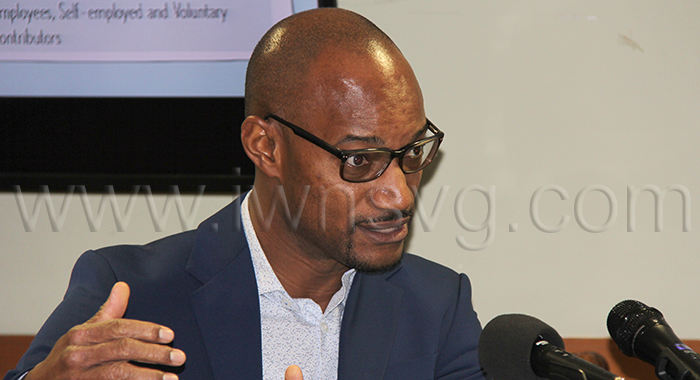

Executive Director of the National Insurance Services (NIS), Stewart Haynes, says St. Vincent and the Grenadines should have a conversation about national health insurance (NHI) and not dismiss it out of hand.
The New Democratic Party (NDP) administration elected on Nov. 27 has promised to implement NHI, while the Unity Labour Party, which it replaced, dismissed it as unfeasible.
However, Haynes, an actuary, noted on Boom FM that while the NIS is celebrating its 39th anniversary, the questions being asked about NHI now are the same ones asked about the NIS in the mid-1980s when it was introduced.
Haynes said he discussed the NHI with Prime Minister Godwin Friday, who is also minister of finance, during their first meeting after the NDP came to office in November.
“He gave a compelling narrative around it. And I noticed his narrative, and I raised some policy points for consideration,” Haynes said.

He mentioned the objectives of an NHI, benefit packages, and national demographics and economics.
Haynes said that the NIS does not have a position on NHI. “The Stuart Haynes position, informed by my experience in the business, is that let us get what we call a steering committee…” Haynes said, noting that some studies were done around two decades ago and should be updated.
“Let us engage in the conversation. Let us engage in the feasibility assessment to see how we can package this NHI,” Haynes said.
He said Grenada assessed but did not implement NHI, and St. Kitts and Nevis is thinking through an NHI programme.
“So let us engage the debate. Let us get the data, let us get the views, let us get the policy perspective, let us set up a steering committee, around it, a think tank around it, then let us go in a direction that best suits the people of St. Vincent and the Grenadines,” Haynes said.
He said that in considering NHI, policymakers must first determine what they want to achieve or avoid.
“What are my policy objectives? Is it quality? Is it access? Is it affordability? … Once we get our objective, what we will do is design strategies to achieve the objective,” Hayne said.
He, however, said the strategies designed for healthcare must consider demographic and economic realities.
“Those are the two driving variables in terms of how our government should package its NHI programme,” Hayne said, adding that the government also has to determine whether an NHI programme would cover primary, secondary and tertiary healthcare.
“There should be a firewall between NIS and NHI funds. The guidance around the NHI is that we work on strengthening the governance and the administration,” Haynes said.
“So, we should entertain the conversation of how to set up a mechanism to improve access, improve quality of service and also the affordability. So this conversation is necessary. Then we have to think through the how.”
He said NHI, as a vehicle to meet a policy objective, could have a different makeup.
“It’s like, ‘So, we work on the governance and the administration to get the healthcare system working efficiently. And after we get that, we work on how we pay for it; how we finance it.
“So, I think it’s a very good time for us to have the debate around it.”
He said his conversation with Friday was “very dynamic”.
“… it’s a policy initiative that we have to wrap our heads around,” Haynes said, adding that he could see himself contributing to the conversation because it is in line with his expertise in actuarial science.
“… it’s only fair that we allow it to be assessed based on current information and providing necessary data and information and guidance and benchmark to guide in terms of how we actually design the vehicle for that,” Hayne said.
“… so, a policy frame is there as a government, but the technocrats now will provide the necessary information and data to basically shape and design the policy.
“So, they will tell you where you want to go. The technocrats will tell you how you can get there, the feasibility of it…”
Haynes said former prime minister Ralph Gonsalves’ position on NHI was based on years-old information, which suggested that it would be too costly.
“But you see, the cost is a function of what you are providing. So based on the package that was offered then, I believe the PM perspective was on that,” Haynes said.
“NHI could be where … we set up a body to treat with the governance and administration, and we leave finance in the same or so forth and so on.
“So, you would have to get the details, the policy objective, and what we want to achieve before technocrats like me can give advice. I could give a general blanket comment around NHI but there’s no one-size-fits-all under NHI.”
This is a strategic and excellent move for SVG. I truly hope it is realised. Now, we must also turn our focus to the economy, where significant potential remains untapped.
Stu surely knows how to toe the lines to keep his big job!
Are the people willing to pay more taxes?Tax,tax ,vat, productivity, low unemployment equals NHI. I am confident the government can do it..show Ralph how it’s done.