



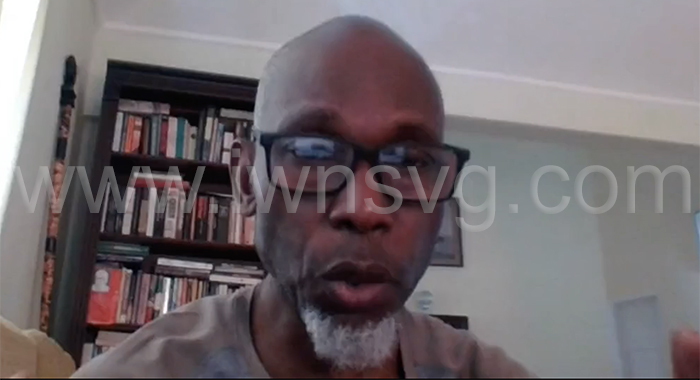

Lawyer Jomo Thomas has questioned the constitutionality of people who qualify for National Insurance Services pension (NIS) having to wait for years after they retire to begin to receive a pension from the state-managed social security agency.
Reforms of the NIS that began in June 2024 will see the contribution rate rising from 10-15% through 2026.
The changes to the social security agency have seen retirees waiting up to three years to receive their pensions, and some may have to wait up to five years when the pensionable age reaches 65 in 2027.
If retirees were to collect their pension early, they must forfeit 6% of it for each year before they reach retirement age.
Thomas, an activist and social and political commentator, raised the issue with NIS Executive Director Stewart Haynes on Boom FM during a media appearance to mark the social security agency’s 39th anniversary.

“I always wondered about the constitutionality of this NIS plan, where people retire at 60 and you pay them five or six years later. I mean, that has to be legally questionable,” Thomas said.
Haynes said his understanding is that the pensionable age differs from the retirement age.
“And you can guide me, but in our research, we don’t think there’s a national retirement age. I think it’s a practice, developed from the government, around 60.”
He said that in St. Lucia, the pensionable and retirement ages are the same.
Haynes, however, pointed out that the NIS is a statutory entity and its operations are guided by the relevant laws, adding that laws are subject to change.
“And because this system is so critical to lives and livelihood, then you have that parameter in terms of where you can make changes to enhance the sustainability,” he said, adding that around the world, there is deviation between the pensionable age and the retirement age.
“I mean, from a policy perspective, we would like it to be aligned. … but I think the focus for us is around ensuring that we can pay these pensioners, we can replace the income of the insured person when there’s a situation that causes a stoppage of income, so the sustainability of it is key for us.”
He said changes at the NIS will be guided by demographics — in the case of the retirement age — and also the economy.
Haynes, an actuary, said the NIS is like a sue-sue hand — an informal arrangement in which people contribute an agreed sum of money to a pool (the “hand”), which is given to each member in turn at agreed intervals.
Haynes also pointed out that the NIS is intergenerational, adding that he is contributing, but his mother is a NIS pensioner.
“So every month that I contribute, that money is used to pay my mother. My daughter is in school. When she enters the workforce and [I reach] retirement, her contribution will pay me,” Haynes explained.
He said social security aims for intergenerational equity.
“So you would adjust parameters like contribution rate, for instance, retirement age, so that you, as much as possible, … equalise the burden across generations,” Haynes said, adding that it is a challenging dynamic.
However, Thomas countered that while he understood the policy, his question was about its constitutionality.
“I don’t want to be ambulance-chasing, but I wish somebody could challenge that, because that can’t be right,” the lawyer said.
“You can’t ask me to pay my money in for 20, 30 years, and then I am thrown out of my job, and you tell me that I have to wait five years before I can start collecting,” Thomas said.
“And worse, there’s a facility where I may get it before, but if I attempt to get it, I am penalised harshly. That has to be unconstitutional.”
He noted that property is a constitutional right, protected by Section 6 of the Constitution of St. Vincent and the Grenadines.
Thomas said that he is entitled to collect a pension in the United States.
“I elected to wait until I’m 70 before I can collect it. But for each year I leave it there, I get interest on what I should get,” he said.
“In St. Vincent, the converse is true. I’m leaving my money there, and I’m not getting anything more on it, but if I try to get it earlier, before 65, I’m penalised. That can’t be right,” Thomas said.
He further said that there is no retirement age in the United States and a 70-year-old person can be collecting three pensions and still working.
“But from the Social Security standpoint, when you get to 60, you’re entitled to Social Security and other benefits, and if you don’t collect it, it compounds; you’re not penalised,” Thomas said.
NIS is a “legal” ponzi scheme! I hope its challenged.
I am not too sure, if Jomo Thomas said, “but from the Social Security standpoint, when you get to 60, you’re entitled to Social Security and other benefits, and if you don’t collect it, it compounds; you are not penalised.” This is not factual! To get Social Security in the US, you have to first have 40 points, paying taxes for ten years, then you can collect earlier, if you’re disable for two years or at age 62 with 20-30 reduction. However, every year, you don’t take it, your benefits increase and you get the maximum at age 70.
But the politicians after 2 termsin office enjoy retirement and more than that pension…where are those politicians care about you the voters..the mood is red
That’s soo sad and heart breaking and harsh That’s wickedness.
Eat grass the years you have to wait to get your pension after you have retired.
It is 8% for every year taken early not 6% as stated in the article
They expect that most people will not live to age 70 you may gorn to the great byound without collecting it that why it was first called a (scheme).
The writer should have done a little more research on receiving Social Security benefits in United States if making comparisons.