




By Ashford Peters
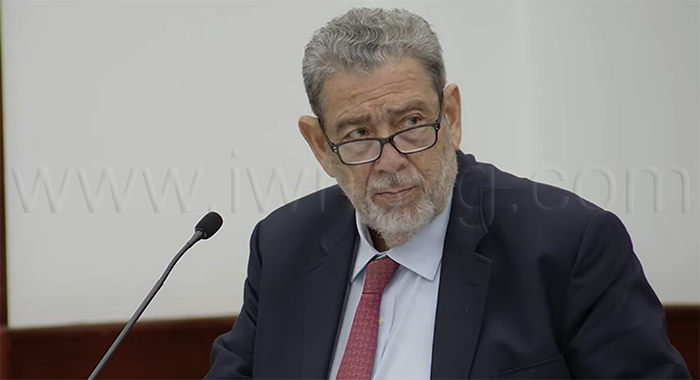
Opposition leader Ralph Gonsalves has again taken a swipe at the New Democratic Party (NDP) administration’s pursuit of the citizenship by investment (CBI) programme.
Debating the 2006 Estimates of Revenue and Expenditure, Gonsalves said the CBI programme is at an end and the government is pursuing an illusion.
“Now, the NDP government wants to sell passports. But he doesn’t know how to do it,” said Gonsalves.
“They have $10 as projected revenue. They created a department in the Prime Minister’s Office. They have no staff, no budget. My view is that they want to outsource this because they’re talking for it for 25 years, but they know they don’t have any plans to do it. And I say, as I’ve said before … the end of CBI is nigh. You looking for a mirage?”

The former prime minister said he will talk a lot about CBI in the budget debate, slated to begin on Feb. 10, the day after the fiscal package is presented.
A CBI programme was a main plank, particularly in the earlier stage of the NDP’s thrust to gain governance.
The party sees it as an important revenue stream that will enable the new government to fund some of its programmes, such as youth employment.
Already, with the NDP administration two months in office, Gonsalves is predicting economic woes, criticising the estimates for this year’s capital programmes.
Further, he suggested that the government will soon face difficulties in paying public sector workers’ salaries.
Earlier on Thursday, the prime minsiter presentes estimates of the EC$1.89 billion, which Parliament went on to approve, paving the way for the Budget on Feb. 9.
The opposition leader pointed out that the capital programme is EC$270 million — EC$4 million less than the revised estimates for 2025.
“That’s why I said you’re not going to have this budget providing a lot of economic growth,” Gonsalves said.
“Because you’re going for a lot of small things in communities, as useful as they may be, you’re not going to be able to fund them, because the funding source, you don’t have it up front, and it’s going to take time if you can raise 200 million at all, and I doubt it.
“And I want to predict further, because of all of what I’m telling you, … you’re gonna have problems paying salaries on a monthly basis and taking care of important bills,” Gonsalves said.
He told Parliament that Deputy Prime Minister St. Clair Leacock understands the situation.
“He’s not involved with you all, with this triumphalist thing. The Honourable Deputy Prime Minister knows what I’m talking about now,” Gonsalves said.
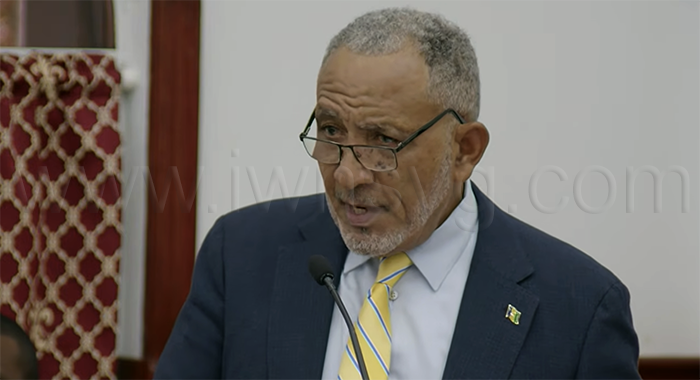
Following his party’s overwhelming victory at the polls on Nov. 27, Friday said this country’s active participation in the CBI programme is “very realistic” and that plans for the programme were already in train.
The CBI programme has, over the years, drawn fire from the former Gonsalves administration, which had described it as a matter of “selling passports”.
The Gonsalves government had raised concerns about the programme’s potential to attract from international destinations unscrupulous people who might want to abuse the Vincentian passport’s visa-free travel to certain destinations.
On the matter of readiness of the programme, Friday said it is “not just launching, it will be up and running…
“We’ll have a programme in operation and we will have revenue coming from that programme in 2026 … before the end of 2026,” the prime minister said.
Friday, whose NDP was returned to office after 24 years in opposition, having lost in 2001 to the ULP, said the NDP had been “planning for this for some time…
“So, we’re not hitting the ground in mud. We know where we’re going on this,” Friday said.
Amid criticisms and challenges, the prime minister acknowledged that while his government was coming late into the game, they had the experiences of the other countries to draw upon and they “can look at best practices”.
“We know now that the Eastern Caribbean Central Bank has also taken on a role as a regulatory agency for these programmes. So, it gives us more of a definite guideline as to where we ought to be going. And there have been consultations with EU representatives … regionally.
“We speak about CBI programmes as though this is a Caribbean regional thing. This is a worldwide phenomenon. There are different variations of it, but all over the world, you have programmes of this nature. And so, this is something that is not going away,” he said.
Friday said there may be adjustments that can be made to ensure it complies with the wishes and concerns, or the security concerns, raised by other countries.
He said those countries are looking out for their interests, and so countries with CBI programmes will make adaptations to address those concerns.
“I don’t think that it jeopardises the programme in any way,” he said.
In September, the Heads of Government of the participating CBI programmes of the Eastern Caribbean States announced the signing of an agreement to further strengthen the integrity, transparency, and sustainability of the CIP offered by the five member states through the establishment of a regional regulatory authority.
Those reforms were developed through extensive regional and international consultations with CBI industry stakeholders and international partners, including the United States, the United Kingdom, and the European Commission.
The OECS Member States of Antigua and Barbuda, the Commonwealth of Dominica, Grenada, St. Kitts and Nevis, and St. Lucia had over the past two years, engaged in intensive dialogue with global partners and have agreed to the adoption of region-wide principles that reaffirm the legitimacy and necessity of CIP revenues to small island economies.
Among key provisions were: the establishment of a Regional Regulator where the OECS Member States were tasked with the responsibility to enact the enabling legislation to establish the Eastern Caribbean Citizenship by Investment Regulatory Authority by October 2025. The body has responsibility for overseeing all CBI/CIP activities, ensuring uniform standards, rigorous oversight, and compliance across participating States.