




By Ashford Peters
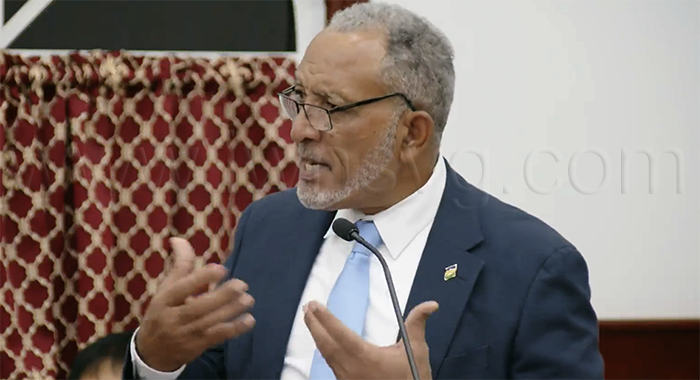
Prime Minister Godwin Friday presented, on Monday, the “dismal” report card on the Ralph Gonsalves administration, which Vincentians voted out of office on Nov. 27, after 25 years at the helm.
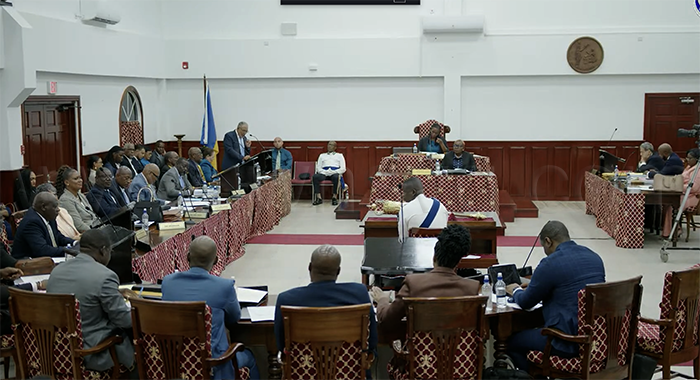
Presenting his first budget to lawmakers, Friday, who is also the minister of finance, said that St. Vincent and the Grenadines (SVG), under the Gonsalves-led Unity Labour Party (ULP) administration, was “heading in the wrong direction”.
He said the EC$3.5 billion in public debt, equivalent to 110.3% of GDP and requiring “nearly 40 cents of every dollar of current revenue to service.
Speaking about the country’s economic performance and its prospects, Friday said the previous government’s “report card on generating sustained economic growth is dismal” and has been “often less than what is required to accommodate population growth and persons entering the labour force under such circumstances…

“This restriction is the dismal state of affairs that our government has inherited and which we are tasked with correcting. And that we shall with policy, goodwill, grit and determination, and by calling for all hands on deck,” Friday said.
The Vincentian electorate rejected the ULP administration after almost a quarter-century of governance. Friday said that during the party’s tenure, the average annual real GDP growth was 2.2%.
This compares to an annual average growth rate of 5% of GDP during the New Democratic Party’s (NDP) time in office — from 1984 to 2001.
He said that while the economy demonstrated resilience recently against the lingering effects of COVID-19, the eruption of La Soufriere volcano in April 2021 and the devastation by category 4Hurricane Beryl, which devastated the Grenadines on July 1, 2024, real GDP growth moderated at 4.4% in 2025 from a strong performance of 5.2% in 2024, according to the International Monetary Fund’s World Economic Outlook.
The prime minister said the people, having confidence in the NDP, elected his party in a landslide 14-1 victory, delivering a clear mandate in a wide call for change, placing upon the NDP “a sacred responsibility to restore fairness, justice, freedom and prosperity for all”.
Friday said he was mindful of the weight and significance of this matter as only five ministers of finance — Robert Milton Cato, James Mitchell, Arnhim Eustace, Ralph Gonsalves and Camillo Gonsalves — have preceded him in delivering the aggregate of budget addresses that have shaped the journey since the nation’s constitutional independence on Oct. 27, 1979.
He also noted that it is the first time in over two decades that a leader of the NDP was standing before the Parliament “to steer the fiscal direction of this country”.
The prime minister told lawmakers that he was mindful that the fiscal leadership of the NDP is not merely a matter of fantasy but a “matter of history”.
“When our then leader, Sir James Mitchell, took office in 1984, he inherited a fiscal landscape that was significantly strained. The outgoing Labour government had left our country grappling with a high debt to GDP ratio, inefficient state-run enterprises and stagnant productive sectors of the economy,” he said.
Friday said the NDP government’s challenge then was “much as it is now”, to “restore investor confidence and stabilise the national budget without triggering a social crisis.”
He said that between 1984 and 1989, the Mitchell-led NDP government implemented a strategy of prudent conservatism, moving away from the heavy state interventionist model that had failed.
“The foundation of that structure remains central to our philosophy today,” he said.
Friday outlined a number of fiscal policies, including strategic tax reform and decisive debt restructuring, which led to “a remarkable turnaround in our nation’s creditworthiness”.
He said that by 1989, the then NDP administration had “successfully turned persistent budget deficits into surpluses, which were then reinvested into the critical infrastructure…
“We did not just correct the books; we laid the groundwork for a decade of sustained growth. Today, we return to those principles with truth, courage and hard work to build truly and finally, one nation together,” the prime minister said.
As he exposed this country’s dismal fiscal condition, Friday said for too long, “the true state of our nation has been obscured by classic statistics that do not match the lived reality of our citizens today”.
On the matter of international and regional economic development, Friday said that as a small island developing state, the economic fortunes of SVG are “inextricably linked to developments beyond our shores, the performance of our major trading partners”.
He said the United States, Canada, the United Kingdom and the European Union have direct and powerful implications for domestic economic activity, influencing tourism, demand, prices, foreign direct investment, remittance inflows and access to external financing.
He said that, according to the IMF World Economic Outlook released in January, the global economy is expected to grow by 3.3% in 2026, broadly in line with 2025 growth and an upward revision from earlier forecasts.
He told Parliament the outlook reflects the balance between persistent downside risks, including geopolitical tensions, trade policy uncertainty and shifting immigration regimes in advanced economies, and supportive factors such as increased investment in digital technologies and artificial Intelligence, more accommodative financial conditions and continued fiscal support in key economies.
“Global inflation is expected to ease in the near term, driven by softer demand and low energy prices for St. Vincent and the Grenadines. These external conditions form the economic climate within which we must operate, shaping tourism receipts, imported inflation, remittance flows and the cost and availability of external financing in the year ahead,” Friday said, noting that in 2025, economic growth in the major diaspora markets remained subdued.
He said the United States grew by 2.1%, Canada by 1.6% and the United Kingdom by 1%.
He said that despite this growth, remittances to this country declined by 3.7% to EC$236.78 million following minimal growth in the previous year.
“This decline reflects the lived reality faced by Vincentian households abroad, rising living costs, changing labour market conditions and increase uncertainty surrounding immigration policies, particularly in the United States,” he said, adding that looking ahead in 2026, growth in the United States is expected to be moderate, while Canada’s growth is forecast to remain flat, and the United Kingdom to slow slightly.
“In this environment, the outlook for remittance recovery remains uncertain, underscoring the vulnerability of this critical income stream,” he stated.
Friday said that at the regional level, the IMF projects that Latin America and the Caribbean will grow by 2.3% in 2026, marginally lower than the growth recorded in 2025.
He said tourism-dependent economies within CARICOM, including SVG, are projected to grow more modestly, reflecting capacity constraints and the lingering effects of recent storms.
Friday said that, similarly, the Economic Commission for Latin America and the Caribbean (ECLAC) projects regional growth of 2.3% in 2026, noting that the outlook remains constrained by weak investment, low productivity growth, sluggish labour markets, and persistent inequality in the Eastern Caribbean Currency Union (ECCU).
He noted that the IMF projects growth of 2.6% in 2026, following 3% growth in 2025 within the currency union.
The strongest performances are expected in Dominica and Grenada, with SVG projected to grow by approximately 2.7%.
Friday noted that the region continues to benefit from tourism demand and high construction activity.
He said challenges remain acute, as elevated inflation, high shipping costs, and continued exposure to external shocks underscore the importance of prudent fiscal management, economic diversification, and resilience-building at home.
“It is against this complex and uncertain international and regional backdrop that this government presents its fiscal and economic strategy anchored in realism, discipline and the determination to strengthen St. Vincent and the Grenadines’ capacity to withstand external shocks while securing sustainable growth for our people,” the prime minister said.
Speaking about tourism, a main pillar of the country’s economy, Friday said the performance was strong in the number of stay-over visitors, with the number surpassing 100,000 for the first time in 2024, finishing the year with 101,471 registered.
He said the momentum continued to 2025, with third-quarter stay-over visitors increasing by 14% year on year.
He said that by September 2025, stay-over visitors had reached 81,025, a notable increase from the 71,000 recorded during the same period in 2024.
“Our country has sought to stabilise and expand our global air connectivity through measured engagement with both new and established carriers,” he said, adding that the increase in arrivals was supported by the entry of five new airlines — JetBlue, 2020, Win Air, Sunrise airline and Delta Airlines — which have significantly improved regional and international access.
“These partnerships pair with the entry of new hotel stocks such as Sandals and Holiday Inn have provided a necessary buffer against external shocks and provided a platform for sustained activity,” he said.
Friday said his government remains committed to a development strategy that makes tourism a pillar of the economy.
“This will involve steady and sustainable development of the sector to establish St. Vincent and the Grenadines as a premier travel destination,” he said.
Tourism activity is expected to remain a primary driver of the country’s economy in the near and medium term as the government continue to manage the sector with a focus on accelerated growth and long-term viability, the prime minister said.
Well, I hope all goes well, but watch out for the IMF and World Bank loans; they are designed to cripple your economy and keep your people poor. They are working for the US dollar hegemony. Turn to China and the BRICS. They are much more favourable.