




By C. ben-David
Many Vincentian commentators, including politicians, community activists, and the general public, continue to blame Cuba’s past and present economic adversities, such as low wages, constant hunger, and poor housing, on the United States economic embargo, often called “el bloqueo” (the blockade) by Cubans.
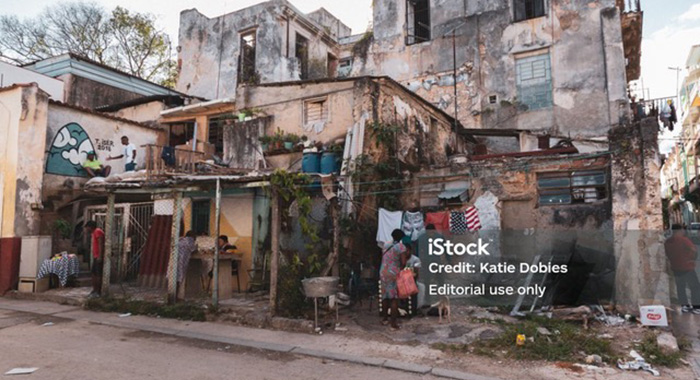
Typical housing for ordinary Cubans
Though this trade blockade consists of a comprehensive set of economic, commercial, and financial sanctions first established in the early 1960s, this has not prevented Cuba from trading with other countries, something it has done throughout its history.
The only current constraints are the loss of most aid and other concessions from its traditional patron, Russia, and the fact that post-revolutionary Cuba has always been on the brink of economic collapse because of destructive collectivistic economic policies, incompetent political administration, and the migration of its best, brightest, and most productive citizens, a feature we also suffer from.

Still, it is the longest-standing trade embargo in modern history, so continues to draw much international attention, even though most of its causes are rarely mentioned or downplayed by its detractors.
The initial trigger for the blockade was the illegal nationalisation of US property in 1960, featuring the Cuban government’s seizure of American-owned assets. After the 1959 revolution, Fidel Castro nationalised oil refineries, sugar mills, and utilities — most without a cent of compensation to their mainly American owners.
This seizure remains a legal hurdle to this day: the U.S. Department of State notes that roughly US$7 billion to US$8 billion in proven claims for stolen property must be resolved before the embargo can be fully lifted.
A second reason for the blockade was a reaction to the Cold War, with the US aiming to isolate the Castro regime to prevent the spread of Soviet influence and communism in the Western Hemisphere.
In particular, Cuba began purchasing Soviet oil and armaments in 1960. In 1962, the Cuban Missile Crisis, based on the discovery of secret Soviet nuclear missiles on an island a mere 90 miles across the Florida Straight, prompted President John F. Kennedy to expand the partial trade ban into a full embargo to reduce the threat to hemispheric security.
In recent decades, the justification for the blockade shifted toward forcing political change to free the Cuban people from the oppressive yoke of communism. Laws like the Cuban Democracy Act (1992) and the Helms-Burton Act (1996) codified the embargo, stipulating that it can only be lifted if Cuba meets specific conditions, such as legalising all political activity and holding free elections; releasing political prisoners; and respecting freedom of the press and labour unions.
Our own Vincentian supporters of the current Cuban political system should tell us whether they would support such restrictions and oppressive conditions in our beloved homeland.
The US has also designated Cuba as a state sponsor of global terrorism multiple times (1982–2015, and again from 2021 to the present).
As far as immediate justifications for the embargo, reasons our political and activist critics are now focusing on, is the American governments concerns about Cuba’s continued support of the current regime in Venezuela, a thoroughly corrupt government that has stolen two elections in a row, is currently harbouring US fugitives, and has close ties to Russia, China, Iran and other bad actors.
Political considerations, particularly in Florida, also continue to play a significant role in maintaining the blockade. The large and influential Cuban-American constituency often supports a hardline stance to punish the Cuban government, a regime that made life for them in their homeland intolerable. This makes any attempt to lift the embargo a sensitive political issue for both the Democrat and Republican parties.
Fast forward to February 2026: the embargo is now a “total pressure” policy under the second Trump administration, which has recently implemented an oil blockade to isolate further the island’s tourism and energy sectors.
Only time will tell whether this pressure will prompt the people of Cuba to rise up and take back their country from its oppressive and crooked Marxist leaders.
The opinions presented in this content belong to the author and may not necessarily reflect the perspectives or editorial stance of iWitness News. Opinion pieces can be submitted to [email protected].
How can someone with no Cuban heritage or connection to the island position themselves as a spokesperson for its people while advocating for U.S. intervention in Cuba reminiscent of actions taken in Venezuela and Haiti? To me, that individual is devoid of substance—an empty vessel attempting to channel imperialistic ideologies, invoking a distorted sense of destiny to justify the subjugation of smaller nations.
This piece is truth and accuracy served up with craft. This would, no, should, make the dimly lit look for a carpet. Or the sand.
Birds of a feather, flock together.