




By Ashford Peters
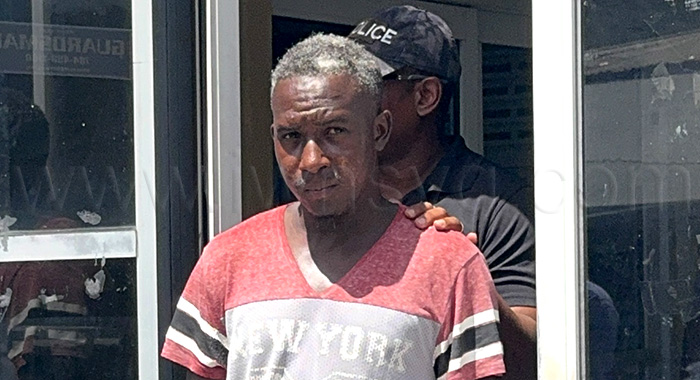
Lowmans Bay resident Sebastian Audain was spared a possible prison and or financial penalty Thursday, his 36th birthday, in a dramatic turn of events when he appeared in court on cocaine charges.
District magistrate John Ballah entered a formal plea of “not guilty” to charges of trafficking and possession of 22.9 lbs of cocaine brought against Audain, vacating a guilty plea he made on Wednesday when he appeared before the Family Court, which sat as an open court then.
Information presented as “facts” by the prosecution before the Layou Magistrate Court on Thursday morning suggested rights violations and procedural irregularities in the investigative process.
However, Audain, aware of the irregularities, admitted his own prejudice, making his plea of “guilty” equivocal before the court; hence, the magistrate vacated the guilty plea and ordered a trial.

The turn of events began when, after Audain’s lawyer, Jomo Thomas, was put on record, lawyer Grant Connell, who is representing a co-accused, Alvin Cyrus, of Largo Height, rose to address the court on a matter of improper procedure.
Connell said that “the entire procedure that you now put the defendant is what is lacking”.
He was referring to Ballah’s explanation to Audain, in keeping with the 2026 criminal procedure guidelines, about his rights and obligations during the hearing.
Connell said he was not advising Thomas, who is his senior, but “in my case, I was present at the police station”, and within half an hour of leaving the station, a police officer “took my client back into the interview room and did an interview in my absence, and got an admission in my absence”.
Connell said that at the time of his arrest, Audain was represented by lawyer Charmaine Walters. He said police took Audain into the room “and did an interview in her absence”.
Connell reiterated that he was not advising Thomas but was “just suggesting” that “this case should be located in the interest of justice”.
Connell said the prosecution “will meet my challenge when they bring my client to court.”
He told the court he “can’t sit here, knowing the factual matrix of what the police did” to the two accused, “and just have the prosecution go through the sentencing guidelines…
“I mean, it would be a travesty of justice,” Connell said.
The prosecutor, Shamrock Pierre, responding to Connell’s comments, said while he agreed that “there was a second interview, the defendant was the one who elected to do that interview in the absence of his lawyer, after his rights were read to him”.
Pierre said Audain was “not represented” by counsel Thomas at the time.
The prosecutor said he was “surprised that counsel Connell did not raise this issue with counsel Thomas before he came to court”.
“I’m not sure if he’s trying to put on a facade. But counsel Thomas is present right here, and here, Mr. Connell is now behaving as if he’s representing the defendant.
Connell fired back, saying he just wanted “to defuse what ignorance the prosecutor is telling this court”.
He said “the only question you ask, in the absence of the lawyer, when the defendant chose to admit in the absence of the lawyer, ‘Who is there acting in the interest of the defendant?’”
Connell raised the question of having a justice of the peace in the absence of a lawyer.
Initially, Thomas told the court his client was maintaining his guilty plea. He said he supported much of what Connell said.
Thomas said it was police practice to take accused persons to a police station, have them say one thing, and then subsequently change their plea.
Thomas agreed with Connell that on the matter of the interview and statement, an accused person should have a lawyer present.
Thomas, who replaced Walters as the defence lawyer, told the court that he did not “poach” his client.
Thomas said he came to court to enter a plea of mitigation, as his client had pleaded guilty to the charges.
At that point, Magistrate Ballah stood the matter down for Thomas to consult with his client.
There was no room for the lawyer and his client to consult privately. They stood aside, a few feet away from the bar table, speaking in very low voices.
When the court resumed, Thomas told the magistrate: “I have to withdraw my statement, which says we are united on the issue of facts. Because, based on what was said back and forth , much of that is stripped from the facts, as I have read and you as well”.
Thomas said the genesis of the drug on the Vincentian market is from the deadly military strikes.
The lawyer said he did not know whether the prosecution was prepared to admit the other set of facts, which he was aware of because, based on his instructions, his client took a particular course of action where he helped the police by leading them to the drug.
The magistrate then asked the prosecution to read the facts of the case.
After the prosecutor read the facts, Thomas told the magistrate that the facts before the court did not properly address the issue at the court. He said much of the record had to do with electronic interviews.
Thomas contended that “extreme pressure” was placed on his client to disclose what he disclosed to the police.
Having listened to what the prosecution presented to the court and the concerns expressed by defence counsel, Ballah replied: “I think the safest thing to do is to vacate his plea. Counsel, I think that is the safest thing to do.”
Ballah said there were “issues of voluntariness, and whether or not the evidence the police have, will be admissible in any court”.
Audain was granted bail in the sum of EC$25,000 with one surety.
As part of his bail conditions, he was ordered to surrender his travel documents and to report to the police every Monday and Friday until the matter is disposed of.
The court has ordered that stop notices be placed at all ports of entry and exit.
When all is said and done,the US is sending us a message. Lets bring up all kinds of laws and rights,perhaps the individuals would be set free. Perhaps ,because leniency won’t serve as a deterrent, we won’t get the message.
Vacating guilty plea commendable; no guilty plea magistrate
Few who sits on the bench in the magistracy, understands such long-established, but least practiced ‘magisterial principle.
Most certainly, trial magistrate, his honour, John Ballah is not a guilty plea magistrate.
From professional knowledge and experience, full trials bring out evidence tested through cross examination and re-examination while guilty pleas only allow for the prosecution to give untested brief facts.
Trials make magistrates more rationally competent while police/crown prosecutors, become more prosecutorially proficient.
Best regards to attorney-at-law, Grant Connell.
Question:
Is the magistrate a relative of Clem Ballah (biabou)?