



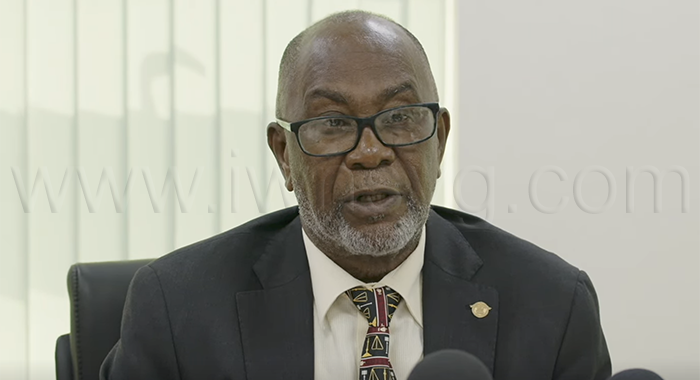

Deputy Prime Minister and Minister of National Security St. Clair Leacock has announced an amnesty from prosecution for people who turn over to the police cocaine that they find floating at sea.
At least two people have been charged with drug possession and trafficking in relation to cocaine that they allegedly found at sea, reportedly as a result of the missile strikes by the US military in or near Vincentian waters on Feb. 13 and 16.
Leacock made the announcement on New Times, the ruling New Democratic Party’s radio programme on NICE Radio on Monday.
He reiterated the position that he had taken in opposition, saying that St. Vincent and the Grenadines must be a second-chance society.
Leacock belaboured the disrespect of the United States, saying that almost two weeks after the military actions in SVG’s exclusive economic zone, Washington had not informed Kingstown about it.

“… The minute we got the news of the ship being blown out to the waters and all the collateral damage to come thereto, … simultaneously, I get a phone call from one of my best supporters: ‘Major, I in trouble. I have a problem. I was fishing in the area I came into possession of so, so, so, and I took it away, and now I’m being arrested.’”
Leacock, who is into a fourth five-year term as MP for Central Kingstown, said that was a situation that the person created.
“But the police also have to do their work. Now, have we got all of the have we got all of the stuff that’s come out of the sea? I don’t know,” he said, noting that people have been charged in connection with cocaine that they allegedly found floating at sea.
“Now we know what having a lot of drugs about the place could mean. If people know you have drugs calling and a large quantity, the wrong guys could come and get the drugs, or the police could come to get the drugs,” Leacock said.
“I think you would prefer that the police come and get it than the wrong guys coming, because people will use different methods to get it.
“So, we have an approach. Just like we had a gun amnesty, for example, where they bring in their gun and no question asked, we take your gun and go, if you came into possession of any of that coke on the high seas now and you wanted to call someone to help you do it, or you feel you could get into the police safely, they’re not going to pursue you.”
The national security minister said he had heard the discussion on the radio recently, with some people suggesting that the drugs could be viewed as an opportunity to get rich fast.
“But then if you go down that road, you should know that you’re making up your mind that you’re going to do things unlawful,” Leacock said.
“But here’s an administration that’s making this easy to say, ‘Look, this is not of your making, these are the circumstances that emerge. You show your willingness to be in cooperation with law enforcement agencies. Get it off yourself. And we say, Go your way.
“We run that by the police high command and they’re on board with that. They actually wanted to tie the two things up, amnesty for drugs and amnesty for police. I said, ‘No, no, separate the two of them. Separate the drug amnesty from the police amnesty.
“So, you’ll find that the police will be encouraging you to do that. You could make a judgment whether it’s a good thing or a bad thing, or people may have other views, but that’s one aspect of how we are seeing it.”
Leacock described his government’s approach as “a soft touch to what could be a hard and serious problem”, saying, “ultimately, what we want is not mayhem on the streets of St. Vincent and the Grenadines and turf war for who have, who don’t have and so on and so forth”.
Last week, Leacock urged fishers or sea-bather who find cocaine at sea on along the islands’ shorelines to report it to the police.
His amnesty announcement came four days after lawyer Grant Connell proposed an amnesty for people winning “the sea lotto” as he said the cocaine finds were being described.
Connell and Jomo Thomas are representing fishermen Sebastian Audain, 36, of Lowmans Bay and Alvin Cyrus, 36, of Largo Heights, who are due back in court on March 2 in connection with possession and trafficking relating to 22.9 pounds of cocaine that were allegedly found at sea after the US military strike.
Connell has essentially warned that the “sea lotto” can mean set for life, set for death, if not jail time.
In two recent press releases, the US Southern Command confirmed two deadly strikes on two vessels that killed six “narco-terrorists” in the Caribbean Sea but did not specify locations.
Authorities and fishermen, however, have confirmed two strikes in SVG’s waters.
“It’s no secret. It is one of the many ramifications of the vessels being blown up. We all know what it is, the remnants of those ships being blown up, coming to our shores, falling into the hands of the fishermen,” Connell told the Layou Magistrate Court Thursday as Audain appeared for his drug charges.
“… this sea lotto they’re talking about should really have some sort of amnesty. Because it’s riddling our land, it’s everywhere … a lot of fishermen have it … If one set of criminals meet you, you end up on a charge, and you end up in jail. If the other set of criminals meet you, you most likely end up in the graveyard,” Connell said.
How convenient: the US military blows up fishing boats and kills people, then SVG finds cocaine floating in the high seas. Yeah, I believe you! Yeah. The SVG Coast Guard can rest easy now, yeah!
What’s a police amnesty¿