



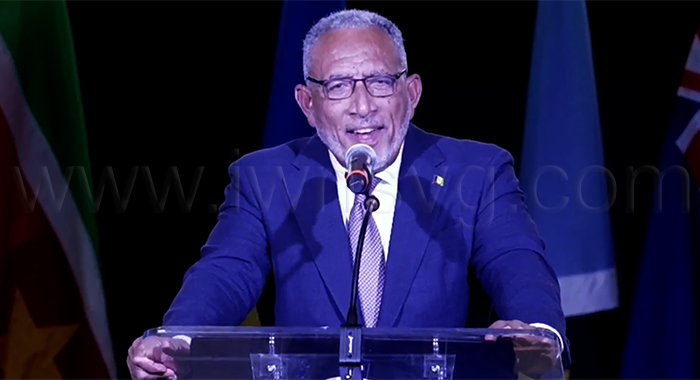

Prime Minister of St. Vincent and the Grenadines Godwin Friday delivered his inaugural address to a meeting of Heads of States and Government of the regional bloc, CARICOM, pledging Kingstown’s continued support for the regional integration movement.
“I am delighted to be here at this vitally important event, at such a critical time for our region,” the Vincentian leader said on Tuesday during the opening ceremony of the 50th Regular Meeting of the Conference of Heads of Government of the CARICOM, in St. Kitts through Friday.
Friday pointed out that the November polls was the first time that Vincentians had elected a new government in almost 25 years.
“And the people gave us a clear mandate to govern. It was an emphatic win,” said Friday, a sixth-term MP who led the NDP to a 14-1 victory over the Unity Labour Party.
“So here I am as a new head of government, a new face at this conference. I may have much to learn about how things are done in this body and across the organs of CARICOM, and about how perennial issues have been addressed over the years and where they stand now,” Friday said.

“But I hope being new on the stage, I am unfettered by the trials and the frustrations of the past, and might bring some small insight or added motivation that might help us to move forward.”
CARICOM’s newest head of government said it seemed to him “that any serious consideration of the subject of regional integration and CARICOM place in it begins with the familiar lament about the agonisingly slow pace of forward movement and the elusiveness of unity and collective action, especially in international affairs.
“Over the years, we have come to near breaking points, words have been exchanged amongst leaders, meetings have failed, or even failed to take place because of an inability to agree on critical matters or a lack of will.”
Friday said that for this, CARICOM has been marked at times as being “Carigone” than CARICOM.
“Yet here we are. CARICOM survives and the spirit of regional integration persists and indeed grows and other countries seek full membership or associate membership in the organisation.
“Consider that despite all the tensions and problems over the years from the Closer Union Conference of 1949 in Jamaica, through the ill-fated West Indian Federation a decade later, then CARITA, and ultimately our much maligned but still beloved CARICOM, the integration spirit has endured.”
The Vincentian leader said that for those who may ask, the answer is simple.
“… because we need it, and we all know this, we may complain and fight amongst ourselves, but meanwhile, we continue to support and reshape it,” Friday said.
“We remain ever hopeful that it will become more able to address our needs. We do this, not only because of the ties of common history and a shared culture, but fundamentally because we all recognise the inescapable fact that we must have CARICOM or something like it.”
Friday said that if the the Organisation of Eastern Caribbean States of which he is now the chairman, and CARICOM or similar organisations, did not exist, “we would feel their absence and set about working to create them.
“Thankfully, CARICOM remains, but now more than ever, we are being tested,” he said, adding, “We are challenged from inside and out.”
Friday said that the world outside the CARICOM region grows more perilous daily.
“International rules and practices that we have become used to over the years have changed in troubling ways that call upon us to look to one another for support where we thought we could safely rely on familiar roads …” Friday said.
“We must now tread cautiously and manoeuvre as best we can to advance our individual and collective interests, friends. Our persistence on the path of regionalism, no matter the challenges, is the best way forward.
“Let us strengthen our resolve about that, as I intimated above, I am committed to working alongside all of my colleagues, not merely out of sentimentalism, but also because there is no better alternative that I can think of for my country, St Vincent and the Grenadines, and indeed, I believe for all of us.”
Friday said that in the current global realities, “we need each other more than ever.
“If we do not continue to strive together and pool our limited power and resources, we cannot hope to withstand the increasing political and economic headwinds and deliver better living standards for our people.
“That is the central value of our integration movement, the reason we make such an effort just to be here. Through CARICOM, we are collectively better able to stake our claim in an evolving world.”
He said CARICOM should never be so discouraged by its shortcomings “that we fail to see just how much we have accomplished over the years, while we must do better, let us acknowledge that what we have done together has been a lot.
“Indeed, I say, let us shout about it, so that not only the technocrats in government offices across the region, but also ordinary citizens too would know about each step forward, big or small,” Friday said, adding that this will enhance the credibility and the relevance of CARICOM in our respective countries.
“Clearly, we must do a better job of engaging our people in the affairs of CARICOM. What we do here and in other forums must not only be about them, it must also be with them, for that is where our strength truly lies — in the people.”
Friday said that CARICOM leaders sometimes question its purpose.
“But let us resolve that when there are doubts, they be only about how and never about whether we go forward.
And then we can confidently work together on the real issues confronting our people, eliminating poverty and creating prosperity, removing obstacles to commerce, including currency related ones; closing the skills gap in our workforce to meet the needs of our economies and promote employment; confronting climate change and resilience, financing; promoting peace and security in Haiti and our region; addressing the emerging humanitarian crisis in Cuba and Cuba’s place within our Caribbean. friends. “
Friday said he was looking forward to working with his CARICOM colleagues.
“… But, please, let us quicken the pace. The road ahead may be arduous and full of obstacles, but it is a viable path, made even more certain when we decide to walk together. When we hold our neighbour’s hand, now we make the journey easier and safer for those who follow,” the Vincentian leader said.
If you win an election, you have a mandate. If you then leave appointees from the opposing party in key roles, you’re making it harder for your own government to function. This isn’t a church picnic; it’s politics. Keeping people who actively campaigned against you in key positions is a sure way to create obstacles for yourself. You can’t govern the country as a group project or run a government on vibes and moral superiority. Loyalty exists in reality.