



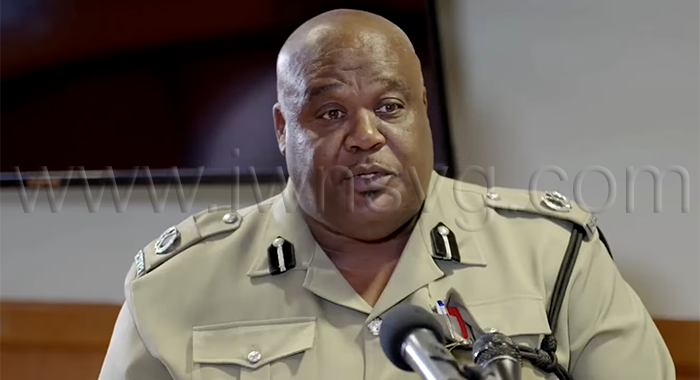

The head of crime-fighting in St. Vincent and the Grenadines, Assistant Commissioner of Police, Trevor “Buju” Bailey, says the country has a responsibility to disrupt the evolving gang culture among its students.
Speaking at the “National Consultation on School Violence in St. Vincent and the Grenadines”, held in Kingstown on Tuesday, Bailey said that in recent months, troubling incidents involving students have forced police to take a closer look at what is happening in and around SVG’s schools.
“They have disturbed, unsettled, and raised difficult questions across the country, and when violence begins to show itself more openly among young people, responsible institutions must do more than react,” said Bailey, an experienced detective.
“We must assess the pattern, speak honestly about the risk, and decide what must change,” Bailey said, adding that from a policing standpoint, school violence cannot be treated as an isolated incident.
“When we examine these situations, we are not looking at fights or isolated acts of defiance. We look at what surrounds it. We look at escalation. We look at repetition. We consider whether behaviour is becoming more organised, more public, more retaliatory, and more resistant to ordinary correction. That is where the concern deepens.”

The senior police officer distinguished between ordinary school indiscipline and “behaviour that points to something more dangerous.
“A child speaking out of turn, breaking a rule, or testing authority is one matter. That has always existed, and schools have long had to manage it,” he said.
“But when we begin to see intimidation, coordinated retaliation, the public display of violence, the carrying of weapons, group loyalty built around fear, and conflicts spilling from the street into school or from school into the street, then we are no longer dealing with indiscipline in the ordinary sense. We are dealing with a developing security concern.”
Bailey said he was referring to “patterns of behaviour that resemble gang culture”.
Among these patterns, he mentioned “group intimidation, pressure to align, retaliation for disrespect, the pursuit of status through violence, and the growing acceptance of fear as a way to control others.
“\Whether that influence is fully formed or still developing, the national duty is the same. We must interrupt it early,” he told the consultation, organised by the Ministry of National Security in collaboration with the police force.
“If we wait until every sign is fully matured, then we have already surrendered valuable ground.”
Bailey, however, said that at the same time, the issue must be approached “with discipline and fairness.
“We cannot afford to make the mistake of branding every troubled child as a criminal. That would be careless, unjust, and harmful,” he said, adding that many young people “are reachable”.
“Many are acting out of immaturity, hurt, poor guidance, or social pressure. Some need firm correction. Some need counselling. Some need stronger boundaries at home.
“Some need intervention before they cross a line that will damage the rest of their lives.”
The senior police officer, however, said that “fairness must not blind us from reality.
“There is equal danger in minimising what is in front of us because the truth is uncomfortable. If law-abiding citizens are too hesitant to name a growing threat, our young people will pay the price for that hesitation. A nation that becomes afraid to speak openly about violent patterns will eventually be forced to confront those patterns under much worse conditions.”
Bailey said this was why the consultation mattered, saying schools are now being asked to bear pressures they did not create themselves.
“Teachers and principals are expected to maintain order in environments where outside influences are arriving through mobile phones, social media, community disputes, peer pressure, weak supervision, and, in some cases, direct exposure to violence.”
He said that by the time some children arrive at school, they are already carrying anger, grievances, fear, or allegiance from outside the classroom.
“No school can solve that alone,” Bailey said, adding that the police have a role and fully accept it.
“We will investigate criminal conduct. We will intervene where intelligence and circumstances require it. We will support prevention efforts. We will work with schools and other agencies to identify warning signs earlier and to act more quickly where risk is building.”
He, however, said that policing alone cannot produce the culture that SVG’s children need.
“A uniform cannot replace parenting. An arrest cannot substitute for moral guidance. A criminal charge cannot repair what should have been corrected much earlier by structure, supervision, and consistent adult responsibility.
“So this issue must be approached for what it truly is: not a problem for schools alone, not a problem for the police alone, and not a problem for one ministry alone. This is a national discipline issue, a family issue, a community issue, and, where necessary, a law enforcement issue.”
He said this means schools must be supported, not left isolated.
“It means parents must be active, alert, and honest about the behaviour of their children. It means communities must stop romanticising disorder. It means state agencies must coordinate, not operate in silos. And it means that when warning signs appear, adults must stop hoping they will disappear on their own.”
Bailey said the warning signs seldom disappear on their own and often get worse.
“If we are serious, then our response must include earlier reporting, better information-sharing, clearer intervention pathways, stronger school support systems, firmer boundaries for violent conduct, and a consistent message to our young people that fear, intimidation, and group violence will not be normalised in this country.
“We also need courage in how we think. Not panic. Not grandstanding. Courage. The courage to identify risk early. The courage to correct behaviour before it becomes criminal. The courage to support schools when they act. The courage to stand with parents who are trying, and to confront those who have withdrawn from their responsibilities.”
He said there was still time to act wisely.
“That is the good news. We are not powerless, and we are not too late. But the window for denial is closing. If we fail to act with seriousness now, then the consequences later will be heavier and more expensive for every institution involved,” Bailey said.
“Our children deserve safe schools. Our teachers deserve orderly learning environments.
“Our parents deserve confidence that schools are places of development, not fear. And this country deserves a response that matches the seriousness of the issue before us.”
He urged that the consultation be more than a meeting.
“Let it be a point of decision. Let it mark the moment when the nation chose to respond with coordination and resolve,” Bailey said.