



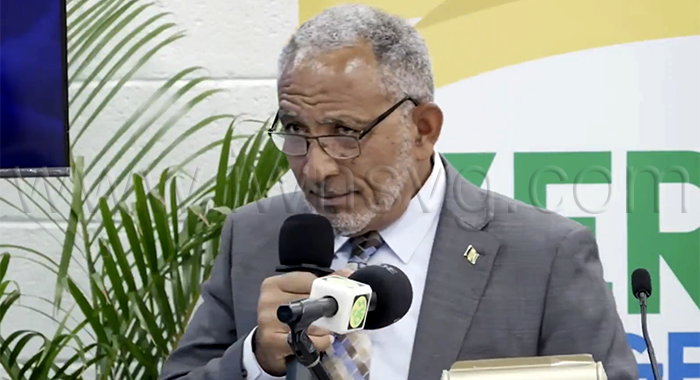

Prime Minister Godwin Friday says that after 10 years in operation, the Zero Hunger Trust Fund (ZHTF) must move beyond ensuring that Vincentians are fed to ensuring that they can feed themselves.
Speaking at a 10th-anniversary event in Kingstown on Wednesday, the prime minister noted the impact of climate change and rising international food prices on food security.
“I don’t raise these issues to dampen our celebration today. I raised them because food security doesn’t exist in a vacuum,” Friday said.
“It is inseparable from employment or unemployment, from economic resilience or lack thereof, from the welfare of our children and our elderly, and from the long-term sustainability of how we grow, distribute and consume our food,” the prime minister said.
“This is why the trust fund exists, and over the next decade, we must become more urgent and more impactful, so that by the end of it, we can say we’ve achieved our objective.

“The plan can’t be that the trust fund goes on in perpetuity with that mission. To do so means that we will have failed,” he said as he outlined his government’s vision for the fund for the next decade, even as he said he would like it to be accomplished in five years.
Friday’s New Democratic Party (NDP) came to office in November after winning 14 of the 15 parliamentary seats.
He noted at Wednesday’s event that the electorate gave his government, “a clear mandate to get St. Vincent and the Grenadines working, that it does so for all the people throughout the country, in every sector of the economy, and agriculture is central to that mandate”.
The prime minister said his administration sees agriculture “not as a legacy industry that we are managing its decline” but one of the pillars on which the government intends to build “a more diversified, more resilient, more prosperous economy”.
He emphasises that the other pillars are the blue economy, tourism, and the new economy.
“Put another way, we intend not just to cope or to react to crises. We intend to build our economy so that we don’t always have to beg and to borrow for everything that we use. We can do it.”
Friday, who is also the minister of finance, noted that in his budget address in February, he committed to the farming community that his government would restore confidence in the agricultural sector.
This means tackling preadial larceny…” he said, adding, “It means investing in the infrastructure, in water systems to improve irrigation and create more productive farming techniques that we can employ here.”
The prime minister said his government’s commitment to agriculture also means “improving and guaranteeing market access, noting that farmers are rational and would cultivate if they know there is a market for their produce.
Friday said the government is also looking for ways immediately to ease the “cost-of-living crisis, which again threatens with the war that is going on in the Middle East, that seems to have no end in sight.
“So, we received a grant of $8 billion from the Republic of China on Taiwan to strengthen social support, and that we have already passed on. We’ve already passed on to struggling families.”
He said his government is also advancing with a $50 million climate resilience-based water infrastructure initiative to create water resilience throughout the Grenadines through desalination and improve storage facilities in St. Vincent.
“And this project will help also with our farming to make it more productive,” Friday said, adding,
“None of this happens in isolation. All of it connects, ultimately, to the question of whether a Vincentian child goes to bed hungry or wakes hungry.
“Nothing pains me more than to consider a situation where a family awakes in the morning and a mother — and it’s usually a mother — you look in the kitchen and you can’t find something to give your children to go to school. That happens far too much in this country.”
He said the work of the ZHT is critical to helping the government deal with this serious social problem.
“So, we’re going to ensure that we continue to work so that no child goes to bed hungry, goes to school hungry, that the elderly persons … have access to nutritious meals so they can live with dignity, that our farmers have the tools, they have the markets and the confidence to keep producing.”
The prime minister said he was happy to see the ZHTF looking ahead to the initiatives that it would like to complete over the next decade.
“… but I’m saying within the next five years,” Friday said, adding, “The Zero Hunger Trust Fund that must be formally integrated into our national social protection and food security operations. It can’t be a project isolated by itself.
Embedding ZHTF into broader policy framework
“My government will work with the fund to embed its operations within the broader policy frameworks of agriculture, social protection, education and economic development,’ Friday said.
“Second, we must close the gap between production and markets for farmers. A channel linking households, producers, farmers, schools, hotels, restaurants and retailers.
“It’s not hard to do. All it takes is to recognise the need for such to have the political will to do it and to mobilise the human resources, the collaboration, the structure that’s necessary to get it done.
“We have the political will. I give you that commitment, and we are committed to building a broad-based partnership to build that coordination that is necessary to move the process forward.”
A third element, the prime minister said, is that the school feeding programme and the school gardens programmes must be strengthened and made permanent.
“When students plant, harvest and eat food that they grow in their own gardens, they are not just being fed. They are learning to see agriculture as a productive activity, as a potential profession. They know where food comes from,” he said.
“That is an investment that pays dividends for a generation.”
The prime minister also said he wants to see more emphasis placed on backyard gardening, adding that the Ministry of Agriculture had always focused first on crops for export “without real care and attention being placed on production in general, whether it’s for market or for one’s own personal use”.
Friday said the Ministry of Agriculture had some of the best-trained people in the public service.
“So, they have to turn their attention to ensure that backyard gardening, where by that I mean subsistence gardening for each household who wants to do it, that the support is there to do it.”
He said that when farmers complain about plant disease, the ministry’s response cannot be,
“‘Well, yeah, that’s a problem we have’ … They should say, ‘Well, listen, we recognise the problem. We will come, send somebody down to look at it, and we’ll find ways to solve it,” the prime minister said.
“So that’s something that will task the Ministry of Agriculture to do much more rigorously, as part of the central, the core mission,” the prime minister said.
“And this is the point that I want to make, food security doesn’t come from stockpiling cans of corn, beef, cooking oil, macaroni. It doesn’t come from creating a warehouse with those things or having well-stocked shelves in the supermarkets.
“Food security comes from producing it ourselves, whether it’s on large farms for exports, or in backyard gardens or in the schools.
“… I say that there’s no excuse for a school, whether it’s primary school, a secondary school, not to have a garden besides the school. I
“ … some of them here, they live in concrete jungles, but you can put boxes and get it done. That was, I say, it doesn’t take, it’s not hard to do. All it needs is for us to have the will, and that, I believe, is something we should do and encourage people to grow more, even for their own needs, and when they have surplus, they can sell,” the prime minister said.