



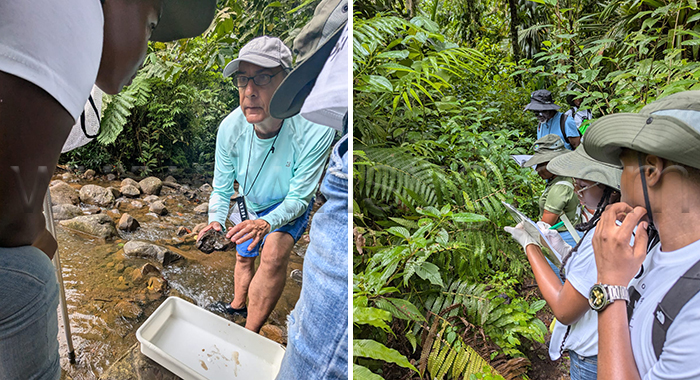

“Citizen scientists” across St. Vincent marked Earth Day 2026 by exploring the Montreal Watershed to document the country’s unique biodiversity as part of the BioSleuths Challenge, a national initiative organised by the Sustainable Development Unit (SDU) of the Ministry of Tourism, Civil Aviation and Sustainable Development in partnership with the United Nations Development Programme (UNDP).
Participants, including students, teachers, technical experts, and members of the public, used smartphone-based observation tools to identify and photograph a wide range of species.
These include plants, birds, insects, reptiles, amphibians, and aquatic life.
All observations will be integrated into St. Vincent and the Grenadines’ national environmental records, strengthening the evidence base for conservation planning and environmental monitoring.
Citizen science initiatives play a critical role in addressing biodiversity data gaps, particularly in small island developing states where scientific resources may be limited. By mobilising citizens as environmental observers, programmes such as the BioSleuths Challenge generate large-scale ecological data while enhancing public environmental literacy and fostering a culture of stewardship.

This approach transforms environmental awareness from passive appreciation into active participation in conservation efforts.
The SDU serves as the national focal point for climate change, biodiversity, chemicals and waste management, oceans, and ozone protection, coordinating environmental programming across government agencies and civil society.
Field guidance for the BioSleuths Challenge was provided by a team of experienced environmental professionals, including fisheries biologist John Renton; L. Fitzgerald Providence, a forestry professional with over 38 years of experience; Sylvester Lynch, plant health specialist; and Amos Glasgow, an environmental consultant.
“These experts delivered hands-on training in species identification, ecological observation techniques, and proper data documentation protocols. Participants were also introduced to mobile identification applications such as Seek by iNaturalist and Merlin Bird ID,” a press release said.
As a party to the Convention on Biological Diversity, St. Vincent and the Grenadines is committed to documenting its biodiversity, monitoring ecosystem health, and reporting on national conservation efforts.
The BioSleuths Challenge directly supports these obligations by expanding the national biodiversity observation network to include trained citizen scientists.
Data generated through the initiative will inform the country’s National Biodiversity Strategy and Action Plan and contribute to regional Caribbean biodiversity assessments.
This initiative forms part of SDU’s broader environmental programming, which includes the Environmental Champions Programme, a national stewardship initiative set to launch on World Environment Day (June 5, 2026) as well as ongoing work in climate transparency, chemicals management, and conservation education.
A second BioSleuths Challenge field event is scheduled for May 22 at the Vermont Nature Trail.
Data collected during the Earth Day field activity will be analysed and shared with participants at a follow-up event.
The SDU says it will continue to expand citizen science and biodiversity initiatives, strengthening the national environmental knowledge base and engaging communities as active partners in conservation.