



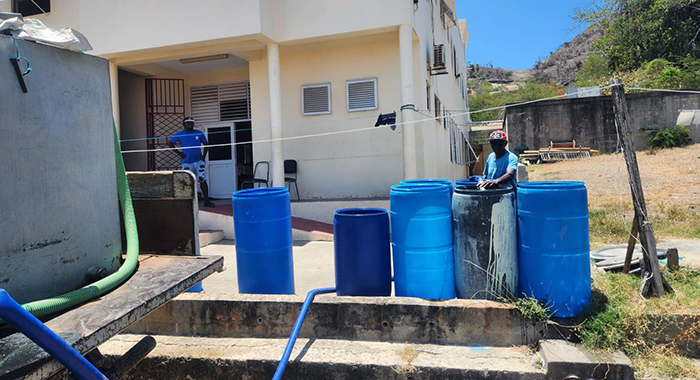

Minister of Health Daniel Cummings has described the ongoing water shortages in the Grenadines as a “super critical” crisis but says authorities are “doing everything humanly possible” to stabilise supplies in the short term while pushing ahead with long‑delayed desalination and transmission projects.
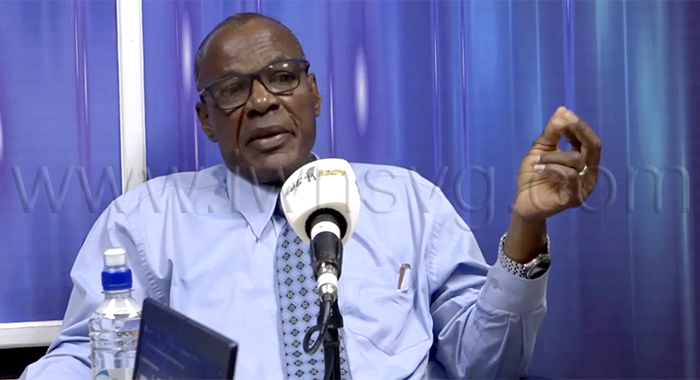
Speaking on NBC Radio on Thursday, Cummings, a former general manager of the Central Water and Sewerage Authority (CWSA), said that while all of St. Vincent and the Grenadines is affected by the ongoing drought, “the crisis is absolutely in the Grenadine Islands. “You cannot have such significant segments of our population going without water.”
He noted that, unlike mainland St Vincent, which relies on rivers and springs, the Grenadines has no streams and no significant groundwater, and depends heavily on rooftop rainwater harvesting and public catchment and storage systems.
Hurricane damage, low rainfall, rising demand
The CWSA had urged consumers since mid-January to activate their home water storage plans, noting that information from the SVG Met Office showed that SVG had received about 50% less rainfall during the 2025 rainy season than in the previous four years.
The country received just 687.1 mm of rain during the 2025 wet season, compared to 1,552 mm in 2025 and 1,455 mm in 2020.
Cummings said the current emergency in the southern Grenadines is the result of damage from Hurricane Beryl on July 1, 2024, reduced rainfall last year, and growing domestic and commercial demand for water.
He explained that many households in the Grenadines invest in cisterns and plastic tanks to capture rainwater from their roofs, but these systems were badly hit by the storm.
“A lot of the homes were destroyed, and a lot of the guttering that channels the water from the roof into their tanks are still not back up,” he said, adding that some of the storage tanks were broken into and polluted.
Public catchment systems — concrete catchments on hillsides that channel rain into large tanks — were also affected.
He said that CWSA teams are now cleaning those storage tanks and sanitising them ahead of the rainy season, which officially beings on June 1.
The minister also linked the broader water stress on water resources to the April 2021 eruption of La Soufriere and a significant drop in rainfall, which he said has reduced river yields on the mainland and affected the natural recharge of springs.
“We are coming out of an unusual period,” he said, noting the significant decrease in rainfall in 2025.
“This, on top of the eruption… which destroyed a lot of the vegetation on the slopes of the mountains…” he said, adding, “So together, what we have is far less water.”
Short‑term response: trucking and shipping water
Cummings stressed that the CWSA is currently responding to the situation in the Grenadines using what he called the “most expensive and improper” but unavoidable method: hauling water by sea.
“The transportation of water by boats and subsequently by trucks to the various parts of the Grenadine islands is the most expensive and improper way of doing it,” he said. “But it has got to be done, because the situation is now super critical.”
The authority has been renting vessels and loading them with water — both in tanks and trucks — for shipment to islands as far south as Union Island.
“The CWSA has been responding beautifully within its current means,” Cummings said. “It has had to rent the services of a number of vessels to take water in the vessels and to take trucks loaded with water onto the vessels as well to be able to relieve the stress caused to residents.”
He said the frequency of trips is being adjusted in real time.
“For example, within the space of three days, they went down twice, because the first trip demonstrated clearly that is not enough. And for as often as it’s required, and for as long as it is necessary, the Water and Sewerage Authority will continue to deliver water by this method.”
Ensuring equitable distribution on each island
Recognising that some residents still miss out even when water is transported to their islands, Cummings said the CWSA is changing how local distribution is managed.
“What the water authority has been mandated to do and is actively pursuing is to have on each island one of its employees who will overlook the distribution of the water with a view to making sure no one goes without water over a period of time.”
He said the authority is monitoring demand, storage levels and delivery intervals and will “make the necessary adjustments so that at all times there will be a certain level of water supply”.
Desalination projects, US$53 million investment
Cummings framed the current emergency measures as a bridge to larger, long‑term investments aimed at giving the Grenadines a year‑round, piped water supply comparable to similar islands in Grenada’s Grenadines.
He said St Vincent and the Grenadines is “on the verge of getting roughly $53 million worth of investment in water in the Grenadine islands”.
“These are all… short‑term initiatives because they do not meet the full nor the long‑term needs of the islands,” he said of the current and near‑term desalination moves. “What should have happened more than 20 years ago… is like what happened on the corresponding Grenadine islands belonging to Grenada. Many years now, Carriacou and Petite Martinique, they have a water supply system that is very reliable.”
He said those islands have long had desalination plants, storage systems, and transmission and distribution networks, allowing residents a consistent supply in both rainy and dry seasons.
“We had those plans here when I was the manager of the Water Authority… that goes back to the early 2000s,” said Cummings, who left the CWSA around 2004. “I am very pleased that at the moment we are in the position where… the projects’ funding will come through, and the projects will be able to move swiftly,” he said.