




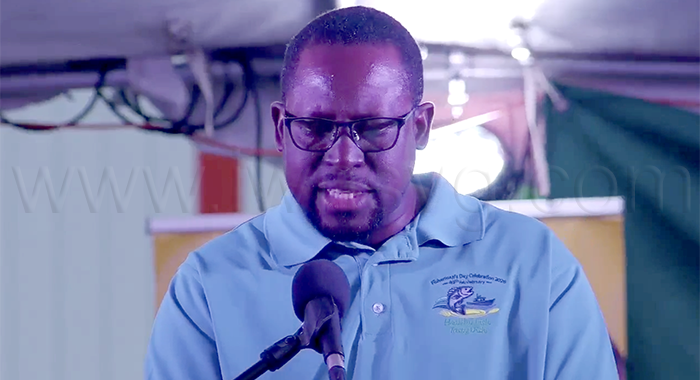
Fisheries Minister Conroy Huggins on Monday used his first Fisherman’s Day address to announce a series of policy moves and investments in the fisheries and blue economy, warning that sharp declines in conch and lobster landings signal mounting pressure on marine resources.
Speaking at Little Tokyo, Kingstown during the 49th Fisherman’s Day celebrations, Huggins said overall fish landings have recovered since Hurricane Beryl in 2024, but key high-value species are under strain.
In 2025, estimated fish landings rebounded to approximately 1.93 million pounds valued at over EC$16.3 million, up from 1.7 million pounds and EC$14.7 million in 2024, he said.
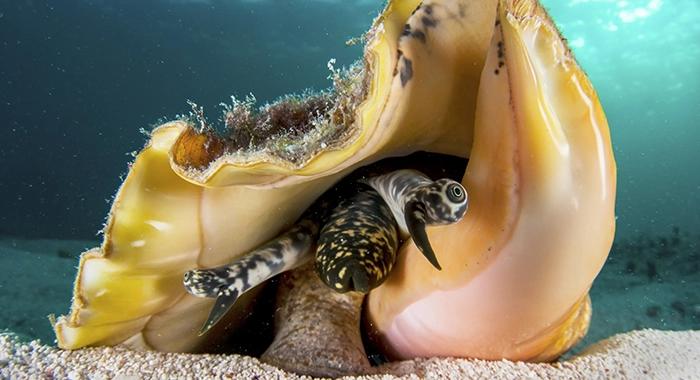
By contrast, he said conch landings decreased by 17.6%, resulting in a loss of earnings of over EC$0.2 million.
Meanwhile, earnings from lobster declined by 27% or an estimated loss of EC$0.3 million.

“These realities… remind us that the sea is generous, but its resources are not unlimited,” Huggins said, pledging science-based, sustainable management.
Conch hatchery and reef restoration
Huggins announced a queen conch recovery initiative, including the establishment of a queen conch hatchery and nursery unit in Union Island.
“That project will start before yearend,” Huggins said.
He said coral reef restoration projects are ongoing nationwide through regional and international partnerships, aimed at strengthening marine habitats, supporting fish populations, and improving climate resilience.
“Where science tells us resources are declining, we must act responsibly. Conservation today is production and sustainability for tomorrow,” he said.
It is the second consecutive year that a minister of fisheries is flagging the decline in conch production in the country.
Speaking at the 2025 Fisherman’s Day event, the then minister, Saboto Caesar, the then Unity Labour Party government was considering a closed season for conch effective 2026.
Caesar had said that his ministry would conclude discussions with its technical staff on a revision of the Fisheries Act.
“And part and parcel of that is going to be the implementation of different rest areas around the country, because as a people, as a generation, we owe a duty of care to the generations to come and it is very important that while we harness the resources available to us, that we do it in a very responsible manner,” Caesar had said.
“Next year, 2026, we are going to see the full implementation of a season for conchs in St. Vincent and the Grenadines,” the then-minister had further stated.
In August 2024, Caesar told Parliament that the government had approved a closed season for conch before Hurricane Beryl struck on July 1 that year.
Budget and blue economy
Meanwhile, Huggins said the 2026 budget allocates about EC$14.3 million to the Ministry of Fisheries, Marine and Land Conservation and Climate Resilience, including over EC$8.4 million in capital expenditure for fisheries infrastructure, Marine conservation, climate resilience and blue economy initiatives.
He described St Vincent and the Grenadines as an ocean state whose marine space is 90 times larger than its landmass and said the government would capitalise on the vast, untapped potential of ocean-based industries.
Sector plan and UBEC project
Huggins said a comprehensive sector plan for fisheries, marine and land conservation and climate resilience “is in the making”.
This will guide policy direction, infrastructure development, marine resource management, climate adaptation, and investment priorities and institutional strengthening.
He linked several initiatives to the World Bank-supported UBEC (Unleashing the Blue Economy of the Caribbean) programme.
The minister mentioned retrofitting fishing vessels to improve catch quality and safety, strengthening systems to combat illegal fishing, developing food safety and inspection systems, and supporting sea moss, conch and lobster aquaculture.
He also cited plans to refurbish fisheries facilities, jetties, boat ramps and climate-resilient storage to better protect fishers’ investments and to invest in vessel monitoring systems, refrigerated storage and access to financing.
Training, youth and shared responsibility
Huggins said the ministry is rolling out training and capacity-building for fishers and fisheries personnel in safety at sea, seafood safety systems, fish handling and processing, boatmaster certification, and modern fishing technologies.
He said new programmes will target youths and women through fisheries training and seafood product development, insisting, “Fisheries is not a dying industry. Fisheries is a sector of innovation, entrepreneurship, science, technology, and opportunity”.
Calling for “shared responsibility,” Huggins urged fishers to follow regulations and communities to help protect reefs, mangroves, beaches and seagrass beds.