



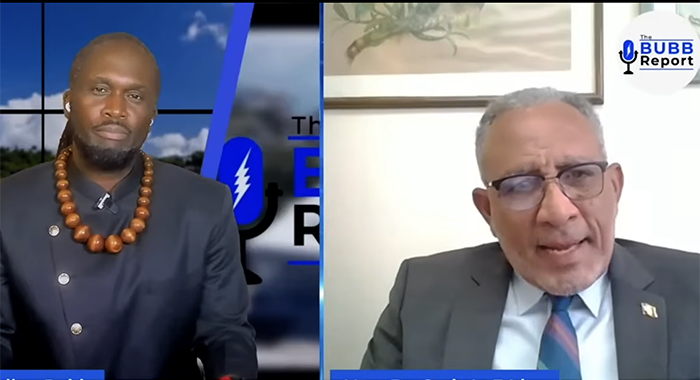

Prime Minister Godwin Friday says any citizenship-by-investment (CBI) programme his government plans to introduce later this year will be structurally separated from the political directorate.
He said the initiative will be tightly regulated and used strictly as a financing mechanism to support the real economy, not as an economic pillar in its own right.
Speaking on “The Bubb Report” with Grenadian journalist Kellon Bubb, Friday outlined his government’s approach to CBI amid regional and international scrutiny of such programmes.
He stressed institutional distance from ministers, strong due diligence, regional oversight, and full parliamentary accountability for inflows and spending.
“There has to be a distance between the way in which these programmes are managed and the political directorate,” Friday said.

“You don’t have… political involvement or interference in it, and there is parliamentary accountability, so that the people know how much money comes in, where the money [is] going. That is absolutely essential.”
He said this separation from partisan control is a core condition for his administration’s participation in CBI.
“It has to be set up [so] you don’t have… political interference,” he said, adding that the public must be able to see clearly that the scheme is managed “in the national interest” rather than for narrow political gain.
‘Not a pillar of the economy… a financing mechanism’
Friday maintained that his government intends to proceed with a CBI programme, consistent with the New Democratic Party’s long‑stated platform and election campaign promise, but repeatedly rejected the idea that it would become a central growth engine.
“We have articulated four pillars of the economy that we are going to focus on in our economic development strategy… [CBI] is not an economy, it’s a financing mechanism.”
He reiterated that the “four pillars” underpinning the real economy are reviving agriculture, accelerating tourism, the “new economy”, including information and communication technologies, and the blue economy, covering fisheries, marine services, shipyards, and the yachting industry.
CBI, he said, is intended to support these sectors by providing capital for investment and debt management, not to substitute for production, jobs and exports.
“What we are going to do is… make sure that we have the financing to get those things in place,” Friday said.
The prime minister linked the decision directly to the country’s high debt burden, limited fiscal space, and a regional “scarcity of capital”.
“Right now, we are in overhead with debt, 113% of GDP and projected to rise,” he said. “We’re seeking to attract foreign direct investment; we’re seeking to unlock our local private sector… and [we need] other ways to raise funds.”
‘Last player’ advantage and rejecting a ‘race to the bottom’
Friday said St. Vincent and the Grenadines (SVG), as the last OECS state to move towards CBI, has the benefit of learning from the experiences — positive and negative — of other countries in the region.
He welcomed efforts to establish common regional standards and oversight, including a regulatory role for the Eastern Caribbean Central Bank (ECCB).
“So that we don’t have these OECS colleagues… competing against each other in a race to the bottom. That is something we will not do,” he said.
Friday said even if a fully harmonised framework were not yet in place, SVG would “push for that” approach, signalling support for higher common denominators on due diligence, pricing and transparency.
Due diligence and the ‘good name’ of the state
Friday repeatedly identified due diligence as a non‑negotiable element of the proposed programme, linking it directly to SVG’s reputation and the value of its citizenship.
“You must have proper due diligence, and that is something that we will not compromise either,” he said.
“Our good name as a country is the basis upon which such programmes… survive,” Friday added.
“We cannot… damage our own good name in seeking to enhance our own economic well‑being, because that will be counterproductive.”
He said his government would not engage in practices that could undermine the standing of Vincentian passports or the wider economy.
“We will not engage in practices that in any way bring our country into disrepute, or in some way diminish… the value of what it is to be a Vincentian national,” he said.
‘Not a get‑rich‑quick scheme’
Friday was explicit in rejecting any view of CBI as a “get‑rich‑quick” arrangement for politically connected interests or short‑term operators.
He warned that the government would be cautious about promoters or investors whose approach is not aligned with long‑term national development goals.
Positioning CBI in the wider economic adjustment
Friday’s CBI comments came in the context of broader remarks about debt, growth and fiscal stabilisation, including his disclosure that SVG’s debt‑to‑GDP ratio stands around 113%, above previously cited levels, and his pledge to work back towards the Eastern Caribbean Central Bank’s 60% guideline.
Within that macroeconomic framework, he presented CBI as one among several tools—alongside debt swaps, potential debt forgiveness, concessional loans, foreign direct investment and domestic private‑sector mobilisation — to finance the “four pillars” of the productive economy and manage the debt overhang.