



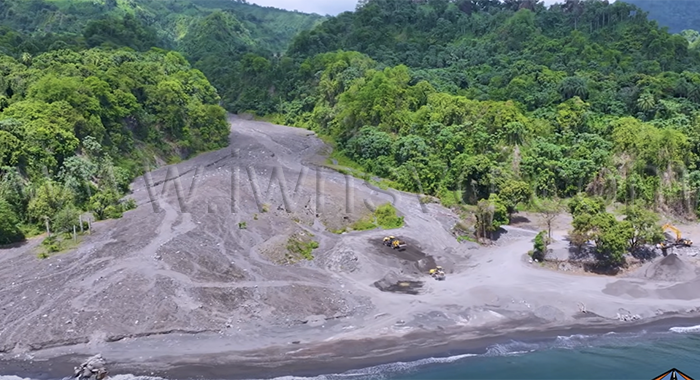

CEO of BRAGSA, Kem Bartholomew, says surveys have identified about 4.2 million cubic metres of suitable material within a three-kilometre stretch of the Roseau Valley in North Leeward that can be harvested.
By comparison, he said, BRAGSA currently works in an area of “just about a kilometre” at Rabacca on the eastern side of St. Vincent, where harvesting of aggregates has been going on for generations.
“If you extract 75% of that at the selling price that we will soon even negotiate… at a higher cost, it will be over $83,000,000,” he said of the naturally occurring aggregate in the Roseau Valley.
Even using the base price of EC$34.80 per cubic metre — the rate at Rabacca — he put the potential revenue at “$73 million easy dollars” for three-quarters of the identified volume.
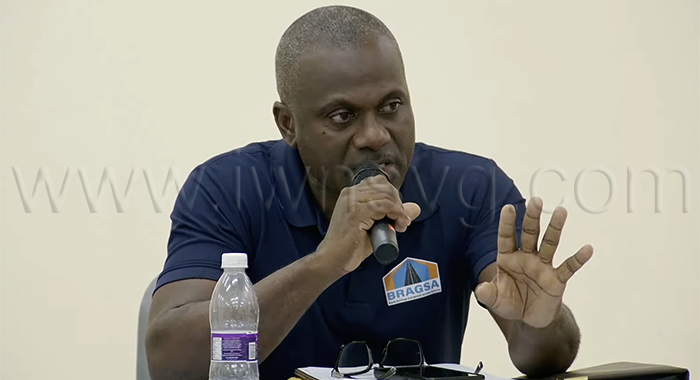
Speaking at a community meeting on Tuesday held as part of North Leeward MP Kishore Shallow’s “North Leeward Matters”, Bartholomew suggested that there was a stark choice for policymakers and the community.

“So what should we do? Do nothing, and allow this material to just go to the sea? And this is what we are here [to discuss], because we want to contribute to this community,” he said.
Jobs, local hires and ‘we need persons here’
Pressed later in the meeting about employment and the practical benefits for residents, Bartholomew said the operation is still in its initial, temporary phase and that BRAGSA wants to hire people from North Leeward for both the construction of on-site facilities and ongoing operations.
Responding to concerns from fishermen and community members about job numbers and local participation, he said:
“Right now, we have a team from BRAGSA that is coming down every day; they’re going to soon be burnt out. I am not aware of any person either going there looking for a job, going to our Chateaubelair office or showing interest. We need persons here.”
He said BRAGSA needs to construct a small “comfort station” and storage structure at Roseau, and that this alone requires local tradespeople.
He said that in the initial phase, BRAGSA will need about 20 employees, and thereafter about 10.
Bartholomew explained that while the harvesting operation is by barge only, the scale and duration of employment will depend on how many purchase contracts BRAGSA secures.
“We have a sale. When that sale is completed, and we save enough material for another barge, and there is no purchase, what do we do?” he asked, saying the “quantity and the time in which we will be harvesting this material … will be based on demand”.
Earlier in the meeting, other speakers had referred to planned training of local machine operators, though Bartholomew said that approach would also be refined as the project evolves.
‘Doing our best with what we know’
Responding to environmental and fisheries concerns, including the risk of turbidity affecting nearshore fishing grounds and crops, the BRAGSA CEO said the operation was designed around natural gravel rather than soil, and pledged adjustments if monitoring shows unanticipated impacts.
“We are not disturbing soil; it is natural gravel,” he said. “If there is any turbidity that will affect the [fishers] as we go along, based on the management plan, as information changes and we have to adjust, we will do so.”
Bartholomew borrowed a line from the late American writer Maya Angelou to characterise BRAGSA’s approach.
“It is doing our best with what we know. Until we know better, we do better,” he said. “We are doing our best. If… we have to adjust, we will do so.”
Bartholomew’s defence of the project came amid sharp questions from community activists, fishers and indigenous rights advocates about consultation, environmental risk, historical land rights and direct community benefit.
While those broader debates dominated much of the meeting, the BRAGSA CEO’s core message remained that “do nothing is never an option” when millions of dollars’ worth of material are accumulating in North Leeward’s rivers and washing into the sea.