



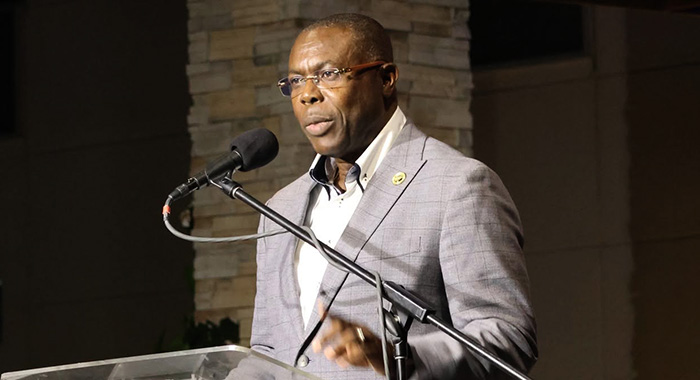

Vice-President of the Caribbean Development Bank (CDB), Isaac Solomon, has praised the Government of St. Vincent and the Grenadines (SVG) for what he described as a rare combination of confidence, clarity and humility in its engagement with development partners, saying this creates the conditions for effective support—provided words now translate into concrete action.
Speaking at the Development Partners Cocktail at the close of the first day of the Development Partners Round Table in Villa, on Tuesday, Solomon said events of this nature “do not happen by accident”, but reflect a government willing to invite scrutiny and articulate a clear, country-owned development vision.
“They happen because a government has the confidence to invite scrutiny, the clarity to articulate a vision, and the humility to say we cannot do this alone,” Solomon said.
“That combination is rarer than it should be. I think it deserves recognition,” he added.
‘Honest, grounded, analytically rigorous’

Solomon said the CDB had been “moved” by what its delegation witnessed earlier in the day, particularly the morning presentation by Prime Minister Godwin Friday and Kevin Hope, the SVG’s ambassador of finance and investment.
“This morning the prime minister and Ambassador Hope gave us something that development partners do not always receive — an honest, grounded and analytically rigorous account of where St. Vincent and the Grenadines stands: its challenges named plainly, and its ambitions articulated with clarity and conviction,” Solomon said.
He stressed that the government’s presentation neither glossed over difficulties nor retreated into them.
“They did not minimise the difficulties, including the fiscal pressures, the weight of climate vulnerability, the structural constraints that this small island economy carries as a matter of its geography and history. But neither did they retreat into those difficulties.”
Instead, he said, Kingstown laid out “a development vision that is coherent, country‑owned, and, critically, one that partners can meaningfully organise around.
‘Commitments were made, coordination was discussed’
The CDB vice-president said the candour and clarity from the SVG side appeared to shape the tone of the discussions among development partners.
“What we then heard from development partners across the room was, I thought, a genuine response to that clarity. Commitments were made; coordination was discussed. A shared sense of purpose took shape. Those are not small things.
Solomon said the “credit for creating the conditions for that conversation” lay first and foremost with the government of SVG and the United Nations team that helped convene the round table.
From the CDB’s vantage point, he said SVG’s priorities and reform direction “resonate deeply” with the bank’s own strategic objectives.
“From CDB’s vantage point, the development priorities, the reform direction, the honest account of the challenges ahead that were articulated earlier today resonate deeply with our own strategic objectives around inclusive growth, resilience, and human capital development.
But Solomon stressed that the value of this alignment lies not in validating the CDB’s framework, but in enabling the bank to be genuinely useful.
“When a country has defined its own direction with this degree of clarity, a development bank’s job becomes more straightforward. It becomes one of deploying our instruments in service of that direction, not in competition with it. That is the kind of partner we intend to be.”
Financing is not enough in a tougher global environment
Solomon cautioned that the challenges identified by SVG cannot be solved by money alone.
“They require the right instruments, the right coordination, and, yes, a sustained political will to see reforms through.”
He said the discussions had demonstrated that “that will is present” in SVG, and argued that the obligation now falls on partners to respond in kind.
“Our job as partners is to match that energy.”
Solomon warned that the global environment has become more hostile for small island developing states than it was five years ago, “characterised by elevated financing costs, geopolitical realignment, and the accelerated pace of climate events.
“These all press on small island economies in ways that large economies can absorb and SIDS cannot.”
He linked these global pressures directly to SVG’s recent experience.
“St. Vincent and the Grenadines knows this, not in the abstract. It knows it through the experience of the La Soufriere eruption [of April 2021], through the fiscal compression that followed, and through the long road of recovery that is still being walked in some areas, and the transition from recovery to transformation and resilience.”
Turning lived vulnerability into leverage
The CDB official said SVG is well-positioned at a time when the international community is re-examining how it supports climate-vulnerable small states, including through debates such as the Bridgetown Initiative and the push to reform the global development finance architecture.
The Bridgetown Initiative is a policy agenda led by Barbados to overhaul the global financial system so that developing nations can afford to fight and adapt to climate change without falling into crippling debt.
“What I took from today is that there’s something else present in this country — a quality of governance, a clarity of vision, and a willingness to engage seriously with difficult questions that position St. Vincent and the Grenadines well, precisely at the moment when the international community is renegotiating the terms on which it supports climate‑vulnerable small states,” Solomon said.
He argued that SVG’s recent shocks give it a strong, experience-based voice in those negotiations.
‘Not a gap to apologise for’
Solomon noted Prime Minister Friday’s assertion earlier in the day that SVG’s development needs are “real, multi-dimensional, and larger than what any single institution can address. The question, as always, is whether partners can orgnaise well enough so that what each brings adds up to more than the sum of its parts.”
He commented:
“This is not a gap to apologise for. It is simply the nature of small island development finance.”
Given that reality, he said, the central question is whether development partners can organise themselves effectively.
“Today suggested we can. The commitments made, the spirit of coordination in the room, the willingness to align around the country’s own vision — these are the ingredients of a partnership that works.”
‘The standard we should hold ourselves to’
Solomon cautioned, however, that the success of the round table will ultimately be measured by tangible changes felt by ordinary Vincentians.
He reiterated that the CDB stands ready to support SVG not only with financing, but also through policy dialogue and advocacy in wider international forums.
“We come to this as a leading voice and also as a committed partner, grateful for the invitation and clear about the responsibility that comes with it.”
Summing up the day, Solomon said:
“This has been a good day — a day that began with honesty about the challenges ahead, moved through serious substantive conversations, and ends here among partners with a sense of shared purpose.”
Good move. Nice one.
Another was of saying the previous government was dishonest.