



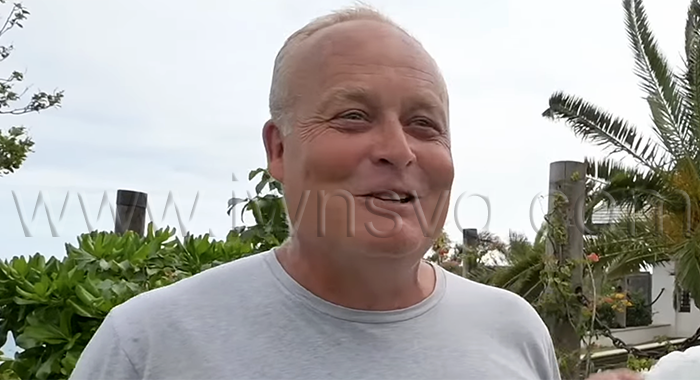

A major housing recovery and resilience project is being launched in the southern Grenadines, with British investor Ian Wace partnering with the Government of St. Vincent and the Grenadines to accelerate reconstruction on Canouan and neighbouring islands devastated by Hurricane Beryl two years ago.
Minister of Housing, Land Management, Urban Development, and Informal Settlement Upgrading, Andrew John, outlined the initiative on NBC Radio, saying the project is intended to “significantly advance housing recovery” and improve long-term resilience in the Grenadines.
New multi‑million investment
Hurricane Beryl damaged or destroyed 90% of the buildings in the southern Grenadines when it moved across SVG on July 1, 2024.
Wace has said he contributed US$25 million to the recovery effort under the Unity Labour Party administration, which was voted out of office in November.

“This is a man who is unbelievably capable and unbelievably erudite. I had come down with a certain perspective about what I should try to do,” he said during a ceremony to mark the first anniversary of the hurricane, in which then-prime minister Ralph Gonsalves said Wace had committed US$5 million to the recovery effort.
Wace said Gonsalves “extracted five times the amount of money” he had planned to contribute.
“And I think that is remarkable. I stand here having received an anal lobotomy of extraction of money, and I am unbelievably proud for having done so. But most of all, I’m unbelievably proud because we did all of this together,” Wace said.
Ahead of the polls, Wace endorsed the ULP and Gonsalves for a sixth consecutive five-year term in office, raising questions about his future contribution to the recovery efforts after the change in government.
However, John said the new project is a joint initiative between the New Democratic Party government and Wace.
“There is an agreement negotiated between our government and himself to do that sort of work again,” John said, noting that Wace “has pledged millions of dollars to come on board” with the new programme.
The project will focus on the repair and reconstruction of homes, with particular emphasis on Union Island, Mayreau and Canouan, and with outreach to Bequia.
John described it as “an important investment in the future” of these islands, where many families are still living with the impact of Beryl’s destruction.
The minister said the partnership with Wace is intended to “push things along much faster and much more quickly than we on our own are able to do”, given the high cost of construction and logistics in the Grenadines.
Costly rebuilding, limited fiscal space
John stressed that the cost of rebuilding in the Grenadines remains a major constraint, citing transportation and financing as key challenges.
He noted that moving materials from the mainland to the Grenadines is “very expensive”, and that after previous disasters, “there was very little money left for the rebuilding process”.
The minister said the government is wary of relying solely on new borrowing to finance reconstruction and welcomed private capital as a way to ease pressure on the public purse.
He said Wace’s coming on board could help to make a difference, adding that the administration is also hearing “whisper of another” potential investor interested in supporting housing in the Grenadines.
Recovery incomplete 2 years after Beryl
John estimated that overall recovery in the southern Grenadines is around 60% complete, with Canouan and parts of Union Island and Mayreau still requiring significant work.
He said a key priority is getting displaced residents who remain in St. Vincent or in rental accommodation back into their homes so that local economies can properly restart.
“If we don’t get the people back, it’s going to be always slow on the economic take-off in Union Island,” he said, making a similar point about Canouan, where wharves and other infrastructure are still under pressure.
Government warehouses in the Grenadines have been restocked with building materials, and John said some 50-plus homes have already had windows reinstalled, with doors expected to follow shortly, allowing more families to reoccupy repaired houses.
Housing plus resilience: shelters, solar and water security
John stressed that the new Grenadines project, backed by Wace, is not only about replacing damaged houses, but building systems that can better withstand future storms.
Key elements include purpose-built hurricane shelters on the affected islands, with Bequia likely to see the first new facility and others to follow in Union Island, Mayreau and Canouan.
These shelters are to be specially engineered “to withstand any kind of severe hurricane”.
The new project is also looking at the integration of solar energy into new and rebuilt homes, with the ministry in talks with a solar provider.
John said they have not reached a final agreement but made clear that the plan is to exploit the Grenadines’ “abundance of sunlight” to reduce electricity costs and dependence on imported fuel.
There will also be a focus on water security measures, including installing tanks and guttering on rebuilt homes so that households can harvest rainwater and avoid annual crises.
John referenced the serious water shortages in the Grenadines earlier this year and said the government is discussing desalination solutions while also improving household storage.
The minister said these measures are part of a broader resilience agenda, adding that the aim is for residents to “go back stronger and better, more prepared” for future weather events.
Hurricane season backdrop
The announcement comes as St. Vincent and the Grenadines enters another hurricane season, with the memory of Beryl “very fresh” among Grenadine communities.
John used the programme to urge residents not to rely on the old saying that “God is a Vincentian”, but to treat each season seriously.
He urged residents to:
• Trim overhanging trees threatening homes
• Reinforce galvanised roofs and check nails and screws
• Follow advisories and warnings from NEMO and other relief agencies
• Make early preparations when watches or warnings are issued
He said the ministry’s ongoing distribution of self‑help building materials is intended to support household-level preparation, especially for the elderly and vulnerable, who may require additional assistance.
“We remain committed to helping you rebuild… This project will support the repair and reconstruction of homes, improve housing in our communities, and help more families return to safe, secure homes,” John said.
The housing minister framed the partnership with Ian Wace as a central plank of that commitment, describing it as a “major relief, rebuilding and resilience project” for the Grenadines, with Canouan among the primary beneficiaries.
In God we praise 👏 all things are possible in Jesus name 🙏 guidance and prayers to each and every one who is part taking in the rebuilding off the homes 🏡 Jah live Allah
Please create jobs at the Islands