



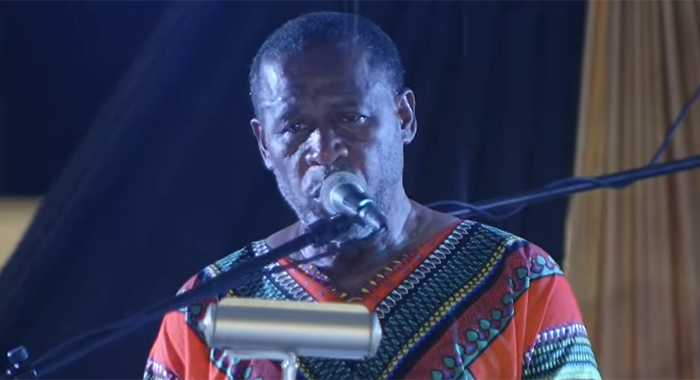

Vincentian historian Michael Dennie has called for an enslaved woman who killed a plantation owner in Mayreau to be declared a national hero, arguing that Emancipation in St. Vincent and the Grenadines was won “in money and in blood” and not granted as a gift.
Speaking at the National Emancipation Rally at Independence Park on Saturday, Dennie said the story of a woman known in the records as “Nelly the Ebo” and four other enslaved women who were executed with her should be placed at the centre of how Vincentians understand freedom.
“Five Black women gave their lives, paid the heaviest price for the freedom that we enjoy today,” he said.
“Freedom wasn’t simply a gift. Freedom is something that we paid for in money, which Professor Fraser would speak about, and blood, that I’m speaking about.”
Describe Nelly the Ebo’s act of resistance as “extraordinary at the time and [still] extraordinary today”.

Dennie cited the records as saying that Nelly the Ebo killed a powerful planter who owned estates in St. Vincent and other Caribbean territories.
“He wasn’t simply an ordinary enslaver. He was an aristocrat … at the top of the show,” Dennie said.
He recounted that while the planter was riding his horse, Nelly attacked him with a hoe, fatally injuring him. She and four other enslaved women then disposed of the body.
“She took a hoe, and she took him out, and she took his body with four other enslaved women, and they threw it into the sea,” Dennie said, adding that archival sources referred to the women as “conspirators”, a term he rejected.
“‘Conspirators’ is the wrong word — co‑freedom fighters,” he told the audience.
The five women were quickly arrested. Four were hanged on the estate once the killing was discovered, while Nelly herself was taken to Kingstown, tried at the courthouse and publicly executed.
Dennie said the episode showed in stark terms that enslaved women in St. Vincent were not passive victims, but active participants in the liberation struggle.
“I’m calling today publicly that by this time next year, Nelly the Ebo must be recognised as the first Black woman who is a national hero of St. Vincent and the Grenadines,” he said, adding that “this is not something which was possible in colonial times, but it is our government [now]. We have the capacity to decide who are our heroes.”
He argued that elevating Nelly would send a clear signal about which stories the nation chooses to honour and pass on.
“We have to understand which stories must be told, which stories have a reverence to which our children must be acquainted,” he said.
“The story of Nelly the Ebo, a Black woman standing against slavery, and with other Black women giving their lives so that we today could enjoy freedom — let us remember them in the most positive way we can. Make Nelly the Ebo a national hero.”
‘Something very special about St. Vincent’
Dennie used his address to press three main points: that St. Vincent had the shortest period of organised chattel slavery in the British Caribbean; that some Vincentians, particularly among the Garifuna, were never enslaved; and that for those who were, freedom was the result of sustained resistance, including armed struggle and individual acts of defiance like Nelly’s.
Dennie told the crowd that, compared with neighbouring colonies, St. Vincent’s period as a full slave society was relatively short, and that this distinction should be better understood and valued.
“It must be recognised as something special to St. Vincent, that in the history of enslavement across the Americas… in St. Vincent we had the shortest time of enslavement,” he said.
He added that the island’s history also includes people who “lived through enslavement but escaped the bonds of slavery itself”, particularly among the Garifuna.
The historian noted that although there was a mass expulsion of Garifuna after the British conquest, “mass expulsion does not mean total expulsion”, saying some families remained in areas such as Greiggs.
Dennie argued that these twin realities — a relatively short period of slavery and the presence of free people of African and indigenous descent during that time — should shape how Vincentians view their past.
Freedom ‘had to be fought for’
The historian insisted that Emancipation in 1834 and full freedom in 1838 did not come from benevolence on the part of colonial authorities.
Dennie traced resistance back to the point of capture in Africa, saying those who were later enslaved in the Caribbean were often “captives of war” who had already fought and seen many comrades die on the continent and at sea.
“Africans simply didn’t say, ‘Okay, here we are, take us across the Atlantic,’” he said. “Those who fought on land, many died. Those who fought at sea, many died. And when they arrived here in the Caribbean and in St. Vincent, they fought again, and many died.”
Within the Caribbean, he said, this resistance produced “heroes” whose stories are still not widely known or “told as loudly and as frequently as they should be”.
‘We paid for freedom in money and in blood’
Dennie framed his intervention as part of a broader effort by historians at the rally to unpack both the economic and human costs of slavery and emancipation.
He said freedom “was something we had to pay for”, and deliberately limited his remarks to the blood price, leaving the financial aspects – including compensation paid to enslavers, not the enslaved – to fellow historian Dr. Adrian Fraser, who spoke after him.
“To understand freedom, what does freedom mean?… One of the ways we can answer that question is to say, freedom was something we had to pay for. We paid for freedom in money, and we paid for freedom in blood,” Dennie said.
He described the 1834 move towards freedom and the 1838 achievement of full legal emancipation as the culmination of generations of struggle that had begun long before enslaved Africans set foot on Vincentian soil.
By highlighting Nelly and the unknown number of others who “fought and died”, he sought to anchor Emancipation Day commemorations not only in memory, but in a recognition that the freedoms Vincentians now enjoy are the result of deliberate, often lethal, acts of resistance.
Dennie concluded by urging that this history be taught, repeated and institutionalised, beginning with formal recognition of Nelly the Ebo as a national hero.
“Those who gave their lives deserve that honour,” he said.
Bravo!
Kudos to Michael Dennie! My hat’s off to you, sir. Mr. Dennie’s recommendation to name the woman I’ve long heard about on Mayreau as “Nelly Ibo” as SVG’s next national hero shows that his thinking is truly emancipated. I can only hope that this inspired recommendation will be noted by those who have shamelessly suggested another candidate whose deliberate perpetuation of slavery-like conditions on Mayreau well into the 20th Century, more than a century after official emancipation, and disgraceful denial of basic rights to Mayreau people can never begin to be erased or even overshadowed by any good works he has done on the mainland.
This is a stretch. Nelly the Ebo killed a man. Period. It is for the same reason that I and many others do not support the death penalty. She was not locked in battle with the man at a moment which we can freeze in time. She waylaid him and killed him. As nobly as we would like to pitch it, she murdered him in cold blood. She might even have deprived him of consequences much more fitting for him than sudden death.
How do I get hold of a copy of the book: Native Genocide and African Enslavement in SVG by Adrian Fraser et al please?
I agree 💯%
Jael is a heroine in the Bible known for killing Sisera, the commander of the Canaanite army, by driving a tent peg through his head while he was asleep in her tent. This act was pivotal in the Israelites’ victory over the Canaanites, as recounted in the Book of Judges, chapters 4 and 5. If she could be counted as a heroine, so could Nelly Ebo/Nelly Ibo.
@ILQI “deprived him of consequences much more fitting for him than sudden death”? Go and study history, only then you will understand how women were treated on these plantations. They were raped mercilessly by the planters and their oversears, who faced no consequences for their actions. These women had no rights or freedom as slaves were considered property. Sometimes I wish some of you can experience the same thing our ancestors endured. Maybe then you would understand the price of the FREEDOM you now enjoy.