



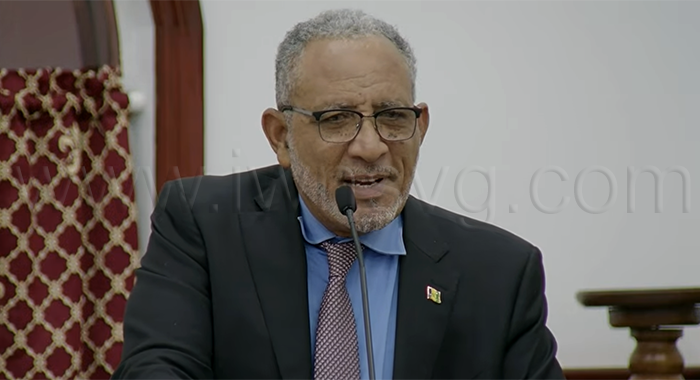

Prime Minister Godwin Friday has unveiled the broad contours of a plan to pull St. Vincent and the Grenadines back from what he calls a fiscal “precipice”, promising to stabilise a debt‑burdened economy and lay the groundwork for faster, private‑sector‑driven growth.
Speaking on NBC Radio on Tuesday, the prime minister painted a stark picture of the country’s public finances, accusing the former Unity Labour Party administration of piling up unsustainable debt and leaving the state constrained just as global shocks — from war‑driven fuel prices to Hurricane Beryl — hit home.
“As we realised once we were in government how terrible the situation really was, it’s actually in an unhealthy position,” he said, recalling that international institutions such as the IMF had been warning as far back as 2016 that St. Vincent and the Grenadines was “on the verge of debt distress”.
He said his government inherited public debt at 113% of GDP, with projections it would surge to 124% within a few years if no corrective measures were taken.
At the same time, debt service now consumes approximately 39 cents of every dollar the government earns.

“You can’t have development, you can’t have rising standards, you can’t sustain a quality of life if you’re doing it on a credit card. Eventually, the bill comes due,” Friday warned.
“We are now in that situation where they’re saying, ‘Well, listen, you can’t afford this, you can’t afford that.’”
Moody’s recent downgrade of the country’s sovereign rating from B3 to Caa1, he added, is both a symptom and a cause of the problem, making external borrowing more difficult and more expensive at the very moment the country most needs fiscal space.
Against that backdrop, the prime minister is promising not just to complain about the state of affairs, but to “fix the problem” with a strategy he says is built on three pillars: stabilising public finances, restructuring the country’s debt burden, and unlocking faster growth through private investment.
‘Stabilise the ship’: Restoring fiscal discipline
The first task, Friday said, is to bring order to the public finances after years of what he characterised as politically-driven spending.
The ULP was in office from March 2001 to last November. Friday accused the ULP administration of deliberately “spending and driving up the debt in a way that became unsustainable” in its last five or six years in office, using borrowing to finance projects and programmes designed to keep it in power rather than to build a durable economic base.
Friday said his administration is therefore moving to “stabilise the ship” by tightening fiscal discipline and introducing new fiscal rules that will bind both current and future governments.
He likened the situation to a household that is forced to raid its children’s school fees and medical budget to pay a maxed‑out credit card.
“At some point, you’re not going to be able to afford the payments, and they could come and reclaim [what you bought],” he said. “In terms of government financing, it’s not much different.”
The goal, he argues, is to ensure that when the state borrows, it is borrowing to invest in capital projects that expand the economy’s productive capacity, not to cover routine bills.
“It makes no sense you’re borrowing to pay [for] lights and salaries,” he said. “If you have to borrow for that, then you’re digging a hole to fill a hole.”
Swapping out expensive debt
At the heart of the government’s debt‑management strategy is an effort to reduce the cost of servicing existing obligations by swapping out expensive loans for cheaper, more concessional financing.
He pointed out that other Caribbean countries have already executed similar operations, often tying debt swaps to development or climate‑related goals.
St. Vincent and the Grenadines, he said, is studying those experiences closely.
As part of this effort, the government has joined the Central American Development Bank (CAF) and is in talks with “other institutions that are willing to provide concessional funding for development programmes,” Friday said.
The aim is to shift the country’s borrowing profile away from higher‑cost local and bilateral loans towards longer‑term, low‑interest financing from multilateral development banks.
The prime minister suggested that a successful refinancing drive, combined with stronger growth, would gradually pull down the debt‑to‑GDP ratio and free up resources for social and development spending.
“As the GDP grows, even if the nominal debt is increasing slower, the debt‑to‑GDP ratio will decline,” he said, adding that fiscal reforms are meant to “send the signal” to creditors and investors that St. Vincent and the Grenadines understands “these things matter” and is committed to sustainable finances.
Growth as the escape route
If stabilising and refinancing the debt are about buying time and space, Friday was clear that only faster economic growth can truly solve the problem.
“You’re not going to grow out of the debt situation, you’re not going to solve the problem simply by being more efficient and being more fiscally responsible,” he said.
To that end, the prime minister is placing heavy emphasis on private‑sector investment, both home‑grown and foreign. With the state’s borrowing capacity constrained, he argues, it is no longer possible for government to be the main driver of big projects.
“Our standard of living will not improve unless we generate more business activity in the country. Government depends on [business]. Either you do that, or you’re just borrowing money… and running up the debt without any means of really paying it back.”
He said his New Democratic Party administration’s role is to create a friendly business environment — upholding the rule of law, minimising unnecessary red tape and ensuring that concessions and incentives are transparent and tied to clear development benefits.
He dismissed the notion that offering tax breaks or duty concessions to major investors is tantamount to “selling out the country,” noting that such incentives are standard practice worldwide and are already used for local investors.
“Even local investors here, they come, they’re investing in a hotel, they get concessions … Because you want them to generate economic activity, and so government will get its piece later on when we tax your earnings, your profits, and the jobs that you create.”
At the same time, Friday vowed to be a “ruthless negotiator” on behalf of Vincentians.
“I have one client… and that is the people of this country,” he said. “So whenever there is a deal, we are going to make sure that it’s the best that we can possibly do under the circumstances.”
He said as the pipeline of investments grows — in tourism, infrastructure, fisheries and other sectors — the government will gain greater leverage to demand better terms from prospective investors.
He also urged Vincentians in the diaspora to see themselves as “preferred investors”, inviting them to “take a risk” and bring capital and expertise back home.
Protecting the vulnerable in a time of adjustment
Friday acknowledged that efforts to rein in debt and pivot to a new growth model will require “some measure of adjustments for everybody”.
But he insisted that the burden would not be placed on those least able to bear it.
“I will not impose that burden on the most vulnerable people in our society, because first of all, they didn’t cause it,” he said. “To ask them to pay… I cannot do it in all good conscience.”
Maybe it’s time to review the Mustique Act, are those international billionaires contributing enough to little SVG ? I’m sure they can afford to send a few more dollars our way.
digging a hole to fill a hole. have we heard this before? That is what the current PM said has happened to the previous government. Instead, he is taking a different approach implementing measures to rein the debt. This is a thinking government, on their feet at all times working on your behalf SVG.
Like a fish out of water.
NDP seems like they’re fresh out of ideas. A lacklustre and lazy government isn’t gonna do it.
Politics keep the masses entertained, distracted and poor and allows the leaders to live lavishly while the poor cheer them on.
Leave Mustique home owners alone. They are more than paying their fair share in taxes.
Investment in tourism, infrastructure, fisheries and other sectors by expatriate Vincentians or returning migrants will never lift us out of this huge pile of debt, as decades of investment failures and bankruptcies by such people has repeatedly shown.
This one-term government will have nothing to show for when they are again reduced to opposition status in the next national election.