



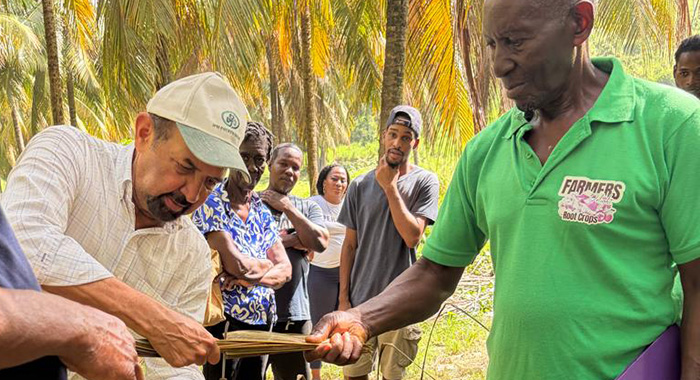

The Food and Agriculture Organization of the United Nations (FAO), in partnership with the Ministry of Agriculture, has concluded a week-long technical mission to strengthen the technical capacity of the coconut value chain in St. Vincent and the Grenadines, with a rapid training session on coconut botany and production.
The mission was carried out under the FAO project “Building Effective Public-Private Partnerships for Production and Marketing of Sustainable Agricultural Products”, and forms part of the Coconut Value Chain Pilot Programme.
Coconut was identified through a market assessment as one of the priority commodities with significant potential for value addition and expanded market opportunities.
The training was delivered by FAO Fruit Tree Crop Specialist Abel Rebouças Sao Jose, drawing on production, nursery management, rehabilitation, and pest and disease management practices that have contributed to the successful development of coconut industries in countries such as Brazil and the Dominican Republic.
“Several challenges still need to be addressed to increase St. Vincent and the Grenadines’ coconut production,” Rebouças said.

He said that expanding the area under cultivation through incentives that make coconut farming attractive and profitable is essential, but so is raising yields on existing land.
“That means selecting high-yielding varieties, establishing nurseries that produce seedlings of good genetic and phytosanitary quality, and adopting good cultivation practices. Improving yields alone could meaningfully increase total coconut production,” Rebouças said.
Training was delivered across two farming clusters commencing at the windward farming cluster in Orange Hill.
There, 43 farmers and technicians covered soil and climate requirements, coconut varieties and hybrids, propagation and nurseries, orchard installation, plant physiology, nutrition and fertilisation, pest and disease management alongside practical field demonstrations.
The programme then moved to leeward farming cluster in Barrouallie, covering the same core curriculum along with farm management for 30 ministry staff and farmers.
The training also included valuable insights from those in the industry, with local coconut manufacturer Sophia Searles highlighting the opportunities available to farmers, saying the opportunity for coconut farmers extends well beyond growing and selling coconuts.
“As manufacturers expand into value-added products, they need a consistent supply of quality raw material, and farmers have a real chance to become part of that growing value chain,” Searles said.
“Capturing it will require greater support for planting and rehabilitation, access to suitable land and inputs, and stronger linkages between farmers, manufacturers and markets.”
Building on FAO’s recent work to strengthen the soursop value chain in Belize and Grenada, Rebouças also led a rapid training session on soursop botany and good agricultural practices, introducing participants to best practices in orchard establishment, crop management, pruning and hand pollination to support improved productivity and fruit quality.
The mission’s reach also extended into the community with a community outreach activity on Aug. 29, bringing together 14 participants from Helen’s Daughters, Eco-home Garden Limited, and Rejoin Fruit and Farm.
The activity carried the mission’s coconut knowledge beyond the two farming clusters and ministry-led sessions, connecting grassroots groups and small-scale growers to the same training available to technicians and commercial farmers, and reflecting FAO and the Ministry’s commitment to a broad-based, community-driven approach to strengthening the sector.
Looking ahead, Agricultural Value Chain Specialist and Project Coordinator Jefferson Jaikissoon said the mission is about more than training.
“… it’s about laying the groundwork for a stronger, more competitive coconut value chain. The recommendations coming out of this week will directly inform the Coconut Value Chain Upgrading Strategy, including our farmer-led replanting initiative.”
As a next step, the Coconut Value Chain Pilot Programme will move forward with a coconut replanting exercise carried out in partnership with the Caribbean Agricultural Research and Development Institute (CARDI) through November 2026.
Building on the training delivered during this mission, the initiative will support farmers in re-establishing productive orchards, applying the improved varieties and practices recommended by Rebouças to strengthen the long-term productivity of the coconut value chain.