



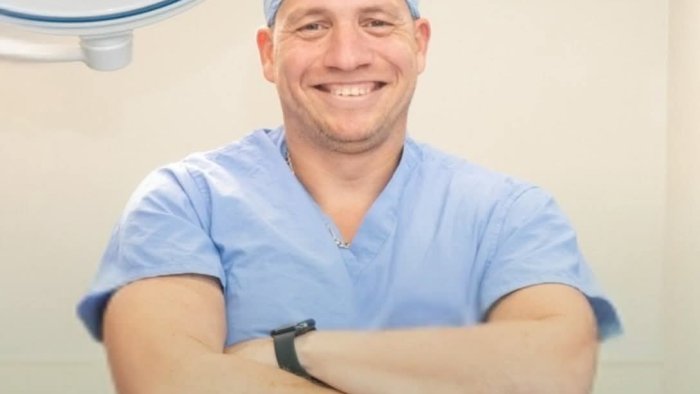

Vincentian surgeon Lee Cummings has made surgical history by leading what has been reported as Africa’s first robotic Whipple procedure, a complex operation used to treat pancreatic cancer.
Speaking during an interview on FOX 8 Morning Edition on Tuesday, Cummings discussed his trip to Abuja, Nigeria, where he served as lead surgeon for the procedure. The operation took place on Aug. 21, 2026, at Nisa Premier Hospital in collaboration with RoboMed Global, using the Toumai Pro Robotic Surgical System—the first robotic surgical platform approved by Nigerian regulators. Nigerian newspaper Vanguard described the milestone as a major step forward for advanced pancreatic cancer care on the continent.
Alongside Cummings, the core surgical team included Professor Obi Ekwenna, chief executive officer and co-founder of RoboMed Global and a tenured associate professor of urology and transplantation in the United States; Robert Amajoyi, chief academic officer of RoboMed Global and a colorectal surgeon; and Ann Olute.
This marks another milestone in Cummings’ surgical career. In 2020, he performed Kansas City’s first robotic Whipple procedure at Saint Luke’s Hospital of Kansas City.
Raised in St. Vincent and the Grenadines, Cummings graduated from the St. Vincent Grammar School in 1996 before pursuing his medical career abroad. He earned his medical degree from St. George’s University in Grenada before completing his general surgery residency at Maimonides Medical Center in New York, followed by a surgical oncology fellowship at Roswell Park Comprehensive Cancer Center and a transplant and hepatobiliary surgery fellowship at MedStar Georgetown University Hospital. Cummings now works as an associate professor of surgery at the Tulane University School of Medicine and surgical director of liver transplantation at the Tulane Transplant Institute at East Jefferson General Hospital.

The Whipple procedure
Often referred to medically as a pancreaticoduodenectomy, the Whipple procedure is considered one of the most complex operations in oncology. Cummings described it as ‘the holy grail of cancer surgery,’ explaining that the procedure involves removing the head of the pancreas, the first portion of the small bowel, and part of the bile duct.
“And then it’s like a plumbing job. After you remove all those complex organs, you then put things back together,” he said.
Surgeons reconstruct the digestive tract by connecting the bowel back to the bile duct, the stomach, and the pancreas.
Robotic Precision
“I think it’s something that we need here in New Orleans. I think the procedure is being done here, but what I think we need to offer is the robotic technique,” Cummings, who practices in New Orleans, said.
He continued his point, saying robotic technology improves surgical outcomes.
“I think it really affords to utilise a robot to really improve what is done in other fields, which is improved outcomes in terms of length of stay, some benefit in terms of oncologic outcomes, and so it’s really the future,” Cummings said.
He added that patients leaving the hospital within a couple of days, rather than a couple of weeks, make a huge difference.
“And more importantly, they can get back to starting chemotherapy early,” Cummings said.
“I think that’s what has allowed us to improve outcomes in colon cancer, breast cancer. It’s about early detection,” he said.
Early detection
Pancreatic cancer rarely causes symptoms in its initial stages.
“Pancreatic cancer is an insidious disease which often presents at late stages—Stage 3 or 4 most commonly,” Cummings said.
He noted that a late diagnosis remains a barrier, though early detection allows the Whipple procedure to offer a primary goal of cure.
Cummings and his colleagues plan to launch screening programmes for high-risk patients in collaboration with Louisiana State University.
“I think that’s where we’re going to gain the most bang for our buck, as it were. Obviously, there have been some significant improvements in oncologic care now—the chemotherapy in particular—which has come about over the last couple of months. And so, I think as we get more growth in that field, that’s really going to allow us to do the one-two punch, which is the surgery and chemotherapy, to really improve outcomes for pancreatic cancer,” Cummings said.
He added that individuals with a family history of pancreatic cancer should speak with a doctor.
“First of all, I think they can then connect you with oncologists, and there are screening programmes… that allow for early detection,” Cummings continued.
Global collaboration
Cummings said surgery operates as a global community.
I think having been able to go to Nigeria—and I’m going again in the next couple of months—you really get to exchange ideas between not just the local surgeons there, but other surgeons from across the world and the country,” he said.
Cummings concluded that exchanging ideas helps surgeons develop techniques that benefit patients in Nigeria and New Orleans.