



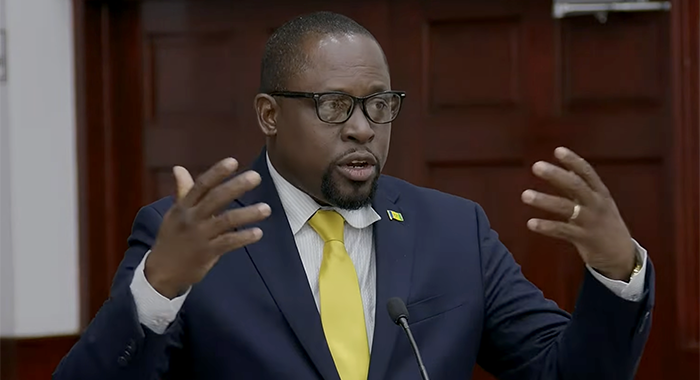

Fisheries Minister Conroy Huggins says fisheries facilities across St. Vincent and the Grenadines had been “literally neglected, left abandoned” under the Unity Labour Party years after funds were secured for their repair and upgrade.
He told Parliament on Tuesday that money set aside after the 2021 volcanic eruption to restore fisheries facilities went unused for years, until the New Democratic Party took office in November 2025.
In a ministerial statement on Tuesday, three days before the NDP government’s first anniversary, Huggins, who is also minister of marine and land conservation and climate resilience, listed facilities now being restored.
He also outlined new cooperation with Japan, conservation projects, and training for fisherfolk.
For 2027, he set targets of 2 million pounds of fisheries and aquaculture production and training for 250 people.

“Despite its importance and considerable potential, the fishery sector has faced, I would say, great neglect over the past two decades,” Huggins told the House.
A ministry promised since 2020
Huggins, who is MP for Central Leeward, noted that he grew up in Barrouallie, a fishing community, and said the sector is “something that is truly dear to me”.
He said Prime Minister Godwin Friday first promised in the 2020 campaign to create a fisheries ministry separate from agriculture, because he felt that fisheries, as a sector, was underserved.
The NDP campaigned on it again in 2025 and separated fisheries from agriculture after winning.
“I am truly honoured to have received that responsibility,” he said.
Huggins noted that fishing has “sustained families, supported coastal communities, strengthened national food security” and provided income for thousands of Vincentian fishers, vendors and the businesses that depend on them.
Mould forced staff out of headquarters
The minister said he was sworn in on Dec. 2, and the next day he asked to visit every fisheries facility in the country.
The first stop was the Kingstown Fish Market and the Fisheries Complex, which houses the division’s administration.
He found that staff had moved out in March 2025.
“They were evacuated because the building was mould-infested,” he said, adding that the building was not maintained after its construction in the early 1990s.
“… as a result, you had leakage, water coming through the roof, moisture build-up, and then there was mould infestation.
“It was not until persons were getting ill, then the decision was taken because it became untenable.”
Huggins said the building was “my first case I had to take to cabinet at our first cabinet meeting”.
Money was put in the 2026 budget, and the roof, plumbing, cleaning and painting are now finished.
“Right now we are going through the procurement of equipment and furniture, and we are anticipating by December we’ll be able to move into that facility. A working government,” Huggins told Parliament.
After visits to Calliaqua, Barrouallie, Bequia, Canouan and Union Island, the situation was clear, Huggins said.
“The stark reality is that all of our fisheries centres were literally neglected, left abandoned, and apart from Kingstown and Calliaqua, much activities were not taking place in any of the other facilities because they were not really fit for purpose.”
He said the ULP administration got money to restore several facilities after the 2021 La Soufrière eruption, and approval came in 2022.
“Between 2022 and … the end of 2025, literally, no work was done on any of these facilities. It took us to come into office in November of 2025 to get several of these facilities up and going,” he said. “I want that to sink in for just a moment.”
The minister said equipment at the Kingstown Fish Market “should have been changed out 10 years ago.
“We had the opportunity to do it, and it was not taken.”
He said the government has asked Japan for help and new equipment will be installed over the next year.
Homeless people at Chateaubelair; Bequia funding nearly lost
The NDP constructed the Chateaubelair Fisheries Complex just before it voted out of office in 2001. The ULP never opened the facility, which fell into disrepair during the ULP’s 24 years in office.
Huggins said that when he visited the Chateaubelair fisheries facility, homeless persons were living in it although the World Bank had allocated money for the project since 2022.
Work is now under way, and the project should be finished in early 2027.
On the Port Elizabeth fish market in Bequia, which is funded by the European Union, he said: “We almost lose that funding … it was just sitting there for years, coming after budget, after budget, after budget, and nothing.”
A contract was signed by June, the project was launched in August, and it should be finished by the end of the first quarter of 2027.
The minister said several more facilities will open in the first half of next year, and others will get new equipment.
Japan returns
Huggins said one of his priorities was to revive the country’s long relationship with Japan on fisheries.
The prime minister sent him to an oceans conference earlier this year and since then three Japanese missions have visited SVG to survey fisheries facilities.
He said a fisheries value chain project will start next year and in January, Japanese engineers will visit to assess five facilities that a team of three experts has already surveyed, and the two sites will then agree on priority projects.
“We are anticipating having at least three more of our facilities being restored between 2027 and 2028,” he said. “We are talking about within 12 months, all of these activities have taken place within the fisheries sector.”
Longliners, coral and a conch hatchery
The minister said three longline vessels were registered in 2026 to develop offshore fishing. Two are operating; the third has been affected by the death of its captain a few months ago.
He said 11 proposed fisheries conservation areas have been mapped, and draft regulations have been prepared for areas including Adams Bay and Western Cay in Bequia.
“Stakeholder consultation remains essential as we continue our engagement on marine conservation,” he said.
In July, staghorn and elkhorn coral fragments were brought from St. Lucia and placed in nurseries, including one at Cumberland.
In Union Island, preparations are well advanced for a mobile Queen conch hatchery laboratory worth EC$212,510 that could produce up to 2,000 juvenile conch a year.
“This is something which is being pioneered here in St. Vincent, and this is also a project that we almost lost, but this government we took the decision to ensure that it was kept,” he said of the project, which is funded by the EU and run by the OECS.
Huggins said the ministry continued to monitor sea turtle nesting sites and to use vessel monitoring technology against illegal, unreported and unregulated (IUU) fishing.
On aquaculture, the ministry, the OECS Commission and the SVG Environmental Fund held a three-day sea moss workshop at the Union Island Secondary School in July for about 30 people.
Huggins said such efforts “create opportunities for small businesses and community-based enterprises”.
Training for women, youth and special needs students
Huggins said 142 people were trained in fish handling, processing and product development in 2026, most of them women.
Training for members of the Barrouallie Fisheries Development Cooperative will run from Dec. 1 to 3.
Twenty-five special needs students will be trained in fish product development and value addition on Dec.7 at the Girls’ High School.
“This is the inclusive approach that we have taken,” he said.
2027: ‘a year of implementation and accountability’
Looking ahead, Huggins said 2027 “must be a year of implementation and accountability”.
His first priority is rehabilitating fisheries facilities and buying essential equipment, with the Port Elizabeth and Barrouallie facilities due to be finished next year.
The second is a production target of 2 million pounds of fisheries and aquaculture output.
He said this will require investments in fleets, effective fish aggregating device management, stronger landing and processing systems, and better market access
The ministry also plans to train 250 fisherfolk, processors, women and young people in sustainable fishing, quality control, value addition and climate-resilient operations.
He said 2027 will also mark the 50th Fisherman’s Day, adding that the 49th edition “was a bang” and he expects the anniversary to be “an even bigger spectacle” that should “celebrate our fisherfolk, honour the history of this industry and renew our determination to build a better future for it”.
Huggins ended by saying how the ministry should be judged. “Our test will not be how many plans we produce, but how many facilities become operational, how many fishers gain skills, market opportunities, how much more value our industry creates, and how well we protect our marine resources,” he said.
“Our fisherfolk have already shown what resilience looks like. Our duty is to match that resilience with functioning infrastructure, maintaining them, sound policy, stronger partnership, and real economic opportunity. The establishment of a standalone ministry was the beginning. Delivery will be the measure of its success.”