

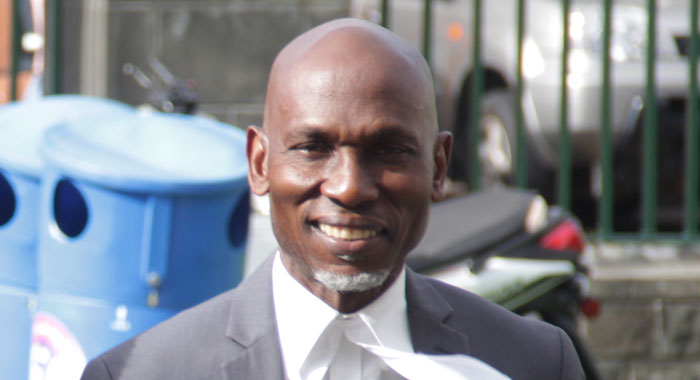

By *Jomo Sanga Thomas
(“Plain Talk” Aug. 22, 2025)
The Donald Trump regime is preparing a false flag event as a pretext for an invasion of the Bolivarian Republic of Venezuela. The people and governments of the Caribbean must defend our countries’ sovereignty and not allow our land, sea and air space to be used as a launching pad for such unlawful and illegal misadventure.
Two events in recent times point to the American attempt to pressure, strangle and eventually invade, overthrow and destroy the revolutionary experiment initiated by Hugo Chavez, the former president of Venezuela, who died in December 2012.
The first occurred on Aug. 8, when US Attorney General Pam Bondi issued a US$50 million bounty for the arrest of President Maduro. The reward is double the US$25 million offered by President Biden on Jan. 10, 2025. The US regime indictment charged the Venezuelan revolutionary leader with aiding drug cartels and corruption. Previously, President Maduro and other top government and military officials were tagged with the spurious charge of narco-terrorism.
The second limb of the macabre scheme came on Aug. 18 with the deployment of air and naval forces to the southern Caribbean Sea. The defence department announced that the deployment was to address threats from Latin American drug cartels. The American incursion into the region, which has a complement of 4,500 marines and sailors, included the Iwo Jima Amphibious Ready Group and the 22nd Marine Expeditionary Unit.
The US has used one pretext after another to destroy the Venezuelan process. In April 2002, they conspired with the political and military elite in a failed coup against President Chavez. After the coup failed, they ramped up their regime change scheme by starving the people into submission. Then, in January 2019, the American regime recognised Juan Guido, the obscure legislator, as president of Venezuela following the 2018 reelection of President Maduro. In June 2020, John Bolton, former national security advisor, admitted in his memoirs that President Trump had okayed a failed plot to oust President Maduro. Last April, President Trump announced his policy of “maximum pressure” in his attempt to topple the Venezuelan Government.
In 1972, when the wave towards independence was gaining ground in the Caribbean, four Caribbean leaders, Barrow, Burnham, Manley, and Eric Williams, broke the American isolation of Cuba by recognising the Cuban Government led by Fidel Castro. They also announced then that the Caribbean was and shall remain a zone of peace. Central to this initiative was the refusal of the Caribbean governments to allow the foreign troops to be deployed in the region. This policy was abandoned in 1983, when President Ronald Reagan commanded Jamaica’s Edward Seaga, Barbados’ Tom Adams and Dominica’s Eugenia Charles to sponsor the American invasion of Grenada.
Since that time, both Guyana and Trinidad and Tobago have warmed to the idea of allowing American troops on their territory. Guyana, in January 2024, announced a plan to boost military ties with the US so as to protect its territorial integrity against Venezuelan threats. A land dispute between the two countries, which dates back to 1899, calls on both parties to seek a settlement of Venezuela’s claims to the Esequibo region, which is currently part of Guyana. Interestingly, during the 1960s, when the leftwing government led by Chedi Jagan held power in Guyana, the Americans supported the right-wing Venezuelan government’s claim to the oil-rich region. This fact proves that the US has only permanent interests and no permanent friends.
In December 2024, former T&T PM Dr. Keith Rowley admitted to signing a security agreement with the US government but angrily denied media reports that the memorandum between Washington and Port of Spain allowed the Americans to establish a military base in the twin island republic. PM Rowley described the Newsday article as being “wholly irresponsible and dangerously incompetent”. The Newsday report claimed that the agreement allowed for the US to station troops on Trinidad territory in the event of military escalation between Guyana and Trinidad. Dr. Rowley said the article sent a false message to the world.
In 2023, Kamla Persad Bessesar attacked then PM Keith Rowley, claiming he “… sheepishly hides behind the zone of peace! Rowley’s talk about the region remaining a zone of peace is not enough. Guyana must know they have our full support with meaningful and practical backing!”
Now that Persad Bessesar sits in the seat of power in Port of Spain, the US may fancy its chances to get its way in the twin-island republic. On Trump’s inauguration on Jan. 20, 2025, the then-opposition leader issued a statement praising Donald Trump. “President Trump is the leader America needs right now, and I wish him and his Government God’s richest blessings and guidance in all their actions for the greater good of America and the rest of the world,” she said.
In light of what happened in 1983, when Caribbean leaders, in clear violation of International law, joined with the USA in the illegal invasion of Grenada, an American false flag event could well see other Caribbean countries wittingly or unwittingly joining with the USA to invade another country in our hemisphere.
The idea is not far-fetched, as CARICOM’s unity is already fractured on the issue of Venezuela. One only needs to remember February 2020 when Jamaica, Haiti and the Bahamas voted against a fellow Caribbean nation, Trinidad and Tobago, at the Organisation of American States meetings to side with Venezuela’s Juan Guido and the Americans.
All those interested in international law, the inviolability of borders, territorial integrity and national sovereignty must raise their voices to ensure that the USA does not seduce or coerce regional governments to cooperate and indulge the US government’s oil lust in Venezuela.
Every effort must be made to ensure that the Caribbean remains a zone of peace free from all military intervention and the deployment of foreign troops.
*Jomo Sanga Thomas is a lawyer, journalist, social commentator and a former Speaker of the House of Assembly in St. Vincent and the Grenadines.
The opinions presented in this content belong to the author and may not necessarily reflect the perspectives or editorial stance of iWitness News. Opinion pieces can be submitted to [email protected].
The escalating U.S. actions against Venezuela, including a naval deployment and bounties on its leaders under spurious “narco-terrorism” charges, follow a well-established playbook for regime change. This history suggests the alarming claim of a manufactured pretext for invasion is not without foundation. However, the official narrative masks the true motive: control over Venezuela’s vast oil wealth, a permanent U.S. interest that consistently outweighs any principled alliances.
The concept of the Caribbean as a Zone of Peace is being undermined as nations like Guyana forge deeper military ties with the U.S., and ambiguous security agreements create potential launching pads for intervention. This will fracture CARICOM, making individual countries vulnerable to being coerced or seduced into supporting the USA’s unlawful misadventure.
If Maduro would hold an open, free and fair election and abide by the result then no one would have any problem with both him and his country but until then he’s a dictator in the same mold as Putin in Russia and deserves all he gets.
The Maduro Bolivian regime is illegitimate because it is founded on electoral theft.
It needs to be overthrown by any means necessary.
The Caribbean would do well to remember the Trump administration’s approach: a deliberate snub by excluding the region from the inauguration, followed swiftly by punitive tariffs and the revocation of visas. This behavior is consistent with a long-standing U.S. foreign policy doctrine that prioritizes its own interests, often through destabilizing regime change to install compliant leaders. A clear-eyed view of this history is essential for the Caribbean’s future sovereignty.