



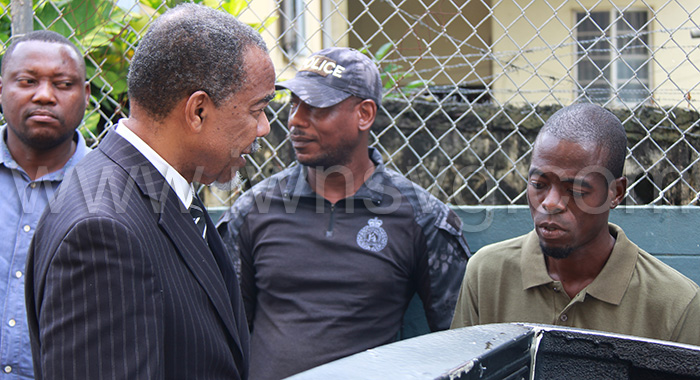

In the criminal justice system, the prosecution is responsible for presenting evidence to support their allegation that an accused person committed the offence for which they are charged.
However, on Tuesday, defence counsel Michael Wyllie argued that the prosecution did just that in the case against his client Ozari Jelani Dennie, of Prospect, who the court found guilty of possession of an unlicensed firearm and four rounds of ammunition.
Wyllie’s strange interventions at the Serious Offences Court triggered the intervention of fellow lawyer Grant Connell, who was not involved in the case.
Chief Magistrate Colin John granted Connell’s application that the sentencing in the case be adjourned, and set that hearing for today (Wednesday).
In his closing submission, Wyllie argued that the gun was found in a bag and not on the defendant.

“The bag did not belong to the defendant,” he said.
He noted that the prosecutor, Inspector of Police Renrick Cato, had pointed out that the defence did not challenge or object to the prosecution’s evidence.
Wyllie said this was true, adding, “I just want to say that in saying that there is far more evidence that they are incorrect rather than they are correct.”
He said that the police did not examine the firearm for exhibits.
The lawyer said this would have helped to determine if Dennie handled the gun or had it in his possession.
“A really unfortunate situation in this case is that the defendant had a witness that could have verified what he said but he was not available to come to court at the time,” Wyllie said.
As regards the evidence that Wyllie did not object to, he said that in the caution statement, Dennie did not admit to possession of the gun.
“It is really unfortunate that Officer David included that in his statement as the defendant saying that. So, that fact alone is far more than enough to dismiss this case,” Wyllie said.
He argued that the evidence in the case was “not sufficient, most of it is illegal, to have the defendant found guilty.
“This matter should be dismissed,” he said, adding that the “biggest controversy” was the “wrong testimony of the prosecution” that the gun was on Dennie.
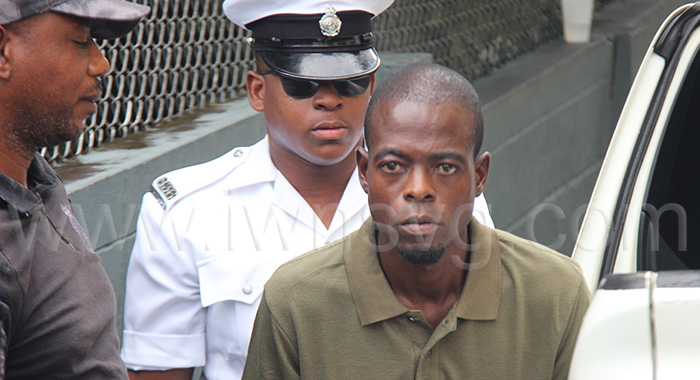
Wyllie said the gun was in a bag next to Dennie who had never been seen with it in his possession.
“So, the big fundamental issue is whether he was in possession of it. He was in possession of the knife. That is what the police found on him, not the gun. The gun was in the bag, and so, he is innocent.”
In his closing submission earlier, Cato said the prosecution had to prove that the item was a firearm, that Dennie knew that it was a firearm and that he had it in his custody or control.
“The offence is not ownership of the firearm. It is possession of the firearm at the time,” he said.
The prosecution noted that the ballistic expert, Station Sergeant of Police Julian Cain had testified that the exhibit is a firearm. It was not in contention that Dennie did not hold a permit to keep a firearm, the prosecutor noted.
The prosecutor noted that the investigating officer, Detective Sergeant Glendon David testified that he was on mobile patrol in Arnos Vale on Nov. 29, 2024, when he saw Dennie acting suspiciously.
David’s evidence was that he approached Dennie, identified himself as a police officer and requested a search of his person, to which Dennie consented. During the search, David found the firearm in Dennie’s waist.
The office said Dannie said that the firearm belonged to his deceased father.
In addition to the oral statement, Dennie gave a written statement at the police station, in the presence of a justice of the peace, saying that he had the firearm for his protection.
In the same statement, Dennie said he knew his father had a gun and that the police had gone to the home of a lady to whom his father was married, looking for the gun.
“He had with him his father’s firearm permit,” Cato further noted to the court…
“In no way at any point in time did the defence challenge the prosecution’s evidence,” Cato noted.
He said that the caution statement was shown to the defence before it was shown to David.
The prosecution did not object to it being tendered into evidence or read, nor did they challenge David or Dennie’s signature on the document.
Cato said he was, therefore, surprised that while Dennie was testifying, his lawyer asked to see the signature on the caution statement then said it was not his signature.
“The defendant said he gave a statement to the police but it was in relation to a knife that he had in his waist,” Cato recalled.
He, however, said the prosecution did not put this to David while cross-examining him.
However, in his defence, Dennie claimed that he had a knife in his waist and the bag was next to him.
He said the police searched the bag, found a gun and arrested him.
Dennie’s argument was that the gun belongs to a security guard.
“Any reasonable person would tell the police the bag is not theirs and belongs to a security person,” Cato said.
“That was never said to the police, based on the evidence of the defendant.”
The prosecutor asked the court to accept its case and find Dennie guilty.
Cato noted that while Dennie said that the gun belonged to his late father, his father had a .38 pistol, while the gun in question is a 9mm.
The prosecutor said that to the best of his knowledge, when the defence fails to challenge the prosecution’s evidence, they are accepting it as true.
“And this is what happened in this case,” Cato said.
“The prosecution’s case was never challenged at all, nor was the defence case put to the prosecution’s witnesses at all.”
After hearing the submissions, the chief magistrate said that the evidence was still fresh in his mind.
He outlined the prosecution and defence cases and found Dennie guilty.
Wyllie was asked to mitigate on Dennie’s behalf but because of the strange nature of his plea in mitigation, Connell asked the court to adjourn the sentencing.
The court set the sentencing for today (Wednesday).
Dennie better ask for another lawyer before sentencing (if possible) This is craziness!
Although it is not advisable, he may have been better-off representing himself!