



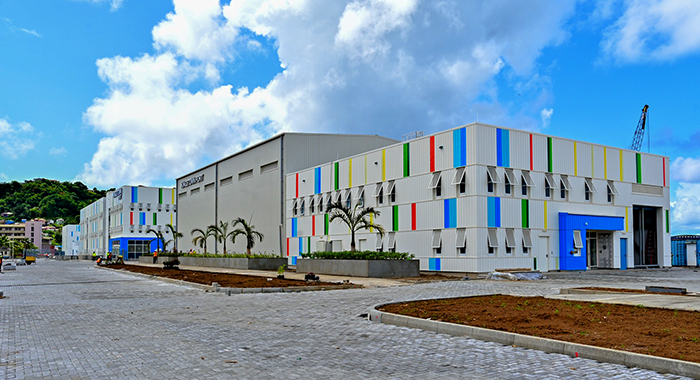
We’ve heard some recent announcements addressing the pending traffic situation around the new port in Kingstown. We’ve written several pieces on this new port, quoting from several documents.
In light of recent pronouncements from the Parliament, we will look back at the final environmental and social impact assessment (ESIA) report of 2019 and ask a few questions.
Traffic
Recently, we heard about the rearrangement of the traffic around Kingstown to accommodate what is expected to be an increase in traffic to the port. Here’s what the ESIA said about how traffic was to be addressed, citing current congestion around the existing port, and what is expected at the new one:
“Therefore, it has been proposed by the Ministry of Transport and Works that for non-port traffic, and for commercial traffic not destined for Kingstown, the by-pass route along Level Garden Bypass will be upgraded by widening of the existing single lane road to 2 lanes.”

Here’s where we ask: is it even possible to widen that road to make 2 lanes?
The report also mentioned other general road improvements; among them, having a 4-lane “foreshore road” directly behind the reclaimed area; “Local repair of roads to Grenville, Halifax and Tyrell Street” and what we heard in the Parliament on Monday — “Roadside parking restrictions, where possible”.
Port size
While on the ESIA, here’s more of what it covers. “At full capacity, the containers will be stacked in blocks to a maximum stacking height of six containers (empty), respectively four containers (laden). It can be assumed that the capacity for container storage is well above the requirements based on the traffic forecast. Therefore, containers will be stacked to a height of two or three only, which requires fewer moves, less time and less energy consumption.”
Interpreting this statement may lead any reasonable person to conclude that the size of what was constructed is far more than what SVG’s forecast needs are. Apparently, SVG is not expected to have the kind of traffic to match the size of what was constructed. In fact, if you were to extrapolate, you may come to the conclusion that it is at least twice the size of what the country’s forecast needs are.
Given that the forecast port traffic (container landings) is what it is, and given that the government had four other options before it for port operation improvement, was it necessary to spend EC$700 million on a new port?
Sheet piles
Again, according to the report: “The container terminal will be constructed on reclaimed land. The required volume of filling material is estimated to be approximately 305,000 m³ (cubic meters). The Draft Geotechnical Report of this project discusses as an alternative to construct the berth on piles. This would drastically reduce the amount of filling material required, while at the same time having less impact on the marine environment, on current and sedimentation patterns. A final decision has not yet been made, but the sheet pile solution is likely to be preferred for financial reasons.”
“Under the current design, dredging is required to accommodate the design vessels as described above.”
Here’s where we now ask: what were the financial reasons for choosing sheet piles over the tried and tested design method of constructing the berth on piles, as it is at the existing old port? The old port has survived several storms and hurricanes.
These are the very same sheet piles that became declutched, causing water to leak back into the reclaimed area, which then cost time and finance to repair.
Also, according to the ESIA report, had the berth been constructed on piles, we would have needed far less filling material (dredged sand). There would have been less impact on the environment and there may not have been any need to dredge (deepen) the area so that larger ships can come in. Not only that, perhaps the need for ongoing dredging would have been avoided. As it stands now, constant dredging will be needed to clear the buildup of tide deposits along the sheet piles, as part of the ongoing maintenance.
The decision to choose sheet piles probably ended up being more costly, given the repair work that it needed to correct the declutching.
Again, whose decision was it to choose sheet piles, and what were the financial reasons? Was it financial reasons, or were we in a rush?
Observer
The opinions presented in this content belong to the author and may not necessarily reflect the perspectives or editorial stance of iWitness News. Opinion pieces can be submitted to [email protected].
You’re darmed if you do and likewise when you don’t. These Monday morning quarter backs. I can’t with you people the Government came up with a idea then a executed it now the negative comments. At least they are doing something to make a difference in the country. Let research the benefits of the project 👌 then you can begin to point out flaws but at least tell me how this can help the country!!!!!