



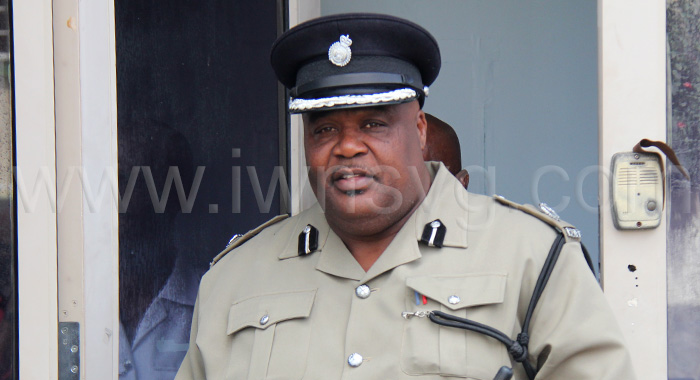

Assistant Commissioner of Police with responsibility for crime fighting, Trevor “Buju” Bailey, who was summoned to testify in Too Cool Chris’ trial for wounding, says “a bit more care would have to be exercised” when dealing with someone who has a mental illness.
The defence summoned Bailey to testify in the case in which Too Cool Chris, a popular DJ and radio personality, is charged with wounding in connection with the shooting of Kevin Patterson in Kingstown on July 4, 2024.
Too Cool, whose real name is Christopher Jones, has claimed that he was defending himself when he shot Patterson three times in the city.
He said Patterson was reaching for something in his bag, which was later found to contain a knife and a box cutter.
However, the prosecution has argued that Jones acted maliciously and that his action did not amount to self-defence.

(Read the details of Jones’ defence here.)
Responding to questions from defence Counsel Grant Connell, who summoned him to testify in the case, Bailey said that he understands self-defence.
He said that sometimes police officers in the line of duty have to interact with people who have mental issues.
Bailey said he knows of incidents where death has resulted from police attempting to arrest people with mental challenges.
Recruits, as part of their courses at the Police Training School, are taught by the Ministry of Health how to interact with people with mental health challenges.
Workshops are also organised for officers on the frontline who deal with people who have mental health issues, Bailey testified.
Bailey said he was never present when a death resulted from police interacting with a mentally ill person.
He said that because a mentally ill person might be acting in a way that they might not have had it not been for their illness, “a bit more care would have to be exercised.
“You have to first ensure that you have the attention of that person, speak in a calm and collected way, and assure the person that you are there to assist them to get the help he or she requires,” the officer said.
“But there are times you may not be able to reason with that person because they might not understand what you are saying because they are not coherent.”
Bailey said he does not know Patterson personally but had “seen him around”.
Connell asked:
“You are on the frontline and you have to arrest him, would you approach with care or normal?”
“With care,” Bailey said.
Connell then turned his attention to a licensed firearm, asking Bailey what the purpose of it is.
The senior police officer said that a person is granted a firearm permit for many reasons, mentioning protection of oneself, protection of one’s family, protection of one’s property, and the prevention of a crime.
He said it is normal that when a firearm is used for any of these reasons that the state takes the firearm away from the licensed holder for “the purpose of investigation…
Asked what he would do if someone, within 10 feet of him, says, “I’ll kill you. I will kill you tonight”, Bailey said:
“Certainly, my alertness would be at its optimum.”
Connell asked Bailey what he would do if the person who uttered those words pushed his hands in a bag repeatedly and approached him, saying, “I’ll kill you.”
“Once I anticipate imminent harm could be inflicted on me, there would be a preemptive strike,” Bailey said.
Asked if he meant he would aim to kill or disarm, the witness said, “The intent is never to kill. It is to reduce the risk or the threat that you are faced with at the moment.”
At this point, Senior Magistrate Tammika Mc Kenzie, who was presiding, asked Bailey if he was speaking as an officer with that training or as a licensed firearm holder.
The witness said he was speaking “as Trevor Bailey”.
Connell asked Bailey if a box cutter would be considered as an offensive weapon.
Bailey said it depends on the manner in which it is carried and used.
Asked to give an example, Bailey said that if he were to use Connell’s analogy of a person armed with a box cutter and issuing threats, the box cutter would be deemed to be offensive.
He said that from his years of investigating summary matters, getting statements from the source where the incident allegedly occurred “is a good place to start”.
Asked if this is where most of his investigations begin, Bailey said, “The source is a rich place to start, to get witnesses to the incident.”
The lawyer commented: “When you start your investigation in a rich place, it usually results in good results.”
Earlier in his evidence in chief, the lawyer had asked Bailey about his roles and responsibilities and involvement in the case.
Bailey said his duties include supervision of all indictable files and any other file that crosses his desk.
He said he knows Jones but did not have any interaction with Jones as regards the case, nor did he have any interaction with the case file.
Bailey said the case file did not cross his desk
The lawyer asked Bailey to outline the procedure from the time an arrest is made until the case reaches the court.
Bailey outlined the process, noting that it is different for indictable and non-indictable offences.
Asked at what point an arrest is made, Bailey said that if the investigation is being done by a constable, the non-commissioned officer who reviews the file can order an arrest.
He said there are, however, instances in which the file is forwarded to a senior office for a directive to charge.
Asked if cases of the “magnitude” of Jones’ usually go to the commissioner of police (COP), Jones said the COP “ultimately has jurisdiction over all investigative matters”.
Bailey said that while all case files do not go directly to the COP, the COP may request any case file that is under investigation.
“Is it usual?” Connell asked.
“I cannot speak to whether it is usual. I know he has jurisdiction and if he summons it, it goes to him.”
Regarding his role of CCTV footage from state-operated camera in crime fighting, Bailey said once the camera captures footage of an incident, the footage is used to assist in the investigation.
He said he does not have access to the camera and could not say if those on Bay Street were working at the time of the incident.
“The camera system does not fall under my portfolio, so I have absolutely nothing to do with them otherwise. If an officer indicates that an incident occurred in the vicinity where cameras are located, an application for such footage would be sent to me, and I would sign off on that application and authorise the release of that footage,” Bailey told the court.
The purpose of getting the footage is to see if the incident was captured and if the footage would aid in that investigation.
“The request will come from the investigating officer. Having read the request, I will sign off to the control room to release the footage,” Bailey said.
During cross examination by the prosecutor, Sergeant of Police Shamrack Pierre, Bailey said the state-owned cameras on Bay Street are monitored from a central location.
Asked if there are any state camera in the area between Court and Home Centre on Bay Street, Kingstown, Bailey said:
“I honestly don’t know where all the cameras are.”
“As a trainee police officer, when dealing with someone who is deemed mentally challenged, is the first objective to shoot that person?” Pierre asked Bailey.
“As stated before, care has to be taken,” Bailey said.
“You are quite familiar with this case that is before the court?” the prosecutor asked.
“I have not seen the case file,” Bailey said.
The senior magistrate is slated to hand down her verdict on Dec. 10, but said she would notify the parties if she has a verdict before then.
Bailey as a person who is charged with law and order is not the smartest cookie around. He can be easily be outsmarted and as a wictness, look at the response he provided. He was bated into a trap for which is response was inconsistent to a hypothetical question.When you failed to graduate from high schol is it not saying something?
I have no respect for the school drop out that has been given a position where there is clearly no fit. Ghe position is over his head.