



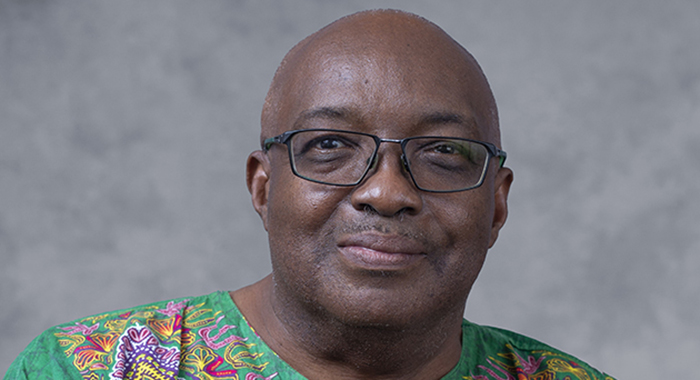

By Ashford Peters
A senior lecturer in history at the University of the West Indies (UWI) is calling for history to be taught in every school in the Caribbean, given that it is of paramount importance to development.
Henderson Carter made the call as he reviewed the book, “St. Vincent and the Grenadines – A General History to the Year 2025, Volume One”, at the official launch at the UWI Cave Hill campus in Barbados.
The book, written by Vincentian historians Cleve Scott, Garrey Dennie and Adrian Fraser, each of whom holds a doctorate in the humanities or social sciences, namely history and political science, offers a native perspective on the life of the indigenous people (Garifuna and Kalinago), European conquest, enslavement, resistance, native genocide, reparation and reparatory justice.
It is to be included on the list of textbooks for every school in this country.
Carter said that while the book focuses on St. Vincent and the Grenadines (SVG), the authors found time to ask the important question: “Why is history important?”

He noted that they quoted Leader of the Opposition, Ralph Gonsalves, a former prime minister of SVG, who made the point that history helps people to understand themselves as “it looks at who we are as a people, what we have been, where we are going, and what we are capable of”
Carter said that “understanding of ourselves, who we are, what we have been, where we are going, and what we are capable of … tells us, therefore, that history is at the heart of development.
“[It is] not a subject that just excites people with a few stories, but is really at the heart of development. It is a subject that ought to be taken by our politicians, because they chart paths, by our civil service, by our students within the university.
“And we endeavour to ensure that all of our students take Caribbean civilisation or introduction to history, which is a good thing. But I think we have to go a bit further and deeper to ensure that in the primary schools and in the secondary schools, from forms one to three, that the students come face to face with history.”
Carter said it is possible for a student to complete their secondary, community college, and university education without engaging with history.
“Because people can do social studies and take that path, and you do Caribbean civilisation, which is compulsory. But it is possible for that to happen, that students could come up and become civil servants and politicians and prime ministers and have not heard about the Monroe Doctrine,” Carter said at the ceremony.
The Monroe Doctrine, proclaimed by President James Monroe in a statement to Congress on Dec. 2, 1823, formed a cornerstone of U.S. foreign policy, declaring the Western Hemisphere closed to further European colonisation and interference.
Initially, the intent was to protect newly independent Latin American nations from Spanish recolonisation.
In its early decades, the doctrine was largely enforced by the British navy, which also sought to maintain trade opportunities.
However, in the 19th and early 20th centuries, it was used to justify U.S. intervention and expansion in Latin America.
Carter reiterated the crucial importance of history to development, and the fact that students are graduating without knowledge and understanding of their past and the history of their country and the region.
“Yes, that’s possible. And it is happening. And we have to make some serious decisions in the region, not only in Barbados, in the region, to say to our leaders that history must be taught in all of our schools – every single one,” Carter said.
“My view is that if you want people to love your country and not commit the heinous crimes that are being committed, it’s important to get them to love their society, their village, their school, and their country. I believe that a lot of this crime is coming about because people do not love their country.
“They don’t appreciate their country. They don’t know about the struggles that we have made or the struggles made on our behalf. So, we have people walking about the country proclaiming boldly and foolishly and not voting, not knowing that in 1935, only 3,500 people voted in this country.”
He noted the struggle between 1935 and 1951 to get the vote for black people, when Whites, using the N-word, were saying, “No, we ain’t want them here”.
Carter pointed out that 3,500 people voted in 1935. “But in the 1951 election held on the 13th of December, 95,000 people voted — 95,000 people!”
Carter reiterated that those people who are walking about saying they’re not voting don’t understand the struggle that it took to get the vote in the first place and so they don’t appreciate the struggle.
“So, they don’t know where we were. And they don’t know where we’re going either,” he said, adding that such behaviour coming from “educated people would lead us into trouble…
“Suppose all of us sit down and say, ‘Well, we ain’t voting.’ You know what would happen? Chaos. … So I want to say, therefore, if we are going to maintain this democratic ethos and maintain this democratic society, we have to put history back on the curriculum,” Carter told the ceremony.
Head of the Department of History, Philosophy and Psychology at Cave Hill Campus, UWI, Rodney Worrell told the ceremony that if students and state managers in the Caribbean had an appreciation for history, they would not be troubled about the developments taking place today.
He said they would know that the United States and the colonial powers had always had ambitions about intruding in the Caribbean.
“We see the theft of the Venezuelan oil, but there was the theft of the resources of the Caribbean at another historic moment,” Worrell said.
“So, the history of St. Vincent and the Grenadines, the history of the Caribbean, but more so that we’re talking about St. Vincent and the Grenadines that is on full display tonight, the history of resistance, the history of resisting genocide, a history of resisting slavery, and this resistance was conditioned with the creation of a better world for their children and their children’s children,” Worrell said.
Worrell congratulated the Vincentian authors for a “massive contribution to the neglected history of the region.
“… this work is a massive contribution to the historiography of the Caribbean. And we know that the Eastern Caribbean has been neglected in terms of writing about its history.”
He said Jamaica and Trinidad seemed to have received much more attention than the Eastern Caribbean.
“So, I must congratulate the Vincy historians for taking up the task and writing this history, and writing this history from the perspective of the peoples of St. Vincent, and also interrogating a lot more sources than, let us say, if it was written from the perspective of the colonisers,” Worrell said.
Worrell noted that the first volume focuses on the native peoples, genocide, and African enslavement in this country from BP 5000 to 1838.
A concerted, committed and most desired initiative. Certainly, these collaborators, have embarked a upon unique task, that is so practical yet so imperative to the Caribbean’s historical chronicles. Hopefully, Turks and Caicos will be mentioned, even a sliver of their rich history from a buccaneers’ hideout to a contemporary and fascinating tourist destination.
This essay speaks volumes when it comes to the inefficacy of Caribbean regional economic integration and corresponding institutions.