



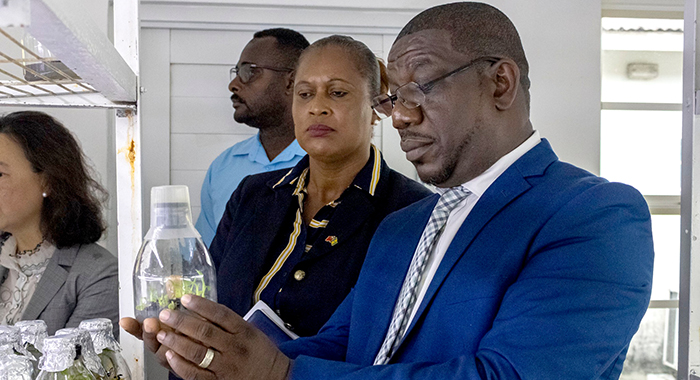

Agriculture Minister Israel Bruce has warned that St. Vincent and the Grenadines (SVG) is “too dependent” on imported food and exposed to global shocks, telling young farmers at the launch of the Agricultural Productivity Recovery and Young Farmers Training Project that they are being invited into a “future‑facing industry”, not asked to “step back in time”.
Bruce said the programme is “about partnership, purpose, and possibilities,” and directly tackles rising costs, climate change, an ageing farm population and weak market structures.
“Today is about the seeds that we plant, both literally and figuratively, that will determine the food on our tables, the strength of rural communities and economies, and the resilience of St. Vincent and the Grenadines in many, many years to come,” he said at the ceremony at the Orange Hill Agricultural Biotechnology Centre.
He used his speech to define and contrast food security and food sovereignty, noting that SVG imports Irish potatoes, onions and garlic from Trinidad and Tobago.
“If we are importing lettuce from America and tomatoes from the USA, we are not food secure because we are relying on the ships to dock at Port Kingstown or for the hucksters to go to Trinidad, sell your agricultural produce, buy Trinidad agricultural produce, and come back to sell you, so that they could pay you for your agricultural produce. That is the dilemma, and that is not a secure situation to be in.”

Bruce said food security presupposes that St. Vincent and the Grenadines is producing enough to feed its people without having to import.
“Food sovereignty simply presupposes that we are producing food that is special to St. Vincent and the Grenadines, to our own sovereign state.”
Bruce argued that local innovation shows how SVG can move in that direction, pointing to agro‑processing efforts at the community college.
He said students there are making cheese and barbecue-flavoured dasheen chips and breadfruit tacos.
“… it tells me we are saying to Mexico, ‘Get out of the way, St. Vincent and the Grenadines is ready to start this fight.’”
He challenged secondary‑school students to support local products,, saying they could consume breadfruit tacos instead of Mexican tacos at supermarkets.
“… that is where food security and that is where food sovereignty comes in,” Bruce said.
“This programme supports both food security and boosts food sovereignty,” Bruce said, adding, “We will prioritise core staples and high‑nutrition crops for domestic consumption.”
Global shocks and local vulnerabilities
Bruce linked the project to mounting global pressures, including price spikes and geopolitical tensions.
“Global volatility is pushing up the cost of fertiliser, and I dare add, pushing up the cost of fuel,” he said.
He noted that other Caribbean countries had already raised fertiliser and fuel prices since December 2025, but SVG had held off.
“… thanks to the steadfast hand of the Honourable Prime Minister [Godwin Friday] … he has held off the suffocation for the people of St. Vincent and the Grenadines, and the government has borne the brunt for all those months.”
Bruce said higher costs are being driven in part by the United States and Israel’s war on Iran.
Bruce added that climate change is reshaping seasons and intensifying droughts, floods, and storms.
“Too much of what we eat is imported. Can I say that again? Too much of what we eat is imported,” Bruce said.
The three‑year, US$3.1 million Agricultural Productivity Recovery and Young Farmers Training Project was framed as both post‑disaster recovery and a generational shift in agriculture.
Officials said 75 young farmers would receive advanced training and hundreds of other farmers and extension officers to benefit from technology and business support.
Taiwan is contributing just over US$2.5 million and St. Vincent and the Grenadines about US$630,000 to the US$3.1 million budget.
‘Not asking [youth] to step back in time’
Bruce said the programme is designed to bring them into a technologically advanced sector.
He said Vincentian youth are being asked to “step into a future‑facing industry” that uses data, sensors, drones, computer applications and climate‑smart practices, one that blends agronomy with entrepreneurship, and one that values creativity as much as hard work.
“Young farmers who are also managers, technologists, marketers, and community leaders,” he said, adding that the training is designed to build exactly those capabilities.
“Practical farming skills, business planning, digital tools for farms, value‑added processing and market access strategies. Therefore, we are committed to ensuring that a young person who chooses agriculture can see a clear pathway from a small start to a scalable enterprise,” Bruce said.
No snails? These guys are all talk.
How does a young person visualize a future as a farmer in SVG?
Does s/he have the resource to start a farm? Of so, how long will it take to produce a living income?
How large must the acreage under production be to reach economies of scale?
Does a program exist to pair ageing farmers with prospective young farmers?
These are some questions that need specific answers, not vague references to food security and food sovereignty.
SVG has never had either food security or sovereignty (except briefly with arrowroot) since the first French settlers began farming here in the 17th century).
Moreover, land fragmentation resulting from the demise of the sugar plantation system in the early 19th century has produced a hand-to-mouth peasantry with the exception of the long ended support of banana production in the British market.
In short, farming has long been a recipe for a meagre existence, if not outright impoverishment, why most young people avoid it like the plague.
Honestly, people just want the basics: steady jobs, decent roads, an efficient way to get from island to island, and a good place to live with proper plumbing and affordable electricity.
Remember these guys are lawyers. Clueless about the subject matter they are supposed to oversee.
All we do is sit back and critic the previous and current Gov’t. Remember you’ll have a say, you can voice your ideas or opinions. I read some of the comments and yes you have some good points, but don’t bring it across as a critic or trying to bring the gov’t idea down. How about reaching out to your representatives and hold a meeting I’m sure they will listen to new and fresh ideas. We need to starting thinking and acting different.
The country is in a state because we do not export nothing only import. We too can give our suggestions, we’re the ones feeling the pressure.
I think if they find markets and make the lands and machines accessible, more younger people will get more involve with farming. There is money in farming but First step is the market to export then we will see change. Just saying we need to be the change, stop being or playing the victim.
Remember this is new to these guys.
No one was born with experience, it comes with time and practice.
They need all our help, we can’t just sit back on rely on the Gov’t .
Lawyers are not alien to Agricultural development ideas. In fact, I would surmise that the Honourable Israel Bruce possesses a solid foundation in Vincy agriculture. Hopefully, he will supplement that background with relevant advice from individuals qualified in Agronomy
Agricultural Economics, Agricultural Engineering engineering, Etc. Don’t sell him short.
Vinci Vin