



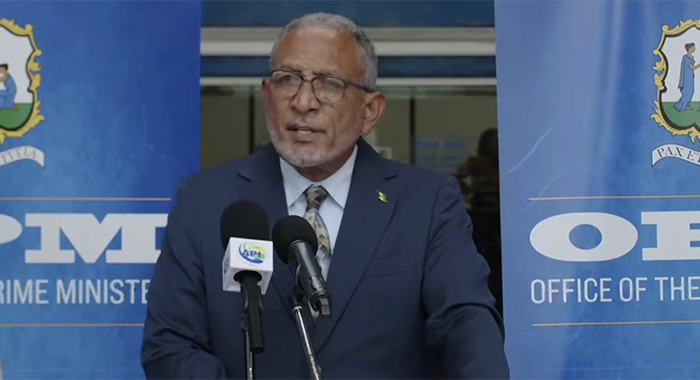

Prime Minister Godwin Friday announced on Wednesday a three-month package of tax and fee reductions on imported fuel in an effort to contain sharp increases in gasoline and diesel prices at the pump.
The announcement in a national address from Kingstown six months to the day since the New Democratic Party was elected to office and Friday said the measures were being implemented amidst “a difficult global reality” driven by higher oil and shipping costs.
Friday said global oil prices and freight costs had created conditions under which Vincentians would otherwise face dramatic increases in fuel prices and a wider spike in the cost of living.
“Between January and May of this year, the price of Brent crude oil rose by 68% from around US$64.50 per barrel to over US$108 per barrel,” Friday said.
“For a small island developing state that depends on imported fuel, those price increases reach us quickly, and they affect us directly.”

He warned that, without government intervention, retail fuel prices in SVG would jump to among the highest in the Eastern Caribbean.
Fuel price shock without intervention
Friday said that, based on current global oil market conditions, domestic fuel prices would have risen steeply if the state had simply passed through the higher import costs to consumers.
“Effectively, the global oil market currently demands an increase of approximately $5.60 on gasoline and over $5 on diesel,” he said.
Based on the government’s three‑month intervention, fuel prices at the pump will be held at:
- Gasoline — EC$16.92 per gallon
- Diesel — EC$16.26 per gallon
- Low sulphur diesel — EC$16.40 per gallon
Friday outlined the projected pump prices in the absence of government action:
- Gasoline would rise from EC$13.22 per gallon to approximately EC$18.82 per gallon;
- Diesel would increase from EC$12.56 per gallon to roughly EC$17.71 per gallon; and,
- Low sulphur diesel would climb from EC$12.93 per gallon to nearly EC$17.85 per gallon.
“Without our government taking steps to cushion the impact of global price increases, gasoline prices at the pump would go up by approximately $5.60 per gallon, an increase of over 42%, and would mean consumers would pay nearly $19 per gallon at the pump,” Friday said.
The prime minister said that such increases would not only hit motorists but would also feed quickly into transport fares, food prices, electricity bills, farming costs, business costs, and ultimately the cost of living for every household in SVG.
Three-month intervention to hold down pump prices
Friday said his government “refuses to sit back and allow that to happen” and is implementing “targeted, responsible measures” for at least 90 days to cushion the impact on consumers.
The Prime Minister announced a three-month intervention measure that will:
• Reduce the excise tax on fuel
• Cut the customs service charge on imported petroleum products by 50%
Friday said the intervention is designed to cap pump prices below what the market would otherwise dictate.
“Instead of gasoline reaching nearly $19 per gallon, the intervention will hold the price to approximately $16.92 per gallon,” he said.
“Instead of diesel climbing to almost $17.71, the intervention keeps the price at $16.26 per gallon and instead of low sulphur diesel rising to $17.85, the adjusted price will be $16.40.”
Friday framed the adjustments as a direct transfer of savings from the state to the consumer through forgone revenue.
“On gasoline, the government intervention is absorbing approximately $1.90 per gallon that would otherwise have been passed on to consumers, and for diesel it is absorbing approximately $1.45 per gallon,” he said.
Impact on motorists, transport operators, businesses
The prime minister said the measures are aimed at protecting ordinary motorists, public transport operators, and businesses that depend heavily on fuel.
“Without this intervention, a standard vehicle owner would have seen fuel costs jump higher in a single month,” Friday said.
“Instead, this measure puts meaningful savings back into household budgets, so people can shop for groceries.”
He said the move is especially significant for operators and producers whose cost structures are directly tied to fuel.
“For a minivan operator, a taxi operator, for farmers and for fishers, it means operating costs lower than they might have been based on the world oil prices,” he said. “That is, the measures keep prices lower for these producers.”
Friday argued that the intervention will also slow the pace at which higher fuel costs translate into higher prices across the economy.
“It means slowing the increase in food and other material prices, delaying the passing on of the cost to consumers,” he said.
He added that, without the measures, SVG “would have become one of the most expensive Eastern Caribbean countries for fuel,” but that with the intervention and current prices of $16.92 for gasoline and $16.26 for diesel, “we are among the lowest in the OECS region.”
Fiscal trade-offs put people first
The prime minister presented the fuel package as part of what he called a “people-first governance model”, while also acknowledging the fiscal pressures facing the state.
Earlier in his address, Friday said his administration had inherited “a sobering economic reality,” including a debt-to-GDP ratio of 113% and an overdraft that “exceeded $200 million, more than double what the law provides.” [
He argued that despite these constraints, the government must intervene to ease the burden on households and businesses.
“Responsible leadership means balancing the books while protecting… necessary social programmes,” he said. “What we can do to make things easier for ordinary people, we will do.”
He characterised the fuel measures as “a fiscally responsible shield against extraordinary global pressures” and said the government is prepared to forgo revenue in the short term to prevent a sharper shock to consumers.
The prime minister linked the fuel measures to a broader effort to contain rising living costs across key sectors and announced measures to contain the cost of electricity and food.
Remember the election promise to lower cost of living? This is capping an increase, not lowering. Politicians are just a necessary evil.