



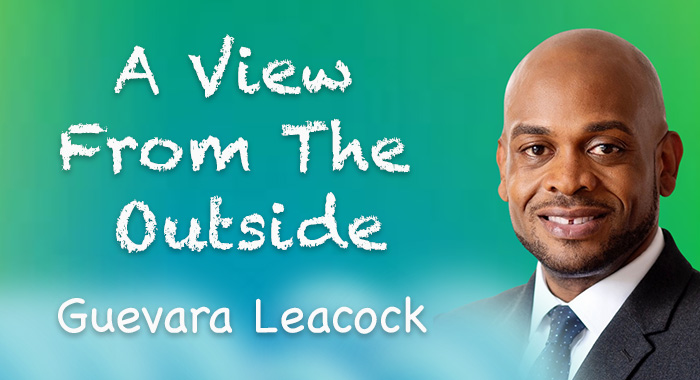

By *Guevara Leacock
On A View from the Outside this week, Saturday, May 30, 2026, we turn our attention to CRITICAL THINKING, with the view being that critical thinking is not just an intellectual exercise. It is part of citizenship. It is a form of freedom. Without it, people begin to accept corruption as normal, incompetence as unavoidable and lies as just another political strategy.
This week’s view is inspired by a conversation I had with a friend of A View from the Outside this past week. That friend said, “A country does not collapse only through economic problems. It collapses when its people stop thinking critically, stop valuing truth and stop demanding excellence not only from themselves but also from their leaders.”
That is a powerful statement. It was made in the context of something the friend noticed recently — Vincentians are thinking and speaking openly again. The statement reminds us that national decline does not always begin with high debt, rising poverty, high unemployment, low wages, or constitutional crises such as the illegal vaccine mandate. Sometimes decline begins more quietly. It begins when citizens stop asking questions, when truth becomes inconvenient and when public debate is treated as disloyalty.
Between 2001 and 2025, many Vincentians knew what that felt like. If you were not loyal to the labour family, you risked trouble. If you spoke out against the regime, the warning was clear, “Ah go deal wid yo.” Decline begins when people fear ridicule, victimisation, exclusion, or punishment for speaking honestly. It begins when leaders expect applause instead of scrutiny, loyalty instead of accountability and silence instead of participation.

It is now becoming clearer that the national decline in St. Vincent and the Grenadines over the past 25 years was not only economic. It was also social and democratic. The voices of Vincentians were stifled. One voice dominated. One set of opinions mattered. Even members of the former regime had to conform to what “massa” wanted, or risk being ostracised.
That is why critical thinking matters. Critical thinking and its outward manifestation of free speech is not a decoration in a democracy. It is not a luxury for comfortable times. It is not simply the right to say popular things. It is one of the main ways a society protects itself from error, arrogance, corruption, incompetence and decay. It is the oxygen of public life. Without it, a nation may still have elections, ministries, courts, schools and media, but its democratic soul begins to die.
When citizens are free to speak, they are free to warn, criticise, expose wrongdoing, challenge weak reasoning, question false promises, reject bad policy and confront poor leadership. They are free to say, “This is not good enough.” They are free to say, “Show us the evidence.” They are free to say, “We deserve better.” In a healthy society, those words are not treated as attacks on the nation. They are recognised as acts of citizenship.
But when freedom of speech is weakened by law, political pressure, social intimidation, or fear, the country loses one of its early warning systems. Mistakes go uncorrected. Lies go unchallenged. Mediocrity becomes normal and public office becomes insulated from public judgment. People begin to whisper in private what they should be able to say openly.
Did you notice that happening over the last 25 years? Did you find yourself whispering in private out of fear? Any honest Vincentian knows that and as a famous talk-show host once said, “fear stalked the land”. When truth can only be spoken in whispers, democracy is in danger.
Have you noticed the difference since November 2025? Vincentians are speaking again. Senior civil servants are commenting on the career choices of students and questioning whether too many young people are pursuing the same areas of study without considering employment realities or national development needs. Others are reflecting on how we have lost our way as a nation, rightly observing that Vincentians once valued substance over appearance.
There has also been open debate, both supportive and critical, about the temporary fiscal measures announced by the government. Vincentians are freely expressing agreement and disagreement. That is healthy. That is democracy breathing again.
A former government minister recently argued that the government’s reduction of electricity bills has not gone far enough and that the fuel surcharge should be removed altogether. Many may agree with that view. Yet it must also be said that the administration with which he was associated for over 20 years did nothing meaningful about it. But we welcome his ideas and views.
More recently, when the Minister of National Security announced a policy involving use of the police in helping to curb crime and violence in schools, his personal, business and family life came under attack. The personal lives of other ministers have also been attacked. Public comments have been made about the prime minister’s son attending important government functions. Some of those comments could be defamatory. Yet no Vincentian has been threatened with a lawyer’s letter. A year ago, some people would almost certainly have received threats of defamation action, or at least a tongue-lashing at a press conference. Those days appear to be over.
Let us be clear. Critical thinking and freedom of speech do not mean freedom from disagreement. They do not mean freedom from criticism. They do not mean every opinion is wise, every statement is true, or every speaker is responsible. Free speech can be uncomfortable, messy and sharp. Sometimes it exposes ignorance. Sometimes it reveals prejudice. Sometimes it brings out the worst in people. But the answer is not enforced silence. The answer is better and stronger argument, clearer evidence, moral courage, and a public culture that can distinguish honest disagreement from deliberate harm.
A mature society does not fear debate. It does not collapse because citizens disagree. It collapses when disagreement is no longer possible, when everyone must pretend to believe the same thing, when questions are treated as threats, and when truth is replaced by performance.
This is especially important in small societies such as St Vincent and the Grenadines. In close communities, people know each other. Families are connected. Jobs may depend on relationships. Public criticism can feel personal. Speaking out can carry consequences. People begin to say, “I better not say anything”, “I have children to feed”, “I do not want trouble”, or “that is just how things are”. No citizen should feel afraid to contribute to public debate in their own country.
We on A View from the Outside remember when Vincentians gathered outside the Bedford Street branch of the former National Commercial Bank to discuss national issues. The debates were robust. People disagreed strongly, but respectfully. Ideas for national development emerged out of those conversations. The now leader of the opposition and Dave Roberts, who offers the view from the inside, were popular members of that group.
Vincentians need to return to those days of serious public debate. That is where critical thinking happens. Over the past 25 years, silence became a habit, and the public squares in Kingstown grew empty. That must change. When citizens are silent, bad government becomes stronger.
Critical thinking is, therefore, not only about individual liberty. It is about collective survival. It is how a people keeps its institutions honest. It is how citizens remind leaders that power is not ownership. Public office is not private property. St Vincent and the Grenadines does not belong to any party, family, faction, or personality, no matter how important they think they are. It belongs to Vincentians and if the country belongs to the people, then the people must be free to speak about how it is governed.
A leader who respects democracy does not fear criticism. A leader may dislike criticism; that is human. But democratic leadership requires discipline, humility and maturity. It requires understanding that criticism is not automatically hatred, scrutiny is not sabotage and opposition is not betrayal. A wise leader welcomes serious criticism because it can reveal weaknesses before they become disasters.
Critical thinking is not negativity. It is not cynicism. It is not opposing everything for the sake of opposition. Critical thinking asks, Is this true? What is the evidence? Who benefits from this claim? What is being left out? Does this argument make sense? Are we being manipulated by fear, emotion, tribal loyalty, or political theatre?
Critical thinking is public hygiene. It cleans the bloodstream of democracy. It helps citizens resist conspiracy theories, empty promises, propaganda and political manipulation.
A country collapses when its people stop demanding excellence from themselves and from their leaders. Critical thinking is one way citizens demand excellence. When people can speak freely, they can insist on better education systems, better healthcare policy, better policing, better public administration, better financial management, better laws, better governance and higher moral standards in public life. They can resist the politics of distraction and can offer ideas that contribute to national development.
The future of St Vincent and the Grenadines depends on the quality of its public conversation. If that conversation is dishonest, fearful, shallow and vindictive, the nation will suffer. If it is free, informed, courageous and serious, the nation will thrive.
We, on A View from the Outside, encourage all Vincentians to think critically, value truth and speak with courage and purpose. May we remain a people willing to speak, willing to listen, willing to question and willing to build to build a great nation together.
*Guevara Leacock is a barrister at law of Lincoln’s Inn in England and an attorney at law in St. Vincent and the Grenadines. He has a keen interest in history and politics and is a social commentator.
The opinions presented in this content belong to the author and may not necessarily reflect the perspectives or editorial stance of iWitness News. Opinion pieces can be submitted to [email protected].
A extremely embarrassing and immature commentary. It was a waste of my time because it only offered the prejudiced opinions of an NDP sycophant and Ralph hater, with no facts or arguments supported by empirical data.
This is a very thoughtful and insightful essay. I commend the author for the wise sentiments he conveyed in this piece. Hopefully many readers will pass this article on to those in their circle of influence.
Thank you
Vinci Vin