




St. Vincent and the Grenadines has “no choice” but to restore fiscal discipline while aggressively pursuing private‑sector‑led growth if it is to escape an unsustainable debt path and entrenched poverty, says Ambassador of Finance and Investments Kevin Hope.
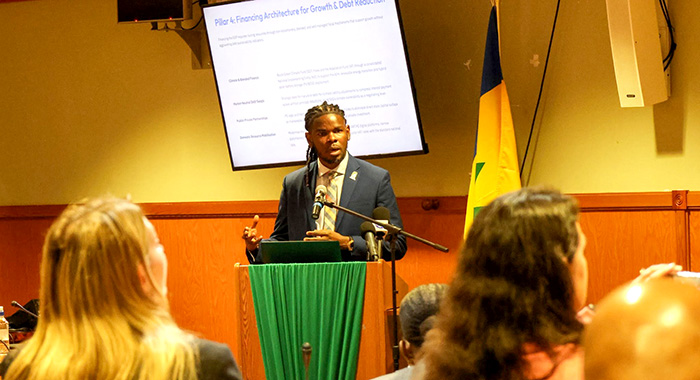
Presenting what he called “the tale of two cities” at the SVG Development Partners Roundtable in Kingstown on Tuesday, Hope sketched a stark macroeconomic picture, then set out an ambitious growth and stabilisation plan for 2026–2030 that he said must be paired with a 15‑year national development plan now being launched.
“As at the end of 2025, we had a fiscal deficit of around 12.3% of GDP,” Hope said.
“Over the last decade, we’ve had successive fiscal deficits which, in addition to these exogenous shocks, have contributed to a situation where we would consider our fiscal and debt to be at a path which is not sustainable, and as such, we need to actually take ownership in terms of the course correction.”
Heavy debt and repeated shocks

Hope’s presentation followed Prime Minister Godwin Friday’s warning that public debt has climbed above 113% of GDP and could reach about 144.5% of GDP by 2031 if current trends continue.
Hope linked the widening deficit and debt burden to a succession of shocks, namely, the COVID‑19 pandemic in 2020, the La Soufriere volcanic eruption in 2021, spillovers from the Russia–Ukraine war, Hurricane Beryl in 2024, and what he described as “fiscal slippages” over time.
He also pointed to structural weaknesses, saying, “We have huge public wage bill expansion, tax expenditures and concessions, and… a situation where we also have to evaluate our capital expenditure in terms of its effectiveness and efficiency.”
On debt sustainability, Hope echoed the prime minister’s concern, noting that the national debt is more than 100% of GDP and is projected to rise to 144.5% by 2031 if the government fails to act.
“A do‑nothing approach would put us in a situation where we will be stressed and obviously would have to take much harsher measures in the future,” he said.
Poverty, vulnerability and a ‘labour market paradox’
Hope argued that any consolidation must be calibrated against already fragile social conditions.
Citing the Country Poverty Assessment (2018–2019), he said that national poverty is estimated at 25.8%, vulnerability averages 33.7%, and food indigence stands at about 5.9%.
“So, you’re at least saying that one in four households is poor, and at least one in three households is at risk of vulnerability,” he said.
Even where the economy is expanding, he said, the benefits are unevenly distributed. From 2016 to around 2024-25, the formal labour market expanded by about 22.5%, yet overall unemployment as of 2022 was estimated at 20.8% and youth unemployment is around 35%.
He described this as a “labour market paradox”.
“We do have a number of public sector projects ongoing… which have huge demand for technical skills, but yet there’s a huge proportion with respect to imported certified tradesmen,” Hope said, citing the modern port project and the Arnos Vale Hospital.
“While this is good, as we are for regional integration, it speaks of a huge deficit within the country with respect to skills,” he added.
Anecdotal information, he said, suggests that “nearly half of the unemployed” have stopped actively looking for work “as a result of geographic or in some cases, wage misalignment”.
MSMEs at the centre of growth strategy
Hope stressed that micro, small and medium‑sized enterprises (MSMEs) must be central to any growth strategy.
His estimates are that services account for about 81% of GDP and roughly 60% of output and 45% of jobs are generated by MSMEs.
“We see our way out of our current demise really through partnerships, public‑private partnerships,” he said. “How could we incentivise and support the private sector and provide the tools and resources that we can grow our way out of our indebtedness?”
He pointed to several measures already underway, including the creation of a Department of Private Sector Development in the Office of the Prime Minister within the Ministry of Finance and a Private Sector Advisory Committee to “engage with the private sector actively to start looking at areas with which we can improve efficiencies, reduce the cost and time of doing business”.
Other initiatives include moves to strengthen Invest SVG and the Centre for Enterprise Development and ongoing work on an MSME Act and an Investment Act through the Attorney General’s Chambers.
‘Growth and stabilisation’ – not stabilisation and growth
Hope said the government was crafting a Growth and Stabilisation Plan as the immediate roadmap for the next three to five years (2026–2030), alongside a 15‑year national development plan for 2027–2042.
“We see it on one hand; we have to restore fiscal and debt sustainability within government, but this ought to be paired with private sector-supported growth to actually help us grow our way out of our indebtedness,” he said.
“Our primary focus is getting people decent wages, getting people employed,” he added. “This is why we say growth and stabilisation, not stabilisation and growth”.
Among the key macro‑fiscal targets are:
- Doubling trend growth from roughly 2.5–2.7% to around 5% in the medium term, then sustaining 4–5% growth [0:39:59]
- Achieving a primary surplus of about 3% of GDP by 2030 and sustaining it
- Returning to the Eastern Caribbean Currency Union debt target of 60% of GDP by 2035
“There is a commitment… to the ECCU target of a debt-to-GDP target of 60% by 2035,” Hope said. “We anticipate that again, with the support within government and with your support, we can find ways and means to become more efficient and more effective”.
He described fiscal sustainability as non‑negotiable’, saying growth must be structural, not subsidised, and… people are the ultimate dividends”.
Public sector reform and ‘doing more with less’
On the public sector, Hope said the government is committed to “rationalisation” of ministries and state‑owned enterprises (SOEs), but framed it in terms of productivity rather than cuts.
“Rationalisation ought not to be a bad word,” he said. “It really speaks to how do we make the public sector more productive and more efficient, and as such, how do we do more with less?”
He said rapid assessments of SOEs have already begun, and that public expenditure reviews, improved tax administration and better use of administrative data are central to the plan.
At the same time, he acknowledged the social risks of sharp adjustment.
“We are mindful that as you try to stabilise, the effect that would have in terms of the growth‑reducing impact,” he said.
“We also have to be mindful… What is this doing for lives and livelihoods in St.Vincent and the Grenadines?”
Hope said the government is therefore seeking what he called a “home‑grown programme”, phasing in reforms in a way that protects the poor and vulnerable.
Financing: climate, PPPs and domestic resources
Hope framed the roundtable itself as an invitation to help “finance the growth and stabilisation plan” more effectively.
He said the government wants to:
- Make better use of climate finance
- Pursue innovative debt instruments to lower borrowing costs
- Expand public‑private partnerships (PPPs)
- Enhance domestic resource mobilisation by reducing tax leakages and strengthening compliance
He also flagged ongoing diaspora engagement, including recent meetings in multiple cities.
“We recently … concluded our third diaspora engagement, where we went to different cities, engaging our diaspora around our development plan, and there are initiatives we are considering… how our diaspora nationals can actually own a piece of our national assets,” he said.
‘People are the ultimate dividends’
Hope’s final message was that macro targets, debt ratios and growth projections must ultimately be judged by their impact on Vincentians’ daily lives.
“Of equal importance… is a commitment for us to walk towards single‑digit poverty and unemployment numbers,” he said.
“This is ambitious, but this is again why we’re here — to really work towards trying to solve around the socio‑economic challenges for St. Vincent and the Grenadines,” Hope said.
“Fiscal sustainability is non‑negotiable, growth must be structural, not subsidised, and ultimately… people are the ultimate dividends.”
Representatives of the UN, CDB, World Bank, CAF, EU, Canada, Germany, China, UK, CARICOM Development Fund, UNICEF, UNFPA, WFP, PAHO, GIZ and others broadly endorsed the government’s direction, while urging stronger coordination, a regional lens, and an explicit focus on the poorest and most vulnerable.
Why
Why does the News Administrator continually post news stories that are several days old, and which could be considered stale news?
News from SVG’s API news service or other media are reported in your publication days later. Wouldn’t it serve the public better to report on current events as soon as possible?
Speak louder. Maybe someone will hear your voice.
look more inward for graduates who were suffering for 25 years without a job, hire them before u hire foreigners. Look into service commision application file and see some persons who were applying everytime a job advert went out, and they were never hired under ULP, even though they qualified for jobs, ask yourself why. Give them a chance now, pull their application and call some of them when there is an opening, they have become tired of applying, with no results; but they are still unemployed. Some of them are UWI graduates consider them also not just the johny come latelies alone.