





The company with which the government has signed a memorandum of understanding, paving the way for a 30-year concession and up to EC$250 million in the Kingstown Cruise Terminal, says St. Vincent and the Grenadines is “under‑marketed” but has strong potential.
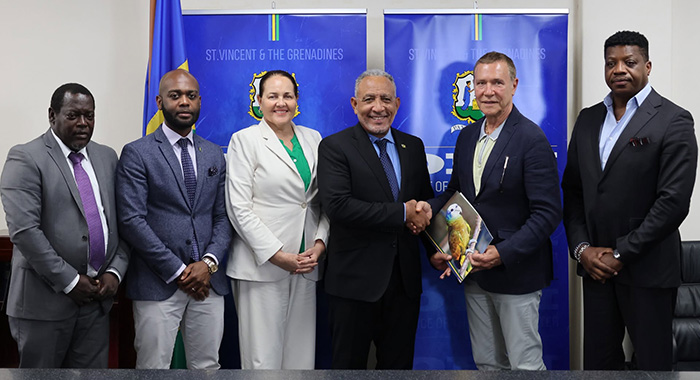
Prime Minister of SVG, Godwin Friday and Mehmet Kutman, chairman of Global Ports Holding (GPH) signed the MOU in Kingstown on Wednesday.
GPH is the world’s largest port operator and manages or operates dozens of cruise ports globally, including Puerto Rico and Nassau.
Kutman said that SVG is under-marketed “because the infrastructure is not there yet…
“The brand in the cruise industry impact is not equivocal… the brand is here, but the demand is not there yet.”

He said GPH’s relationships with cruise lines and its marketing capacity are intended to bridge that gap.
“Our primary duty is to ensure that through the marketing, through the renewed infrastructure, through our links and channels—we have very good relations with all the cruise lines—that the marketing is there, hence the brand gets what it deserves.”
Kutman projected that, once infrastructure upgrades are in place, cruise traffic could triple within five to seven years.
He cited Puerto Rico and The Bahamas as examples where GPH‑led investments and marketing produced sharp increases in passenger volumes and spending.
“In The Bahamas… when we signed the agreement in 2019, the number was a little bit over 2 million, maybe close to 3 million. This year we’re going to have 6.7 million, next year 8 million passengers, which makes The Bahamas the largest transit cruise port in the world,” he said.
On spending, Kutman said Nassau’s average per-passenger spend more than doubled after redevelopment.
“When we were awarded the licence or the concession, $56 per person, per passenger, was spent,” he said.
“Now that spend is the highest in the Caribbean at 128 dollars per passenger… Our aim is to get for Bahamas at least 150 to 200 dollars.”
Shallow noted that SVG currently has one of the lowest visitor spends among Eastern Caribbean cruise destinations.
“Similarly, over the last five years, with the cruise passengers being just under 300,000 per year on average, we in the OECS… have the lowest visitor spend of only about 59 dollars,” he said.
“That is partly because our product, it is not mature enough… and in partnership with GPH is a commitment as well to ensure that the shore excursion and the activities on land improve, which obviously means more time spent in the country and the communities, [and] means spending more.”
Local jobs, local operators, and a ‘community first’ approach
Kutman repeatedly stressed a “community‑first” operating philosophy, saying GPH intends to rely on local staff and local businesses.
“We work with the existing teams or with the locals,” he said. “None of the stores which are being developed, none of the excursions — we don’t do it, we don’t manage them. We just support them. We give them necessary training; if they need cash, we lend them cash. Of course, we’re not a non‑profit organisation… but the community has to be happy; that’s rule number one for GPH.”
He said the company “never, ever, ever” imports people to run or manage operations.
“Every member of the community, whether it’s Kingstown, whether it’s St. Vincent, whether it’s Grenadines, they have to be happy,” Kutman said.
“So we work in very close coordination, collaboration with the locals. We never, ever, ever import people to run or manage anything.”
Meanwhile, Friday said his visit to GPH’s Nassau operation, while attending a Caribbean Development Bank meeting, gave him confidence that this principle can work in practice.
“Everybody we dealt with, from the very top [to] all the middle‑level people, they were Bahamians, and they were very proud to tell us that they are born and bred Bahamians,” he said.
“Some of the stores that were built… were not large operations that you have to pay huge rents. They were small spaces that persons could do their business and sell their stuff… evident that they are there to basically give the small operator an opportunity.”
‘Investor‑friendly’ but tough negotiations
Asked about making St. Vincent and the Grenadines “investor‑friendly”, Friday said the government’s goal is to streamline processes while maintaining transparency and rule of law.
“It’s always an advantage in tourism business, because people have an option; they can go anywhere else rather than come here,” the prime minister said.
“When we talk about making the destination investor‑friendly, it’s to make it so that we eliminate unnecessary red tape… and that we are a country of the rule of law… everything is transparent and above board.”
At the same time, he underlined his role in defending the national interest.
“… for me, I represent the people of the country … so I’m looking to get the best arrangement I can to get the greatest benefit I can from this for the country,” Friday said.
“We are all transparent and upfront about that, and I don’t think there’s anything wrong in us both doing that.”
Kutman, for his part, said that although he considers SVG “investor‑friendly”, the negotiations were among the most demanding GPH has faced.
“Although St. Vincent and the Grenadines can be defined as investor‑friendly, this was the toughest discussion and negotiation we had as GPH — at least I had — thanks to AG and the minister,” he said.
When they offer you 250 million, they intend to earn more than that from the 30-year deal. *Look at the African gold mine deals.