





Prime Minister Godwin Friday and his legal team have struck an upbeat tone as the election petition challenging his eligibility for office and that of his Minister of Foreign Affairs, Dwight Fitzgerald Bramble, reached its midway point on Thursday.
Speaking outside the High Court after three days of testimony, Friday framed the proceedings as a test not only of his government’s mandate but of the country’s democratic institutions.
“I’m very, very upbeat… Our legal team did extremely well,” Friday told reporters outside the High Court in Kingstown, where acting High Court judge, Justice Gerthel Thom, a retired justice of appeal, is presiding over the case.
“There are people who want to unseat [the mandate the people gave me]. I’m going to make sure that it doesn’t happen. That’s why I’m in the court every single [day] and will be until the court rules in this matter.”
The petitions centre on dual citizenship and constitutional eligibility for elected office — an issue that has surfaced in several Commonwealth Caribbean jurisdictions and is now under intense scrutiny in Saint Vincent and the Grenadines.

Carlos Williams and Luke Browne of the opposition Unity Labour Party (ULP) have filed petitions challenging the eligibility of Friday and Bramble to contest the November 2025 general election on the grounds of their dual Vincentian and Canadian citizenship.
The ULP candidates brought the petitions after losing in the Northern Grenadines and East Kingstown in the Nov. 27 general election.
Halfway through the trial
Senior Counsel Anand Ramlogan, a former attorney general of Trinidad and Tobago, appearing for Friday and other respondents, said the case had reached “the halfway mark” with the completion of evidence for the petitioners.
He noted that the petitioners had called their witnesses and an immigration expert, who faced extensive cross‑examination.
“I cross‑examined Ms Sarah McKinnis, the Canadian immigration expert attorney … She was in the box for quite a long time, testifying virtually. I’ve cross‑examined both petitioners and all of their witnesses, and several remarkable things have emerged during intense interrogation … that we are looking forward to addressing the court on.”
Ramlogan said the respondents will present their case when the matter resumes in the first week of September, followed by legal submissions, expected in November.
“We remain extremely confident about this matter,” he added. “We repose our confidence in the [trial] judge to do justice according to law and in the best public interest.”

Friday: defending ‘the people’s mandate’
Friday, who has been present in court throughout the proceedings, argued that his continuous attendance is part of his duty to defend the outcome of the last general election.
On Nov. 27, Friday led the New Democratic Party to a 14-1 victory at the polls, ending the Unity Labour Party’s quarter-century stint at the helm, which began in March 2001.
“I’m the prime minister of the country. Rather than governing, rather than sitting in the courtroom for three days of testimony… I am here because the people have put me here. I respect their mandate,” Friday said.
“Everybody in the country has accepted [the result], but some people just can’t take their licks, and so they will come into court to try to do something else. We are going to protect and defend the mandate that the people gave us.”
He insisted he would not make “cameo appearances” in the courtroom.
“I’m going to be here every single minute for every day,” Friday said. “I’m here to represent the people… I’ll be in the court until this matter is vindicated.”
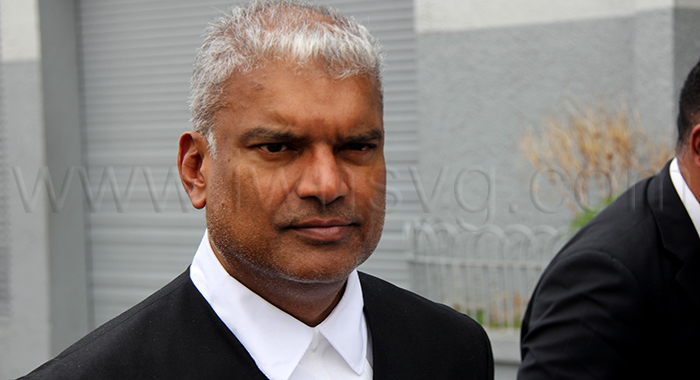
Ramlogan suggested that the challenge is politically late‑coming, given his long tenure in Parliament.
“Bear in mind this is not [my] first political rodeo,” he noted, referencing his 25 years in Parliament.
He described it as “rather interesting and curious… that this objection has suddenly emerged” after Friday was elected prime minister.
Dual citizenship and the constitution
At the heart of the petition is whether dual citizens are constitutionally barred from serving in Parliament or holding high public office.
Friday maintained that the law is already clear, telling reporters, “The constitution says it very clearly in section 25… It has been ruled on elsewhere, but from our standpoint, it’s a fairly clear situation, and that’s the argument we presented.”
Ramlogan, whose regional practice has exposed him to similar disputes in other countries, said the case has implications well beyond St. Vincent and the Grenadines.
“The concept of dual citizenship is one of some significance because we’ve had some cases before in the Commonwealth Caribbean on this matter,” he said.
“Given the smallness of the islands in the Caribbean… I think it’s important that we not confine ourselves [to] too small a talent pool.”
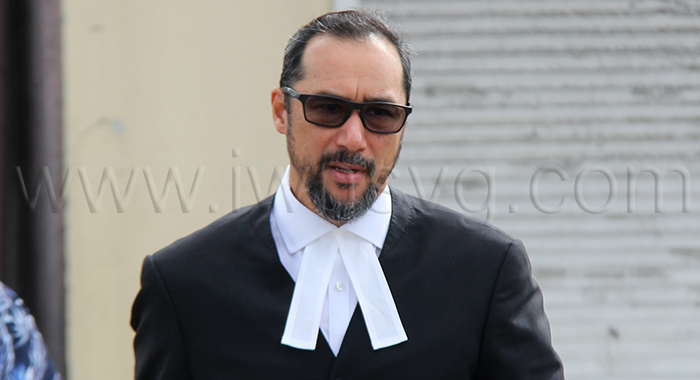
Ramlogan argued that many Caribbean states now have larger diasporas abroad than populations at home, and that those citizens often bring crucial skills and experience.
“Those are the people who have the international exposure, international experience, the education and the expertise that can come back and serve to… progress a country forward,” Ramlogan said.
“To shut them out and slam the door in their face… is a self‑inflicted wound and it’s counterproductive.”
He said dual citizens who choose to return and serve should not be barred solely because they once held or still hold another nationality.
“The time has come to review those things,” he argued. “There should be no reason why a dual citizen who is loyal and wants to live in St. Vincent and the Grenadines as a Vincentian should be prevented from serving in public office”.
Petitioners: testing constitutional ambiguities
On the other side of the courtroom, petitioner Browne cast the case as a legitimate use of constitutional rights and a valuable civic lesson, even as the respondents expressed confidence in their own interpretation of the law.
“We sought to exercise our rights under the Constitution to challenge the validity of the election, and we are just going to trust the process of the law taking its course,” Browne said.
Browne, a lawyer, described the hearings as an important educational experience, particularly for younger members of the legal profession.
“The matter in court today and for the past few days has provided a great learning opportunity for our students of law and also for young lawyers,” he said.
“We have … veteran legal practitioners being a part of the process, including senior counsel from Trinidad and Tobago on both sides, so we are able to drink from the cup of their wisdom.”
Petitioner Williams similarly defended the decision to bring the matter to court.
“We have just presented our arguments… It is a matter of a constitution, the integrity, which is a national matter,” Williams said.
“Where ambiguity lies… you go to the court, have it tested in court, and this is exactly what we are doing.”
The petitioners are represented by Senior Counsel Stuart Young, a former prime minister of Trinidad and Tobago.
Bramble: petitioners used ‘very poor judgement’

However, Bramble criticised the timing and rationale of the case, while acknowledging that the petitioners have the right to challenge the election results.
“This petition brought before us… it’s the right of the petitioners so to do,” Bramble said.
“But I think in this particular case they exercised very poor judgement in utilising that right that’s available to them. You want to tell me after 25 years of Prime Minister Friday being in Parliament, it’s only now you realise that there’s some ambiguity, and you didn’t realise that before?”
Bramble said he would continue to focus on his constituents in East Kingstown until they decide otherwise.
“I appreciate the opportunity offered me by the people of East Kingston to serve them, and I will continue so to do until those people decide they no longer want me. Nothing else, and no one else,” he said.
Beyond the courtroom: law, politics and public sentiment
Both sides voiced respect for the court’s role while drawing contrasting conclusions about the strength of their positions and the wisdom of bringing the case.
Ramlogan sought to differentiate between legal outcomes and political popularity, saying that while “the law is the law”, public support for Friday was visible daily outside the courthouse.
“When I see the throngs of people, how they are attracted to [the] Prime Minister and the love that they show him … no law, no judgement can take away that love that he enjoys,” he said.
The 14-1 ass-whipping is really painful. It’s enough to make ULP lose their minds. Lord, they can’t take it no more. Lawd me can’t tek it no more. Give me back the woman weh you give me before!
The people spoke! This attempted hijacking must be seen for what it is. I hope the MP’s prevail. The NDP should then clarify the constitution to state that only VINCENTIAN BORN citizens can serve. If SVG is not good enough for your birth, serve where you were born.
This is coming from a government when they were in opposition; one of their main criticisms of the then government was that they operated outside of the law. Now they are the government and law; it doesn’t matter anymore. Bunch of hypocrites. But not much longer since you all are a one-term. Vincentians are beginning to realize the huge mistake they made.