



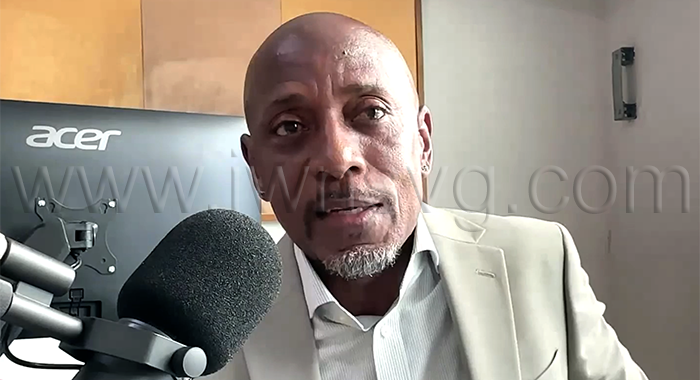

East Kingstown MP, Dwight Fitzgerald Bramble, has denied that the New Democratic Party (NDP) promised to reduce VAT within 60 days of coming to office, although this was a central plank of the party’s campaign for last November’s general election.
In October, long before then-prime minister Ralph Gonsalves announced the Nov. 27 polls, the NDP had promised to reduce the VAT from 16% to 13% should they be elected.
As the political campaigns heightened, the NDP listed the VAT reduction as one of the policies that it would implement within the first 60 days in office.
However, in an interview on Hot 97.1 radio on Thursday, Bramble acknowledged that the VAT-reduction was an election platform promise, but vehemently denied that it was a 60-day shortlist item.
Asked how he rated the NDP administration’s performance since taking office, Bramble gave the administration a perfect score of 10.

He said that his perfect score of 10 was on the basis that over the three and a half months in office, the NDP had “delivered every single thing that we said we would deliver in 60 days”.
Bramble, an economist who is minister of foreign affairs, foreign trade, foreign investment, and diaspora affairs, was asked about the promised VAT reduction.
“Well, the reduction in the VAT, we didn’t say that would happen in 60 days,” he said. “We said that we would reduce VAT from 60 to 13% but that was not one of the items that we said would happen in 60 days.”
He said the NDP had said that within 60 days it would pay a salary bonus, have a VAT-free day and double Public Assistance.
“The cutting of the VAT from 16 to 13% was not restricted to 60 days. We never said we would do that within 60 days. I’m telling you. I know that for a fact,” Bramble said.
However, the host of the search told Bramble that they would fact-check him and their internet searches showed that the NDP had, in fact, promised to reduce VAT within 60 days.
Bramble, who is in his second term as an MP, vehemently denied this, claiming that the artificial intelligence (AI) employed in the online search was wrong.
“I am telling you that is wrong and I will stand by it. That is wrong. The reduction of the VAT from 16 to 13%, yes, we promised it, but we never said that we would do that in 60 days.”
He said that the NDP will reduce VAT, adding, “but we never said we would do it in 60 days.
“Nobody can’t fool me on tha one dey. I’m telling yo. AI, is wrong. AI is wrong with that one,” the East Kingstown MP said.
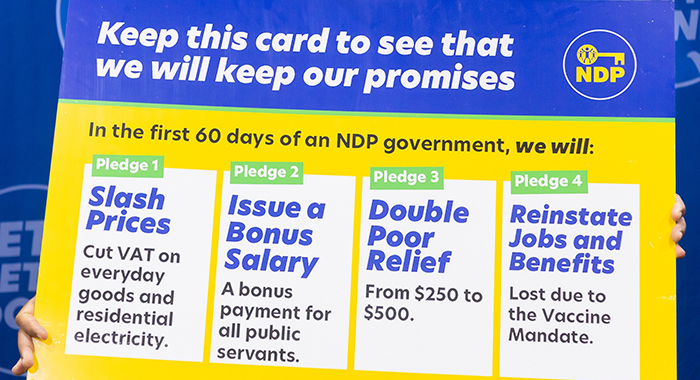
Reducing VAT within 60 days was among the four promises that Friday announced at a press conference on Oct. 1.
“These are things that are real and practical,” Friday sai adding that within 60 days of coming to office, and NDP administration would slash prices by cutting VAT on everyday goods and on residential electricity, will provide salary bonuses to all public servants, … double Poor Relief from EC$250 to EC$500 and reinstate jobs and benefits lost under the Unity Labour Party (ULP) government’s “draconian vaccine mandate”.
During the press conference, Friday had held up a card displaying the four promises his party intended to implement within 60 days.
PM explained delays, said VAT reduction by October
On a recent appearance on Hot 97.1, observing his administration’s first 100 days in office, Friday said that to help ease the cost-of-living crisis, his administration will reduce the VAT from 16% to 13% “during the course of this year”.
“This is not an election gimmick. It’s part of our strategy. So why would we not do it? It’s a matter of timing and getting things done in a way.”
The prime minister said there were certain things you have to put in place to implement the VAT reduction “in a way that is going to deliver the benefits that we are expecting it to do”.
Presenting the 2026 Budget, Friday told Parliament in February that the Ministry of Finance, the Inland Revenue Department, and key stakeholders were actively undertaking a comprehensive assessment of options to reduce the burden of VAT on households, with particular focus on essential goods and domestic electricity.
He said this assessment is “to ensure that any reform delivers real relief to consumers while remaining fiscally responsible and sustainable”.
VAT was introduced by the Ralph Gonsalves administration at 15% in May 2007.
Ten years later, VAT was increased by 1 percentage point, with the additional revenue allocated to the Contingencies Fund to support recovery after a natural disaster.
Friday said his government “is acutely conscious of the pressure that the cost-of-living places on households” across this country, including high prices for food, electricity, and essential goods, erode wages, strain family budgets, and undermine social stability.
In his budget presentation, Friday said his administration was reviewing the design and timing of VAT‑free shopping initiatives, particularly around back‑to‑school and the Christmas period, to provide targeted, time‑bound relief to families at moments of peak financial pressure.
He said tax relief must be well‑targeted, administratively feasible, and consistent with his government’s wider fiscal consolidation objectives, including the reduction of public debt and the achievement of a sustainable Primary Balance.
He said for that reason, his government will not act on impulse but on evidence.
“We intend to return to the public and to this Honourable House with the findings of this assessment, prior to an implementation target date in October 2026. At that point, Vincentians will be able to see—not promises—but practical, costed measures designed to put more money back into household budgets while safeguarding fiscal stability,” Friday said.
“This is how responsible governments lower the cost of living: not through rhetoric, not through recklessness, but through careful reform that delivers lasting relief.”
If IWN had been reporting like this earlier, the ULP would have lost a long time ago; that other newspaper might as well rename itself ULP News.