




In June 1985, then columnist Dr. Kenneth John wrote “Government One Year Old”. He was assessing the performance of the then 1984 Mitchell NDP administration after its first year in office.
Among the many other things that he highlighted were the release of one Junior Cottle from prison, “after spending over eleven years behind bars”; the recruitment of Arnhim Eustace as the Director of Planning, after spending 7 years at the CDB; and the appointment of St. Claire Leacock as head of the Marketing Board.
However, what we really wish to take from that edition of Dr. John’s column is this: “Overall though, the Government has been on the right track in adhering to strict financial house-keeping and imposing its own temporary austerity programme rather than allow itself to slip into the permanent debt trap of the I.M.F which is the stark alternative…”
This statement from Dr. John suggests that there are similarities between the two political eras. Perhaps we will revisit the article in totality on the anniversary of this current Friday NDP administration and see how things compare with the past.
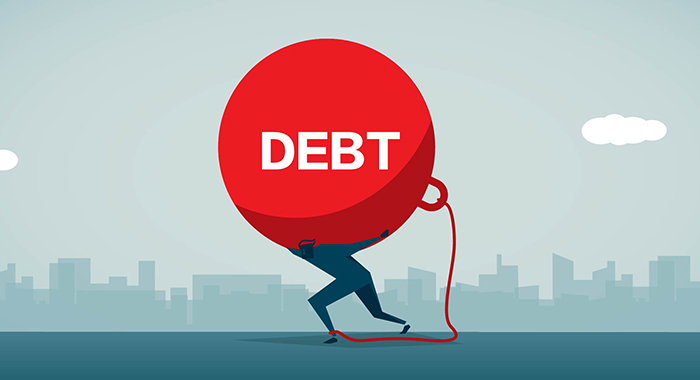
We’ve had a number of recent pronouncements by the now opposition ULP forces, particularly since the recent disclosures by PM Friday and IMF representatives, on the fiscal situation of the country. While ULP forces try to paddle in this water hoping to cause a political ripple, what is their debt toll?

When Mitchell’s NDP took over from Cato in 1984, he reported that the country’s national debt was EC$190 million. The Trinidad Guardian quoted Mitchell as referring to this debt as a “helluva debt situation”, considering the unaffordability of 9 and 11% interest rates at which the country was borrowing infrastructural development loans.
When the ULP took over in 2001, many bought into the idea as sold, that the ULP government had received a bad hand. Quoting the then prime minister Gonsalves, from the Dec. 4, 2001, parliamentary session: “… then what about the debts, which we have been left — $640 million — the Leader of the Opposition then Prime Minister has left for me; $640 million national debt, including the Ottley Hall debt which will be about $140 million with the subordinated loan. That is what is left you know.”
Considering that the amount for Ottley Hall was forgiven, it means that the NDP left a debt of EC$500 million. If you also consider the EC$190 million inherited from Cato, then one can argue that the NDP had only added EC$310 million dollars to the debt in 17 years. That’s $18 million per year.
At the end of September 2007, it was reported that the national debt stood at EC$1.162 billion. This essentially represents a net increase of EC$662 million between 2001 and 2007, not including Ottley Hall shipyard debt, since it was forgiven that same year — 2007. Can you think of the gains of the country between those years to the tune of EC $662 million? If it matters, VAT was introduced in May 2007.
Budget 2015 reported the national debt at EC$1.51 billion as of Sept. 30, 2014. Essentially, this represents a net increase of EC$348 million over 7 years (2007-2014). Can you think of the overall gains of the country during that time?
Budget 2020 reported the national debt at EC$1.7 billion as of Dec. 31, 2019; an overall increase of EC$190 million over the 5-year period (2014-2019).
From the 2024 estimates, total debt as of Sept. 30, 2023, stood at EC$2.5 billion. This included EC$726 million owing to domestic creditors, and EC$1.7 billion in external loans; altogether, an overall increase of EC$800 million in 4 years (2019-2023).
The current NDP government took office in November 2025 and has since reported to the country that the national debt is over EC$3.5 billion dollars large. What does the country have to show for an added EC$1 billion to the national debt between September 2023 and the end of 2025?
Essentially, the debt grew by EC$3 billion in 25 years. That’s an average of EC$120 million per year for the ULP, versus $18 million for the previous NDP administration.
That is the ULP’s debt toll.
Observer
The opinions presented in this content belong to the author and may not necessarily reflect the perspectives or editorial stance of iWitness News. Opinion pieces can be submitted to [email protected].